Air Filter DRM? Hacker Opts Out With NFC Sticker

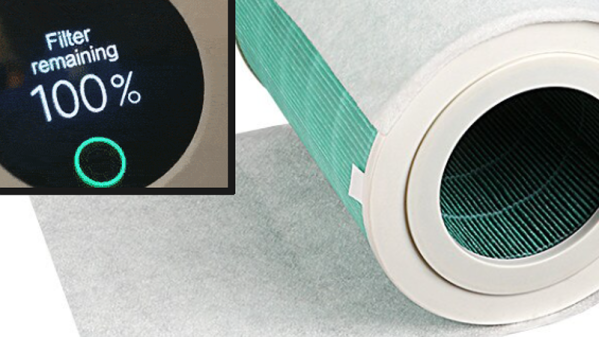
[Flamingo-tech]’s Xiaomi air purifier has a neat safety feature: it will refuse to run if a filter needs replacement. Of course, by “neat” we mean “annoying”. Especially when the purifier sure seems to judge a filter to be useless much earlier than it should. Is your environment relatively clean, and the filter still has legs? Are you using a secondary pre-filter to extend the actual filter’s life? Tough! Time’s up. Not only is this inefficient, but it’s wasteful.

Every Xiaomi filter contains an NTAG213 NFC tag with a unique ID and uses a unique password for communications, but how this password was generated (and therefore how to generate new ones) was not known. This meant that compatible tags recognized by the purifier could not be created. Until now, that is. [Flamingo-tech] has shared the discovery of how Xiaomi generates the password for communication between filter and purifier.
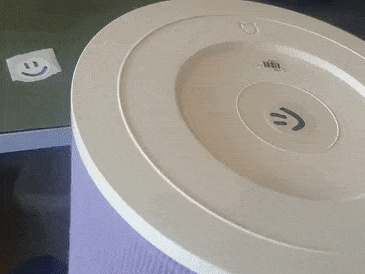
A small NFC sticker is now all it takes to have the purifier recognize a filter as new.

[Flamingo-tech] has long been a proponent of fooling Xiaomi purifiers into acting differently. In the past, this meant installing a modchip to hijack the DRM process. That’s a classic method of getting around nonsense DRM on things like label printers and dishwashers, but in this case, reverse-engineering efforts paid off.

It’s now possible to create simple NFC stickers that play by all the right rules. Is a filter’s time up according to the NFC sticker, but it’s clearly still good? Just peel that NFC sticker off and slap on a new one, and as far as the purifier is concerned, it’s a new filter!

If you’re interested in the reverse-engineering journey, there’s a GitHub repository with all the data. And for those interested in purchasing compatible NFC stickers, [Flamingo-tech] has some available for sale.
The Chip Shortage Leads To The Strangest Things

The global chip shortage has not made the life of the electronic design engineer an easy one, as products have been designed around whatever parts are available rather than the first choices. This has manifested itself in some unexpected ways, including as [CNX software] investigates, products whose multiple-choice bill of materials has led to mistakes being made in manufacture.

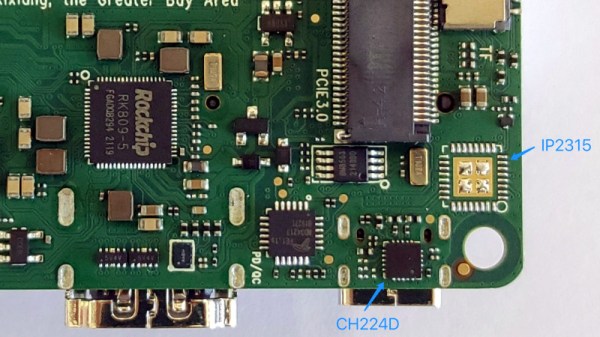
On the face of it, designing a PCB with two sets of footprints to accommodate more than one part choice is a clever move. But as Radxa found out with their Rock 3A single board computer, this could lead to a production mishap as some boards left the production line with a mix-and-match BoM in their USB PD circuitry which left them unable to operate from voltages above 5 V. The board has footprints for both an Injoinic and a WCH part, and the faulty boards appear to have the support components fitted for the other chip to the one on the board.

We’d join [CNX] in congratulating Radxa for coming clean, and we like that one of the options to fix it is to be sent the chip to fit yourself. We’re left rather glad that it wasn’t us on whose watch such a mistake occurred, as from experience we know these things can happen all too easily.

Has the chip shortage led to any similar production mistakes in your life? Let us know in the comments.

Swarm Vs. Iridium: Which Satellite IoT Service Is Right For You?

In a world where it seems like everyone’s face is glued to a device screen, the idea that wireless service might be anything other than universal seems just plain silly. But it’s not, as witnessed by vast gaps in cell carrier coverage maps, not to mention the 70% of the planet covered by oceans. The lack of universal coverage can be a real pain for IoT applications, which is a gap that satellite-based IoT services aim to fill.

But which service is right for your application? To help answer that question, [Mike Krumpus] has performed the valuable work of comparing the services offered by Swarm and Iridium in a real-world IoT shootout. On the face of it, the match-up seems a little lopsided — Iridium has been around forever and has a constellation of big satellites and an extensive ground-based infrastructure. But as our own [Al Williams] discovered when he tested out Swarm, there’s something to be said for having a lot of 1/4U Cubesats up there.

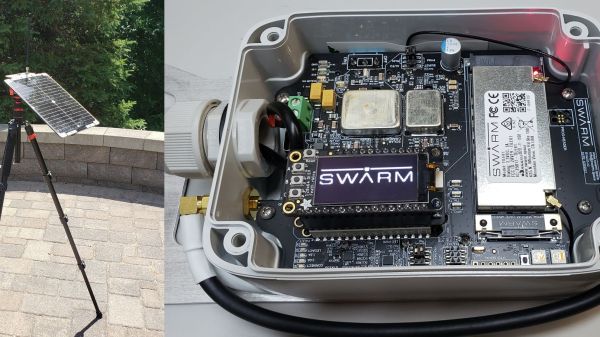
[Mike] picked up the gauntlet and did head-to-head tests of the two services under real-world conditions. Using the same Swarm development kit that [Al] used for his test, alongside an Iridium dev board of his own design, [Mike] did basic tests on uplink and downlink times for a short message on each service. We couldn’t find specs on the test message length, but Swarm’s FAQ indicates that packets are limited to 192 bytes, so we assume they’re both in that ballpark. Iridium was the clear winner on uplink and downlink times, which makes sense because Swarm’s constellation is much smaller at this point and leaves large gaps in coverage. But when you consider costs, Swarm wins the day; what would cost over $1,500 with Iridium would set you back a mere $60 with Swarm.

The bottom line, as always, depends on your application and budget, but [Mike]’s work makes it easier to do that analysis.

Svelte VR Headsets Coming?

According to Standford and NVidia researchers, VR adoption is slowed by the bulky headsets required. They want to offer a slim solution. A SIGGRAPH paper earlier this year lays out their plan or you can watch the video below. There’s also a second video, also below, covers some technical questions and answers.

The traditional headset has a display right in front of your eyes. Special lenses can make them skinnier, but this new method provides displays that can be a few millimeters thick. The technology seems pretty intense and appears to create a hologram at different apparent places using a laser, a geometric phase lens, and a pupil-replicating waveguide.

Continue reading “Svelte VR Headsets Coming?”

Fusion 360 Logo

Local Simulation Feature To Be Removed From All Autodesk Fusion 360 Versions

The removal of features from Autodesk products would appear to be turning into something of a routine at this point, with the announced removal of local simulations the latest in this series. Previously Autodesk had severely cut down the features available with a Personal Use license, but these latest changes (effective September 6) affect even paying customers, no matter which tier.

While previously executed local simulations on designs will remain accessible, any updates to these simulations, as well as any new simulations will have to use Autodesk’s cloud-based solver. This includes the linear stress, modal frequencies, thermal, and thermal stress simulation types, with each type of simulation study costing a number of Cloud Tokens.

Solving a linear simulation should initially cost 0 tokens, but the other types between 3 – 6 tokens, with the exact cost per token likely to vary per region. This means that instead of solving simulations for free on one’s own hardware, the only option in a matter of weeks will be solely through Autodesk’s cloud-based offerings.

Naturally, we can see this change going over exceedingly well with Fusion 360 users and we’re looking forward to seeing how Autodesk will spin the inevitable backlash.

(Thanks, [Jeremy Herbert] for the tip)

Homebrew Biped Bot Shows Off Some Impressive Moves

We’ve seen enough DIY robotic platforms here on Hackaday to know that most of them take the literal and figurative path of least resistance. That is, they tend to be some type of wheeled rover. But of course, there are plenty of other forms of locomotion, should you want to take on something a bit more challenging.

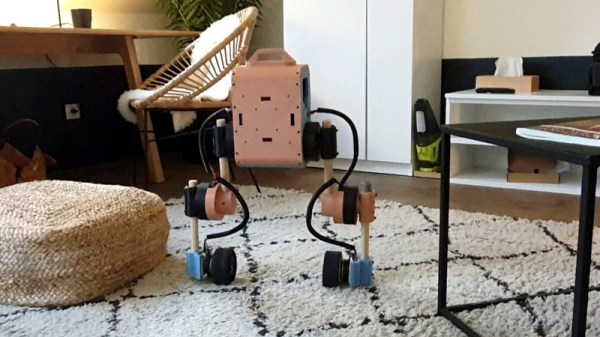
This biped robot from [Tast’s Robots] is a perfect example. While it’s still technically wheeled, its self-balancing nature makes things quite a bit more complex. It doesn’t just stand upright either, it also has a unique ability to crouch down by rotating its motorized knees and hips. As demonstrated in the video below, it can even navigate relatively uneven terrain — pulling off such a smooth transition between hardwood and carpet is no easy feat for a self-balancing bot like this.

But the best part? It isn’t just fully open source, it’s also designed to be built with only the tools and capabilities available to the average home gamer. That means 3D printed components, wooden dowels, and RC car parts. Even the power supply, a Ryobi 18 V tool battery, is easy to source and relatively hacker friendly.

Just as impressive as the hardware is the suite of software packages developed to handle things like balancing, locomotion, and reverse kinematics. Each one is maintained and documented as their own individual Apache-licensed projects, making them far easier to utilize than they would be if it was all implemented as one monolithic system.

If you really want to ditch the wheels, we’ve seen a few biped walkers in the past. But frankly, none of them can compare to the capabilities and scope of this project.

Continue reading “Homebrew Biped Bot Shows Off Some Impressive Moves”

Hackaday Prize 2022: Solar Power Through Pyrolysis

We’re all familiar with solar cells, be they photovoltaic, or for heating water. But they are only the more common ways of converting the sun’s energey into usable power, and to the extended list there is now an addition courtesy of [Dennis]. He’s using the sun to drive the pyrolysis of biomass waste, releasing hydrogen fuel.

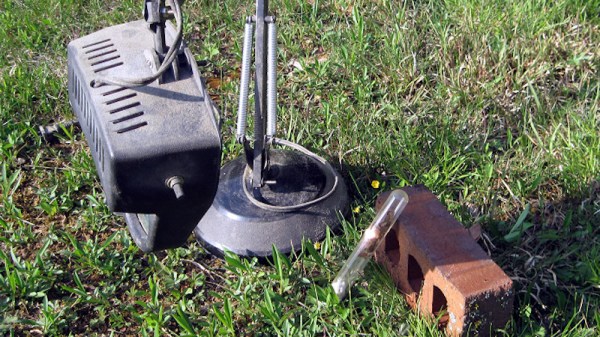
For those who aren’t familiar with the chemistry, pyrolysis refers to chemical reactions triggered by heat. In this case, when organic biomass is heated in the absence of oxygen it breaks down and releases the gaseous products of that breakdown as well as a mass of carbon. The idea behind this pyrolysis cell is that a Fresnel lens will focus the sun on a reaction chamber, providing the required heat for the reaction to occur. A test with a magnifier and a test tube proves that there’s something in it.

Of course, sharp-eyed readers will notice that this isn’t quite in the same vein as other cells which convert the Sun’s energy into a usable form, in that while it provides an input of energy for the pyrolysis the chemical energy in the resulting gas comes mostly from the original biomass. There is a silver lining to the prospect of burning gas though, in that the left-over carbon can be incorporated into the soil as biochar, an effective carbon sink.

We’ve seen a project pursuing a similar chemistry before, though not using solar energy to do it.