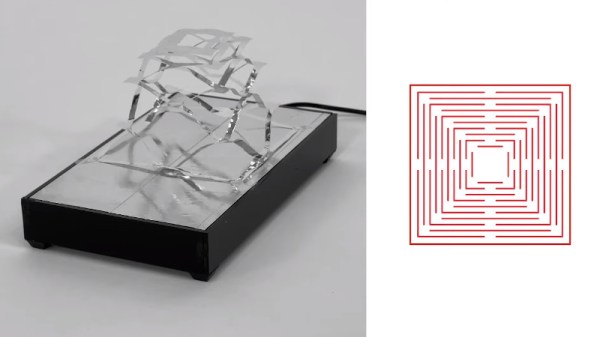
Mylar has a lot of useful properties, and as such as see it pop up pretty often, not just in DIY projects but in our day-to-day lives. But until today, we’ve never seen a piece of Mylar jump up and try to get our attention. But that’s precisely the promise offered by ElectriPop, a fascinating project from Carnegie Mellon University’s Future Interfaces Group.
The core principle at work here is fairly simple. When electrostatically charged, a strip of Mylar can be made to lift up vertically into the air. Cut that strip down the center, and the two sides will repel each other and produce a “Y” shape. By expanding on that concept with enough carefully placed cuts, it’s possible to create surprisingly complex three dimensional shapes that pop up once a charge is applied. A certain degree of motion can even be introduced by adjusting the input power. The video after the break offers several examples of this principle in action: such as a 3D flower that either stands up tall or wilts in relation to an external source of data, or an avatar that flails its arms wildly to get the user’s attention.
The bane of life for anyone who possesses a well-used pile of spanners is the humble nut and bolt. Durable and easy to fasten, over our lifetimes we must screw and unscrew them by the million. When they do their job they’re great, but too often they seize up solid, or more alarmingly, gradually undo themselves over time due to vibration or thermal stress. There are a host of products such as locking nuts or thread sealant to deal with this problem, but the Fraunhofer Institute have an idea which might just remove the worry surrounding important fastenings. Their work has resulted in a solar-powered bolt with an embedded sensor that phones home when the connection loosens, allowing an engineer to be dispatched with a spanner to tighten it up.
The sensor itself is a washer which reports the force placed upon it, when this reduces an alert is sent. Communication is via Fraunhofer’s own MIoTy low-power wide-area network (LPWAN) protocol, but we’d imagine that one of the many competitor technologies could also serve.
This is an interesting idea that could no doubt result in targeted maintenance catching faulty fastenings early and averting disaster in the infrastructure projects such as bridges and wind turbines that they mention. We worry slightly though, because these types of structures have lives not in the few years of most tech products but in centuries. Will an IoT bolt head sensor still be phoning home in a few decades time, or will the system rely on old bolts being replaced at regular intervals of a decade? It’s not unknown for disasters to be the result of failures in fastenings a century old, so we sincerely hope that authorities in charge of whatever bridge relies on these won’t be tempted to skimp on their replacements. Perhaps a guy with a spanner every few years might be a more dependable option.
Watching television today is a very different experience from that which our parents would have had at our age, where we have high-definition digital on-demand streaming services they had a small number of analogue channels serving linear scheduled broadcasting. A particular film coming on TV could be a major event that it was not uncommon for most of the population to have shared, and such simple things as a coffee advert could become part of our common cultural experience. Behind it all was a minor miracle of synchronised analogue technology taking the signal from studio to living room, and this is the subject of a 1952 Coronet film, Television: How It Works! Sit back and enjoy a trip into a much simpler world in the video below the break.
Production values for adverts had yet to reach their zenith in the 1950s.
After an introduction showing the cultural impact of TV in early-50s America there’s a basic intro to a cathode-ray tube, followed by something that may be less familiar to many readers, the Image Orthicon camera tube that formed the basis of most TV signals of that era.
It’s written for the general public, so the scanning raster of a TV image is introduced through the back-and-forth of reading a book, and then translated into how the raster is painted on the screen with the deflection coils and the electron gun. It’s not overly simplified though, for it talks about how the picture is interlaced and shows how a synchronisation pulse is introduced to keep all parts of the system working together.
A particularly fascinating glimpse comes in a brief mention of the solid copper co-axial cable and overland microwave links used to transmit TV signals across country, these concrete towers can still be seen today but they no longer have the colossal horn antennas we can see in the film.
A rather obvious omission in this film is the lack of any mention of colour TV, as while it would be late 1953 before the NTSC standard was formally adopted and early 1954 before the first few colour sets would go on sale. Colour TV would have been very much the Next Big Thing in 1952, but with no transmissions to watch and a bitter standards war still raging between the field-sequential CBS system and RCA’s compatible dot-sequential system that would eventually evolve into the NTSC standard it’s not surprising that colour TV was beyond the consumer audience of the time.
Thus we’re being introduced to the 525-line standard which many think of as NTSC video, but without the NTSC compatible colour system that most of us will be familiar with. The 525-line analogue standard might have disappeared from our living rooms some time ago, but as the last few stations only came off-air last year we’d say it had a pretty good run.
Join Hackaday Editor-in-Chief Elliot Williams and Managing Editor Tom Nardi for a review of all the tech that’s fit to print. Things kick off with an update about the Hackaday Prize and a brief account of the 2022 Vintage Computer Festival East. Then we’ll talk about an exceptionally dangerous art project that’s been making the rounds on social media, a smart tea kettle that gave its life so that others can hack their device’s firmware, some suspiciously effective plant grow lights, and the slippery slope of remote manufacturer kill switches. We’ll wrap things up with some thought provoking discussion about personal liability as it pertains to community repair groups, and a close look at what makes synthetic oil worth spending extra on.
Check out the links below if you want to follow along, and as always, tell us what you think about this episode in the comments below!
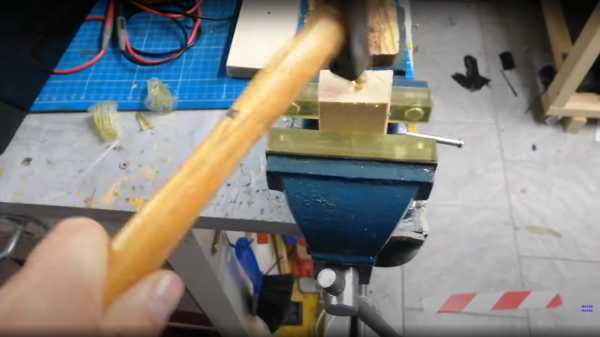
Resin printing still seems to polarize opinions amongst hacker types, with some considering such machines a good tool for the right tasks, and some just plain rejecting them outright. There are many arguments for and against, but like fused deposition modeling (FDM) machines, resin printers are improving in leaps and bounds — and so is the liquid resin itself. Nowadays low-odor resins are common, colors and finishes are varied, and now thanks to some dedicated development work, the brittleness that often characterizes such prints it being addressed. [Mayer Makes] has designed a super tough “engineering resin” that he demonstrates is so tough, you can print a nail and hammer it into a block of wood! (Video, embedded below, if you don’t believe it.)
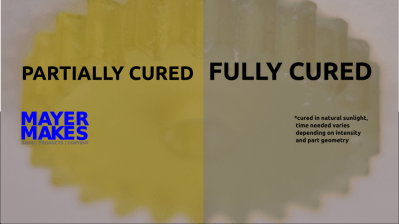
This particular resin is destined for mixing, given its natural cured shade is a kind of greenish-grey, but it does have a neat trick of presenting a definite yellowish hue when not fully cured, which is very helpful. This is particularly useful when removing support structures as you can use the color change during the curing process to judge the right moment to snap off the thicker sections, minimizing the risk of damaging the print. The resulting printed part is also tough enough to withstand subsequent traditional post-processing, such as milling, giving greater final finishing tolerances. Try doing that with an FDM print.
One of the neat things about resin chemistry is that you can simply mix them in their liquid form to tune the resin properties yourself and they can also be colored with specially formulated dyes without affecting the other properties too much, so this new super-tough resin gives prototypers yet another tool in their resin armory.
DNS spoofing/poisoning is the attack discovered by [Dan Kaminski] back in 2008 that simply refuses to go away. This week a vulnerability was announced in the uClibc and uClibc-ng standard libraries, making a DNS poisoning attack practical once again.
So for a quick refresher, DNS lookups generally happen over unencrypted UDP connections, and UDP is a stateless connection, making it easier to spoof. DNS originally just used a 16-bit transaction ID (TXID) to validate DNS responses, but [Kaminski] realized that wasn’t sufficient when combined with a technique that generated massive amounts of DNS traffic. That attack could poison the DNS records cached by public DNS servers, greatly amplifying the effect. The solution was to randomize the UDP source port used when sending UDP requests, making it much harder to “win the lottery” with a spoofed packet, because both the TXID and source port would have to match for the spoof to work.
uClibc and uClibc-ng are miniature implementations of the C standard library, intended for embedded systems. One of the things this standard library provides is a DNS lookup function, and this function has some odd behavior. When generating DNS requests, the TXID is incremental — it’s predictable and not randomized. Additionally, the TXID will periodically reset back to it’s initial value, so not even the entire 16-bit key space is exercised. Not great. Continue reading “This Week In Security: UClibc And DNS Poisoning, Encryption Is Hard, And The Goat”→
Despite their claims of innocence, we all know that the big tech firms are listening to us. How else to explain the sudden appearance of ads related to something we’ve only ever spoken about, seemingly in private but always in range of a phone or smart speaker? And don’t give us any of that fancy “confirmation bias” talk — we all know what’s really going on.
And now, to make matters worse, it turns out that just listening to your keyboard clicks could be enough to decode what’s being typed. To be clear, [Georgi Gerganov]’s “KeyTap3” exploit does not use any of the usual RF-based methods we’ve seen for exfiltrating data from keyboards on air-gapped machines. Rather, it uses just a standard microphone to capture audio while typing, building a cluster map of the clicks with similar sounds. By analyzing the clusters against the statistical likelihood of certain sequences of characters appearing together — the algorithm currently assumes standard English, and works best on clicky mechanical keyboards — a reasonable approximation of the original keypresses can be reconstructed.
If you’d like to see it in action, check out the video below, which shows the algorithm doing a pretty good job decoding text typed on an unplugged keyboard. Or, try it yourself — the link above implements KeyTap3 in-browser. We gave it a shot, but as a member of the non-mechanical keyboard underclass, it couldn’t make sense of the mushy sounds it heard. Then again, our keyboard inferiority affords us some level of protection from the exploit, so there’s that.
Editors Note: Just tried it on a mechanical keyboard with Cherry MX Blue switches and it couldn’t make heads or tails of what was typed, so your mileage may vary. Let us know if it worked for you in the comments.
What strikes us about this is that it would be super simple to deploy an exploit like this. Most side-channel attacks require such a contrived scenario for installing the exploit that just breaking in and stealing the computer would be easier. All KeyTap needs is a covert audio recording, and the deed is done.





 have a neat trick of presenting a definite yellowish hue when not fully cured, which is very helpful. This is particularly useful when removing support structures as you can use the color change during the curing process to judge the right moment to snap off the thicker sections, minimizing the risk of damaging the print. The resulting printed part is also tough enough to withstand subsequent traditional post-processing, such as milling, giving greater final finishing tolerances. Try doing that with an FDM print.