The Magnetic Rubik’s Cube

Ernő Rubik has much to answer for when it comes to the legacy of his namesake cube. It has both enthralled and tormented generations, allowing some to grandstand in the playground while others are forced to admit defeat in the face of a seemingly intractable puzzle. It just so happens that [Tom Parker] has been working on a Rubik’s cube with a novel magnetic design.

Yes, that’s right – [Tom]’s cube eschews the traditional rotating and sliding mechanism of the original cube, instead replacing it all with magnets. Each segment of the cube, along with the hidden center piece, is 3D printed. Through using a fused deposition printer, and pausing the print at certain layers, it’s possible to embed the magnets inside the part during the printing process.

[Tom] provides several different versions of the parts, to suit printers of different capabilities. The final cube allows both regular Rubik’s cube movements, but also allows for the player to cheat and reassemble it without having to throw it forcefully against the wall first like the original toy.

It’s an interesting build, and a great one to get to grips with the techniques involved in embedding parts in 3D prints. It may not be capable of solving itself, but we’ve seen another build that can pull off that impressive feat. Video after the break.
Continue reading “The Magnetic Rubik’s Cube”

Robot Solves Rubik’s Cube With One Hand Tied Behind Its Back

For all those who have complained about Rubik’s Cube solving robots in the past by dismissing purpose-built rigs that hold the cube in a non-anthropomorphic manner: checkmate.

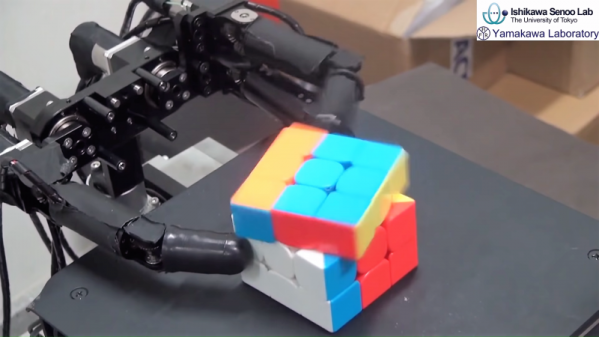
The video below shows not only that a robot can solve the classic puzzle with mechanical hands, but it can also do it with just one of them – and that with only three fingers. The [Yamakawa] lab at the University of Tokyo built the high-speed manipulator to explore the kinds of fine motions that humans perform without even thinking about them. Their hand, guided by a 500-fps machine vision system, uses two opposing fingers to grip the lower part of the cube while using the other finger to flick the top face of the cube counterclockwise. The entire cube can also be rotated on the vertical axis, or flipped 90° at a time. Piecing these moves together lets the hand solve the cube with impressive speed; extra points for the little, “How’s that, human?” flick at the end.

It might not be the fastest cube solver, or one that’s built right into the cube itself, but there’s something about the dexterity of this hand that we really appreciate.

Continue reading “Robot Solves Rubik’s Cube With One Hand Tied Behind Its Back”

Self-Solving Rubik’s Cube

Rubik’s Cube has been around for what seems like forever now, and has spawned an entire subculture devoted to solving the puzzle with automation. Most Rubik robots put the cube in a specially designed cradle bristling with actuators and sensors, and while those rigs are impressive, they don’t come close to this robotic Rubik solver built into the cube itself.

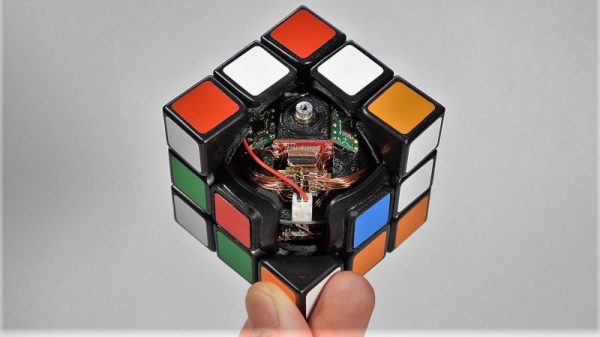
Fair warning that [Human Controller] doesn’t provide much detail on this build other than pictures; even translating the Japanese web page doesn’t offer much more information. But there are pictures, plus the video below, which reveal the engineering masterpiece encased within the standard sized Rubik’s cube. The internal mechanism of the original cube had been replaced by a spherical assembly around which the cube’s faces rotate. The sphere, which appears to be 3D-printed, houses six motors and gear trains, along with a microcontroller board and what appear to be Hall sensor boards to detect the position of each face. Everything is wired up with magnet wire to keep bundles to a minimum size, and buried deep inside is a LiPo battery pack. A disassembly video offers further clues to this ingenious device’s inner workings.

Once the cube senses that it has been scrambled, it sets to work on the solution, walking all over the table in the process. It’s clearly not just recording the scrambling steps and playing them back in reverse; the video below shows far more moves to solve the cube than the 15 it took to scramble it.

While we’re always impressed by marvels of speed like this robot with a 637 millisecond solve time, putting everything needed to solve the cube inside it is a feat worth celebrating. Here’s hoping that a build log shows up soon to satisfy our need for details.

Continue reading “Self-Solving Rubik’s Cube”

Rubik’s Cube Table Has A Hidden Surprise

[Nothorwitzer] built a pretty incredible Rubik’s Cube table with hidden storage. The coolest feature of this table is the way it opens. Twisting the top section of the cube causes two drawers to pop out from the sides. The further you turn the top, the more the drawers extend. As the top hits its rotational limit, the lid of the cube lifts up, revealing the entire top section is hollow.

[Nothorwitzer] built the table from plywood, hardboard, and MDF. Hiding inside the base is an old car wheel hub and bearing. The entire rotating system spins on this assembly. The drawers are actuated by an ingenious set of plywood cams which push the two opposing drawers out as the top assembly rotates. Two levers pop the top open.

The attention to detail here is amazing. [Nothorwitzer] build a set of hidden hinges that make the lid invisible, yet allows it to lift up and over the edge of the cube. A spring ensures that the heavy lid will pop open neatly. The lid fit is so close that air pressure ensures the top doesn’t slam down when it is dropped.

While the internal parts of the table are left in bare wood, that the external parts had to match a real Rubik’s Cube. [Nothorwitzer] scrambled a cube, then copied the colors. The panels are made of cut hardboard. Each panel is spray painted, then hot glued to the cube. The body is plywood which [Nothorwitzer] grooved with a router to match the profile of a real Rubick’s Cube.

The project doesn’t end here. [Nothorwitzer] has created a second cube, which is even more tricky. The lid pops by pressing in one section. The drawers operate in a similar way, but there is a lever to engage or disengage the drawer opening. This may be the perfect place to hide your retro gaming systems!

Continue reading “Rubik’s Cube Table Has A Hidden Surprise”

Solving A Rubik’s Cube With Just Two Motors

We’ve all seen videos of Rubik’s cube champions who can solve the puzzle in less than 5 seconds. And there are cube-twisting robots that can solve the cube even faster, often in under a second. This Rubik’s cube solver is not one of those robots, but it’s still pretty cool.

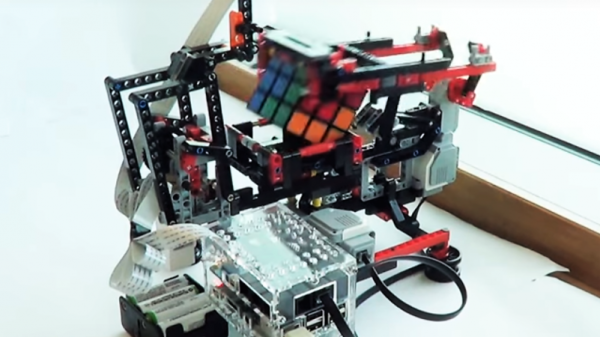
The reason we like Dexter Industries’ “BricKuber” is not for its lightning speed — it takes a minute or two to solve the puzzle. What we like is the simplicity of the approach to manipulating the cube. Built from LEGO parts, including Mindstorms motors and a BrickPi controller, the BricKuber uses only two motors to work the cube. One motor powers a square turntable upon which the cube sits, while the other powers an arm that does double duty — it either clamps the cube so the turntable can rotate a layer, or it rakes the cube to flip it 90° on the turntable. With a Pi Cam overhead, the rig images all six faces, calculates a solution to the cube, and then flips and twists the cube to solve it. It’s simultaneously mind-boggling and strangely relaxing to watch.

All the code is open source, and we strongly suspect a similar and possibly faster robot could be built without the LEGO parts. You might even be able to build one with popsicle sticks and an Arduino.

Continue reading “Solving A Rubik’s Cube With Just Two Motors”

Symmetry For Beginners – The Rubik’s Cube

Symmetry is everywhere in our natural world. Just take a look at your hands, a butterfly, or a sunflower.  It’s easy to pass off the idea of symmetry and symmetric structures as a simple quirk of existence, and to pay it little mind. If this is your view, I can assure you it will no longer be by the end of this series. If we force ourselves to look beyond the grade school applications of symmetry, we find a world rich in connections via many different types of symmetric identities. One of the most interesting is Gauge Symmetry, which lies at the heart of Quantum Electrodynamics, or QED (we’ll get into this a bit later in the series). Several branches of higher level mathematics study symmetry in detail, allowing a host of sciences, from physics to chemistry,  to view difficult problems and theories from a different perspective.

The subject matter of the ideas explored in symmetry is complicated, and not well known outside of academia and the theoretical sciences. It is the goal of this series of articles to simplify some of the concepts that underpin the study of symmetry, so that the average hacker can gain a basic (and I mean basic) understanding of this fascinating body of knowledge, and put it to use in future projects.  We’ll start things off by taking a look at a machine that has crossed the Hackaday server many times – those nifty Rubik’s Cube solvers. Just how do those things work anyway?

Continue reading “Symmetry For Beginners – The Rubik’s Cube”

Robot Solves Rubik’s Cube In Just One Second

Some of the fastest Rubik’s cube solvers in the world have gotten down to a five second solve — which is quite an incredible feat for a human — but how about one second? Well, [Jay Flatland] and [Paul Rose] just built a robot that can do exactly that.

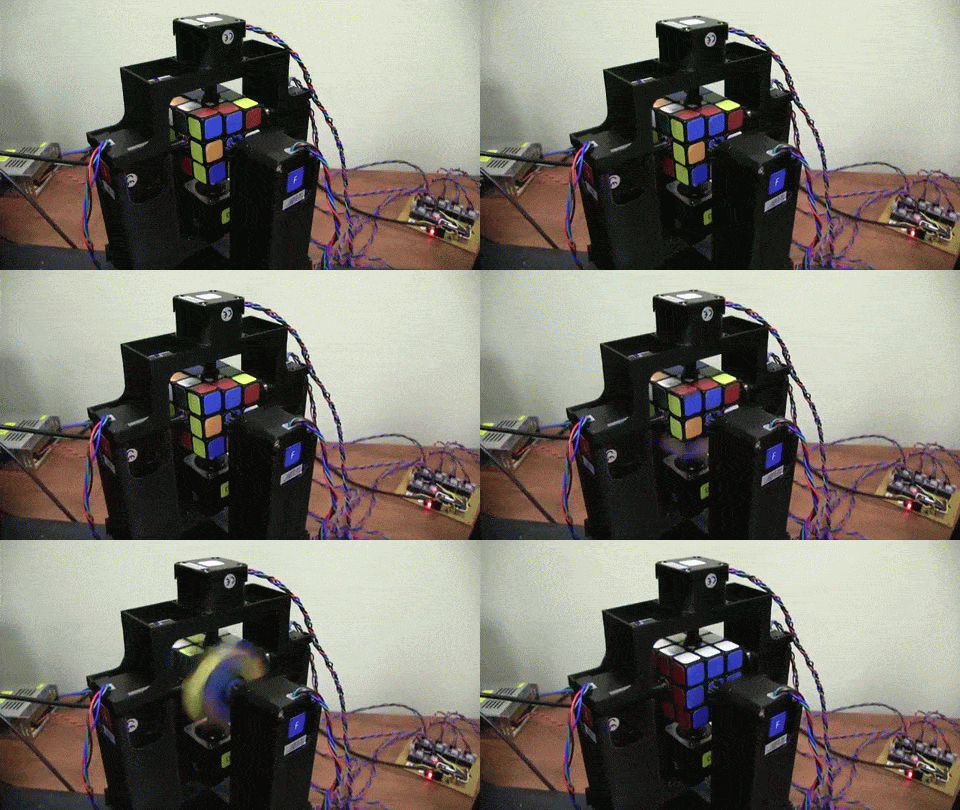
The robot uses four USB webcams, six stepper motors, and a 3D printed frame. The only modification to the Rubik’s cube are some holes drilled in the center pieces to allow the stepper motors to grip onto them with 3D printed attachments.

The software is running off a Linux machine which feeds the data into a Rubik’s cube algorithm for solving. In approximately one second — the cube is solved.

Continue reading “Robot Solves Rubik’s Cube In Just One Second”