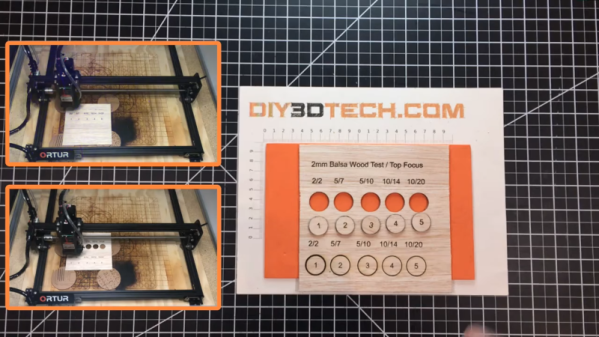
The air assist helped clear the cut parts and reduced charring in the wood. The air system clears residue and fumes that can reduce the effectiveness of the laser. It can also reduce the risk of the workpiece catching on fire.
The display relies on an Arduino Mega 2560 Pro Mini as the brains of the operation. It drives strings of WS2812B LEDs which correspond to stations along the various metro lines in the area. Additionally, the microcontroller drives a 4.3″ Nextion LCD display. The Nextion displays have the benefit of acting as a self-contained human machine interface, running their own controller on board. This means the Arduino doesn’t have to spend cycles driving the display, and the Nextion hardware comes with a useful software package for quickly and easily designing GUI interfaces. For further feedback, a DFPlayer MP3 module is used to allow the system to playback prerecorded voice samples that provide information on the rail system. The attractive front panel is made with lasercut acrylic and a color printed acetate sheet.
It’s a build that bears striking similarity to real rail information systems fielded by railways around the world. We can imagine such a device being particularly useful in a backpacker’s hostel or university dorm to help those new to town find their way around. If you prefer a more stripped-back aesthetic, we’ve seen a barebones PCB build done as well. Video after the break.
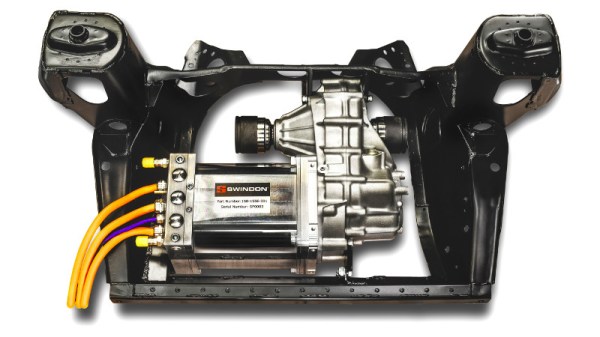
With electric vehicles such as the Tesla or the Leaf being all the rage and joined by fresh competitors seemingly every week, it seems the world is going crazy for the electric motor over their internal combustion engines. There’s another sector to electric traction that rarely hits the headlines though, that of converting existing IC cars to EVs by retrofitting a motor. The engineering involved can be considerable and differs for every car, so we’re interested to see an offering for the classic Mini from the British company Swindon Powertrain that may be the first of many affordable pre-engineered conversion kits for popular models.
Swindon Powertrain’s demo Mini
The kit takes their HPD crate EV motor that we covered earlier in the year, and mates it with a Mini front subframe. Brackets and CV joints engineered for the kit to drop straight into the Mini. The differential appears to be offset to the right rather than the central position of the original so we’re curious about the claim of using the Mini’s own driveshafts, but that’s hardly an issue that should tax anyone prepared to take on such a task. They can also supply all the rest of the parts for a turnkey conversion, making for what will probably be one of the most fun-to-drive EVs possible.
The classic Mini is now a sought-after machine long past its days of being dirt-cheap old-wreck motoring for the masses, so the price of the kit should be viewed in the light of a good example now costing more than some new cars. We expect this kit to have most appeal in the professional and semi-professional market rather than the budget end of home conversions, but it’s still noteworthy because it is a likely sign of what is to come. We look forward to pre-engineered subframes becoming a staple of EV conversions at all levels. The same has happened with other popular engine upgrades, and no doubt some conversions featuring them will make their way to the pages of Hackaday.
We like the idea of conversions forming part of the path to EV adoption, as we’ve remarked before.
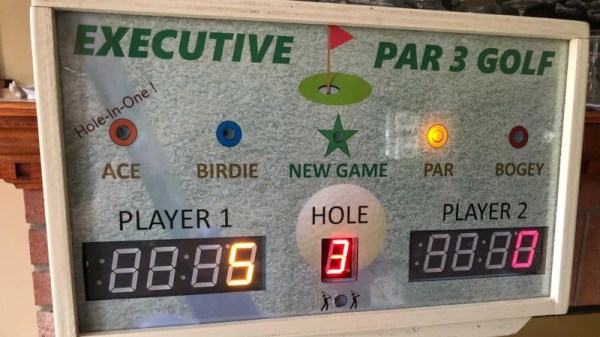
Minigolf is a fun, simple pastime that has the benefit of taking up much less space than the classical game it is inspired by. [gcall1979] had built himself a small game for the lounge room, but found keeping score to be a tedious exercise. Of course, that was nothing that couldn’t be solved with some electronics!
The game consists of a skeeball-type minigolf course, where the score is determined by the hole the player puts the ball through. To track this, each hole is fitted with an IR break-beam sensor that triggers when a ball passes through. Vinyl siding is used to guide the balls going through the holes to ensure the sensor is triggered consistently. The sensors are read by an Arduino Mega, which is also responsible for flashing LEDs and updating the score throughout the game on the included 7-segment displays.
It’s a basic hack, but one that makes the game far more of a self-contained experience. No more fumbling with pencils and paper means it’s easier to focus on dominating the competition on the (miniature) green. Of course, those with dreams of the driving range might consider this recreation of the famous Floating 14th Hole!
There are plenty of small microcontrollers available for all kinds of tasks, each one with its unique set of features and capabilities. However, not all of us want to spend time mucking about in C or assembly to learn the intricacies of each different chip. If you prefer the higher planes of Python instead, it’s not impossible to import Python on even the smallest of microcontrollers thanks to MicroPython, which [Rob] shows us in this project based on the ESP32.
[Rob] has been working on a small robot called Marty which uses an ESP32 as its brain, so the small microcontroller is already tasked with WiFi/Bluetooth communications and driving the motors in the robot. Part of the problem of getting Python to run on a platform like this is that MicroPython is designed to be essentially the only thing running on the device at any one point, but since the ESP32 is more powerful than the minimum requirements for MicroPython he wanted to see if he could run more than just Python code. He eventually settled on a “bottum-up” approach to build a library for the platform, rather than implementing MicroPython directly as a firmware image for the ESP32.
The blog post is an interesting take on running Python code on a small platform, and goes into some details with the shortcomings of MicroPython itself which [Rob] ended up working around for this project. He’s also released the source code for his work on his GitHub page. Of course, for a different approach to running Python and C on the same small processor, there are some libraries that accomplish that as well.
When looking for the best deal, it pays to shop around. When it comes to chain stores, of course, one expects the price to be the same across their retail network. However, where international companies are concerned, occasionally a better deal is just a border crossing away. To investigate the best possible price on IKEA’s flatpacked goods, [Sn0w5t0rm] whipped up a scirpt to make comparisons easy.
The hack consists of a small piece of Javascript that runs in a browser extension like Greasemonkey (Firefox) or Tampermonkey (Chrome). When visiting an IKEA product page, it shows the price of the same item in the alternative country of your choice. Often, significant savings can be had – the SKOGSTA table is €176 cheaper in the Netherlands compared to Belgium.
While the script does require some customization to suit your location, it could nonetheless save you a bundle on some home furnishings if your live near enough to a border. We’d love to see the concept taken further to tease out best prices in a given region for goods from all stores. Similar techniques can net you cheap airfares, too!
When we think of 3D printed parts for our projects, most of us imagine little bits like brackets and mounting plates. Perhaps the occasional printed project enclosure. But if you’ve got a big custom printer as [Joshendy] does, plus plenty of time, it opens up a whole new world of large scale projects. Take for example the gorgeous RGB LED guitar body he recently completed.
Despite the considerable 300 x 300 mm build area of his custom 3D printer, [Joshendy] still had to design the guitar body in sections that could be bolted together after being printed in ABS. It took around 60 hours to run off all the parts, with the large central section taking the longest to print at 28 hours. With the generous application of heat-set inserts, the assembled guitar should be plenty strong.
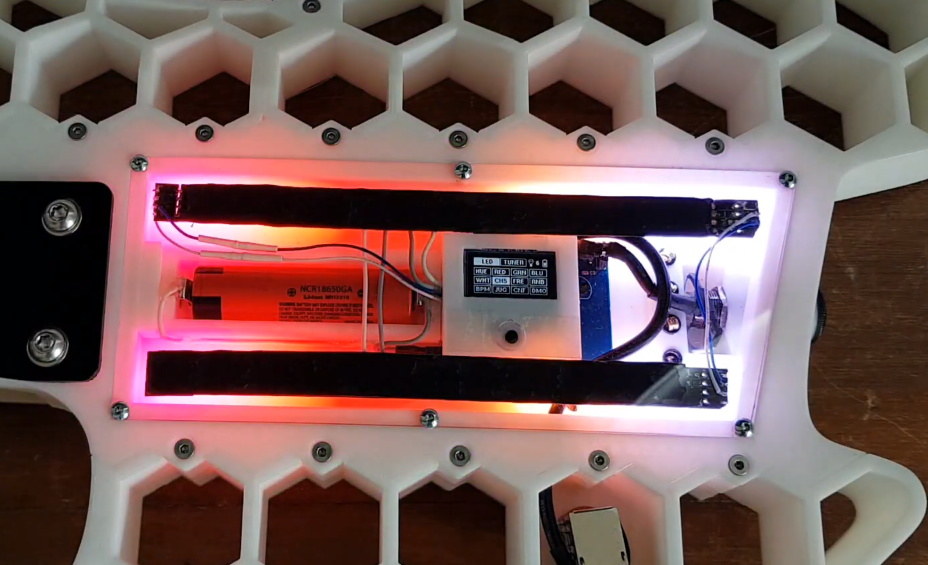
The white ABS of the guitar body helps diffuse the LEDs.
While the skeletal plastic body of the guitar is certainly visually interesting in itself, it only makes up for half of the final look. Inside the central cavity, [Joshendy] has embedded two strips of RGB LEDs, a 128×64 OLED screen, and a custom PCB that plays host to a STM32L4 microcontroller the appropriate voltage regulators necessary to run it all on a battery pack.
The board taps into the audio being produced by the guitar and uses a fast Fourier transform (FFT) to get the LEDs reacting to the beat. As demonstrated in the video after the break, you can use the screen to navigate through the different lighting modes in real-time right on the instrument itself.
We covered the equally impressive large-format 3D printer that [Joshendy] used to produce this guitar earlier in the month, and it’s quite exciting to see the sort of things he’s printing on it already. This project has already set the bar very high, and we can’t wait to see what he comes up with next.