MIDI Slide Whistle Shows The Value Of A Proper Fipple

We pride ourselves on knowing the proper terms for everyday things: aglet, glabella, borborygmi, ampersands. But we have to confess to never having heard of a “fipple” before finding this interesting MIDI-controlled slide whistle, where we learned that the mouthpiece of a penny whistle or a recorder is known as a fipple. The more you know.

This lesson comes to us by way of a Twitter post by [The Mixed SIgnal], which showed off the finished mechanism in a short video and not much else. We couldn’t leave that alone, so we reached out for more information and were happy to find that [The Mixed SIgnal] quickly posted a build log on Hackaday.io as well as the build video below.

The slide whistle is a homebrew version of the kind we’ve all probably annoyed our parents with at one time or another, with a 3D-printed fipple (!) and piston, both of which go into a PVC tube. Air is supplied to the pipe with a small centrifugal blower, while a 3D-printed rack and pinion gear of unusual proportions moves the piston back and forth. An Arduino Due with a CNC shield controls the single stepper motor. The crude glissandos of this primitive wind instrument honestly are a little on the quiet side, especially given the racket the stepper and rack and pinion make when queuing up a new note. Perhaps it needs more fipple.

While the humble author is new to fipple-isms, luckily the Hackaday editors see all and know that there two epic hacks featuring fipples to create bottle organs. These are far from the first weirdest instruments we’ve seen — a modulin, a Wubatron, and the Drum-Typeulator all fit that bill well. But we like what [The Mixed Signal] has done here, and we’re looking forward to more.

Continue reading “MIDI Slide Whistle Shows The Value Of A Proper Fipple”

Mobile Transmitter Gets Internal GPS And Bluetooth

While [Selim Olcer] was relatively happy with his Kenwood TM-D710a radio, he didn’t like the fact that it needed a bulky external GPS “backpack” for APRS location data. So he decided to crack open the head unit and see if he couldn’t integrate his own GPS hardware (machine translation). Not only did he succeed, but he even threw in Bluetooth compatibility for good measure.

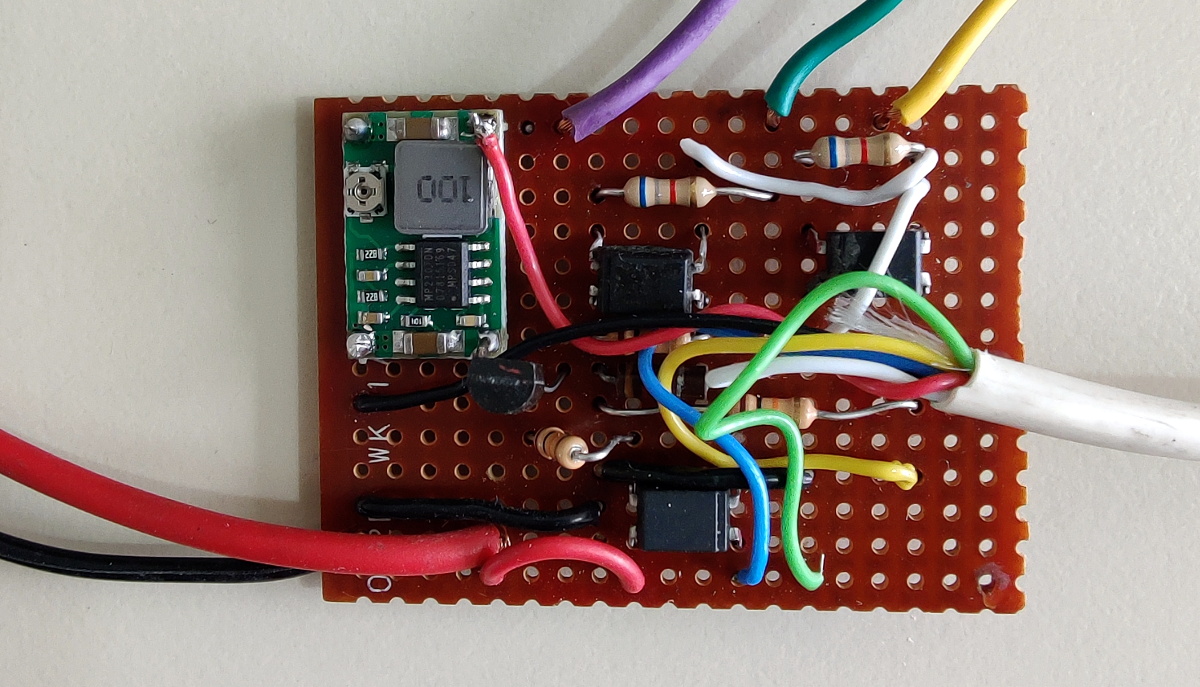
With the repair manual circuit diagrams in hand, it was no problem to find the GPS RX and TX lines that were being broken out to the external connector. Unfortunately, the radio’s electronics are all 5 volts and the GPS module [Selim] wanted to use was only 3.3 V. So he came up with a small PCB that included not only the voltage regulator to power the GPS module, but also some voltage-dividers to level shift those signals.

Since the Kenwood TM-D710a was already designed to accept a GPS upgrade module, he just needed to change some configuration options in the radio’s menus for it to see the new hardware. Technically the project was done at this point, but since there was still room in the case and he had a GPS module spitting out NMEA sentences, [Selim] tacked on a common Bluetooth serial module so he could see the position information on his smartphone. With an application like APRSdroid, he now has a nice moving map display using the position pulled from the radio’s GPS.

With this modification done it looks like the head unit is ready to go, but that’s only the beginning for a mobile rig. Now we want to see how he integrates the whole thing into the car.

E-Paper Display Shows Movies Very, Very Slowly

How much would you enjoy a movie that took months to finish? We suppose it would very much depend on the film; the current batch of films from the Star Wars franchise are quite long enough as they are, thanks very much. But a film like Casablanca or 2001: A Space Odyssey might be a very different experience when played on this ultra-slow-motion e-paper movie player.

The idea of displaying a single frame of a movie up for hours rather than milliseconds has captivated [Tom Whitwell] since he saw [Bryan Boyer]’s take on the concept. The hardware [Tom] used is similar: a Raspberry Pi, an SD card hat with a 64 GB card for the movies, and a Waveshare e-paper display, all of which fits nicely in an IKEA picture frame.

[Tom]’s software is a bit different, though; a Python program uses FFmpeg to fetch and dither frames from a movie at a configurable rate, to customize the viewing experience a little more than the original. Showing one frame every two minutes and then skipping four frames, it has taken him more than two months to watch Psycho. He reports that the shower scene was over in a day and a half — almost as much time as it took to film — while the scene showing [Marion Crane] driving through the desert took weeks to finish. We always wondered why [Hitch] spent so much time on that scene.

With the proper films loaded, we can see this being an interesting way to really study the structure and flow of a good film. It’s also a good way to cut your teeth on e-paper displays, which we’ve seen pop up in everything from weather stations to Linux terminals.

Hackaday Links Column Banner

Hackaday Links: August 23, 2020

Apple, the world’s first trillion-dollar company — give or take a trillion — has built a bit of libertarian cachet by famously refusing to build backdoors into their phones, despite the entreaties of the federal government. So it came as a bit of a surprise when we read that the company may have worked with federal agents to build an “enhanced” iPod. David Shayer says that he was one of three people in Apple who knew about the 2005 program, which was at the behest of the US Department of Energy. Shayer says that engineers from defense contractor Bechtel, seemed to want to add sensors to the first-generation iPod; he was never clued in fully but suspects they were adding radiation sensors. It would make sense, given the climate in the early 2000s, walking down the street with a traditional Geiger counter would have been a bit obvious. And mind you, we’re not knocking Apple for allegedly working with the government on this — building a few modified iPods is a whole lot different than turning masses of phones into data gathering terminals. Umm, wait…

A couple of weeks back, we included a story about a gearhead who mounted a GoPro camera inside of a car tire. The result was some interesting footage as he drove around; it’s not a common sight to watch a tire deform and move around from the inside like that. As an encore, the gearhead in question, Warped Perception, did the same trick bit with a more destructive bent: he captured a full burnout from the inside. The footage is pretty sick, with the telltale bubbles appearing on the inside before the inevitable blowout and seeing daylight through the shredded remains of the tire. But for our money, the best part is the slo-mo footage from the outside, with the billowing smoke and shredded steel belts a-flinging. We appreciate the effort, but we’re sure glad this guy isn’t our neighbor.

Speaking of graphic footage, things are not going well for some remote radio sites in California. Some towers that host the repeaters used by public service agencies and ham radio operators alike have managed to record their last few minutes of life as wildfires sweep across the mountains they’re perched upon. The scenes are horrific, like something from Dante’s Inferno, and the burnover shown in the video below is terrifying; watch it and you’ll see a full-grown tree consumed in less than 30 seconds. As bad as the loss of equipment is, it pales in comparison to what the firefighters face as they battle these blazes, but keep in mind that losing these repeaters can place them in terrible jeopardy too.

Continue reading “Hackaday Links: August 23, 2020”

Lithium Sulfur Batteries Slated For Takeoff

Spectrum recently published a post on a new lithium sulfur battery technology specifically targeting electric aviation applications. Although lots of electric vehicles could benefit from the new technology, airplanes are especially sensitive to heavy batteries and lithium-sulfur batteries can weigh much less than modern batteries of equivalent capacity. The Spectrum post is from Oxis Energy who is about to fly tests with the new batteries which they claim have twice the energy density of conventional lithium-ion batteries. The company also claims the batteries are safer, which is another important consideration when flying through the sky.

The batteries have a cathode comprised of aluminum foil coated with carbon and sulfur — which avoids the use of cobalt, a cost driver in traditional lithium cell chemistries. The anode is pure lithium foil. Between the two electrodes is a separator soaked in an electrolyte. The company says the batteries go through multiple stages as they discharge, forming different chemical compounds that continue to produce electricity through chemical action.

The safety factor is due to the fact that, unlike lithium-ion cells, the new batteries don’t form dendrites that short out the cell. The cells do degrade over time, but not in a way that is likely to cause a short circuit. However, ceramic coatings may provide protection against this degradation in the future which would be another benefit compared to traditional lithium batteries.

We see a lot of exciting battery announcements, but we rarely see real products with them. Time will tell if the Oxis and similar batteries based on this technology will take root.

Monitor Not VESA-Compliant? It Is Now!

Some monitors lack the holes on the back that make them VESA-compliant, so mounting them on a monitor arm can be a non-starter. To handle this, [Patrick Hallek] designed and 3D printed these adapter arms to make flat monitors mount to VESA hardware whether they want to or not.

How does it work? When a monitor can’t attach directly to a VESA mount, this assembly attaches to the mount instead. The three arms extend around the edge of the monitor to grip it from the bottom and top. Some hex-head M5 bolts and nuts are all that are required to assemble the parts, and the top arm is adjustable to accommodate different sizes of monitor. As long as the screen size is between 17 and 27 inches diagonal, and the monitor thickness falls between 30 mm and 75 mm, it should fit.

It’s a smart design that leverages one of the strengths of 3D printing: that of creating specialized adapters or fixtures that would be troublesome to make by hand. That is not to say that there’s no other way to make exactly what one wants when it comes to mounting monitors: check out this triple-monitor setup using some common metal struts, no welding required.

[via reddit]

The CIA’s Corona Project Was About Satellites, Not A Virus

We take orbital imagery for granted these days, but there was a time that it was high technology and highly secretive. [Scott Manley] has a good overview of the CIA’s Corona spy satellites, along with declassified images from the early days of the program.

It seems strange today, but the spy images needed high resolution and the only practical technology at the time was film. The satellite held a whopping 3,000 feet of film and, once shot, a capsule or bucket would return to Earth for retrieval and development. They didn’t make it to land — or at least they weren’t supposed to. The CIA didn’t want opponents sweeping up the film so an airplane was supposed to snag the bucket as it descended on a parachute, a topic covered in [Tom Nardi’s] article about the history of catching stuff as it falls from space.

The early cameras could see detail down to about 40 feet. By the end of the program in the 1970s, improved cameras could see down to 3 feet or less. Later satellites had a 3D-capable camera and multiple return buckets. The satellites were — officially — a program to expose biological samples to the space environment and return them for analysis. The Discover program was pure cover and the whole thing was declassified in 1992.

Of course, film from airplanes also had a role. Some spy satellites tried to scan film and send the data back, but that saw more use on lunar missions where returning a capsule to Earth was a lot more difficult.

Continue reading “The CIA’s Corona Project Was About Satellites, Not A Virus”