Open Sourced Carbon Fiber Rod Ends

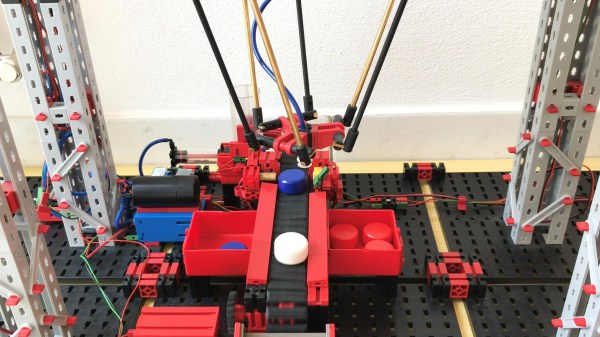
Modellers and makers who have been around the block for a few decades generally have their preferred materials. Balsa wood, sheet metal, brass tube… these were all staples of the hobbyist workshop. Composites are very much the new kid on the block and are starting to gain more of a foothold in the hobby marketplace. [Anthony] has been experimenting in this area, and has created some useful attachments for carbon fiber tubing.

The fittings are designed to be lasercut from aluminium or 3D printed. The rod ends are a simple two-piece design that slots together, before insertion into the carbon fiber rod. [Anthony] shows off a series of rods being used as linkages with a stepper motor, before performing pull-out tests on the links. Installed with cyanoacrylate glue, the link holds up to a pull load in excess of 180 lbs. The strength is impressive, and [Anthony] also talks about how to install the appropriate bearings to use the links for motion projects.

Overall, these links will likely prove useful to anyone using carbon fiber rods in a build, and helpfully, the required files are all available on GitHub. The source material is now cheap and readily available online, and is strong and resilient when used properly. We’ve seen carbon fiber popping up in a lot more projects recently, too. Video after the break.

Continue reading “Open Sourced Carbon Fiber Rod Ends”

Crash Your Code – Lessons Learned From Debugging Things That Should Never Happen™

Let’s be honest, no one likes to see their program crash. It’s a clear sign that something is wrong with our code, and that’s a truth we don’t like to see. We try our best to avoid such a situation, and we’ve seen how compiler warnings and other static code analysis tools can help us to detect and prevent possible flaws in our code, which could otherwise lead to its demise. But what if I told you that crashing your program is actually a great way to improve its overall quality? Now, this obviously sounds a bit counterintuitive, after all we are talking about preventing our code from misbehaving, so why would we want to purposely break it?

Wandering around in an environment of ones and zeroes makes it easy to forget that reality is usually a lot less black and white. Yes, a program crash is bad — it hurts the ego, makes us look bad, and most of all, it is simply annoying. But is it really the worst that could happen? What if, say, some bad pointer handling doesn’t cause an instant segmentation fault, but instead happily introduces some garbage data to the system, widely opening the gates to virtually any outcome imaginable, from minor glitches to severe security vulnerabilities. Is this really a better option? And it doesn’t have to be pointers, or anything of C’s shortcomings in particular, we can end up with invalid data and unforeseen scenarios in virtually any language.

It doesn’t matter how often we hear that every piece of software is too complex to ever fully understand it, or how everything that can go wrong will go wrong. We are fully aware of all the wisdom and cliches, and completely ignore them or weasel our way out of it every time we put a /* this should never happen */ comment in our code.

So today, we are going to look into our options to deal with such unanticipated situations, how we can utilize a deliberate crash to improve our code in the future, and why the average error message is mostly useless.

Continue reading “Crash Your Code – Lessons Learned From Debugging Things That Should Never Happen™”

New Part Day: Small, Cheap, And Good LIDAR Modules

Fully autonomous cars might never pan out, but in the meantime we’re getting some really cool hardware designed for robotic taxicab prototypes. This is the Livox Mid-40 Lidar, a LIDAR module you can put on your car or drone. The best part? It only costs $600 USD.

The Livox Mid-40 and Mid-100 are two modules released by Livox, and the specs are impressive: the Mid-40 is able to scan 100,000 points per second at a detection range of 90 m with objects of 10% reflectivity. The Mid-40 sensor weighs 710 grams and comes in a package that is only 88 mm x 69 mm x 76 mm. The Mid-100 is basically the guts of three Mid-40 sensors stuffed into a larger enclosure, capable of 300,000 points per second, with a FOV of 98.4° by 38.4°.

The use case for these sensors is autonomous cars, (large) drones, search and rescue, and high-precision mapping. These units are a bit too large for a skateboard-sized DIY Robot Car, but a single Livox Mid-40 sensor, pointed downward on a reasonably sized drone could perform aerial mapping

There is one downside to the Livox Mid sensors — while you can buy them direct from the DJI web site, they’re not in production. These sensors are only, ‘Mass-Production ready’. This might be just Livox testing the market before ramping up production, a thinly-veiled press release, or something else entirely. That said, you can now buy a relatively cheap LIDAR module that’s actually really good.

Screen Shake In VR, Minus The Throwing Up

In first-person games, an effective way to heighten immersion is to give the player a sense of impact and force by figuratively shaking the camera. That’s a tried and true practice for FPS games played on a monitor, but to [Zulubo]’s knowledge, no one has implemented traditional screen shake in a VR title because it would be a sure way to trigger motion sickness. Unsatisfied with that limitation, some clever experimentation led [Zulubo] to a method of doing screen shake in VR that doesn’t cause any of the usual problems.

Screen shake doesn’t translate well to VR because the traditional method is to shake the player’s entire view. This works fine when viewed on a monitor, but in VR the brain interprets the visual cue as evidence that one’s head and eyeballs are physically shaking while the vestibular system is reporting nothing of the sort. This kind of sensory mismatch leads to motion sickness in most people.

The key to getting the essence of a screen shake without any of the motion sickness baggage turned out to be a mix of two things. First, the shake is restricted to peripheral vision only. Second, it is restricted to an “in and out” motion, with no tilting or twisting. The result is a conveyance of concussion and impact that doesn’t rely on shaking the player’s view, at least not in a way that leads to motion sickness. It’s the product of some clever experimentation to solve a problem, and freely downloadable for use by anyone who may be interested.

Speaking of fooling one’s senses in VR environments, here is a fascinating method of simulating zero gravity: waterproof the VR headset and go underwater.

[via Reddit]

Buy Your Very Own Commercial Flight Simulator

If you happen to live near Phoenix, Arizona, have a spare US$10,000 or so kicking around, and have always fancied your own true-to-life commercial flight simulator, today is your lucky day. With just over a week to go on the auction, you can bid on a used flight simulator for a Bombardier CRJ200 regional jet airliner.

The CRJ200 jet was produced between 1991 and 2006, first being introduced in 1992 by Lufthansa. It’s a twin-engine design, with about 50 seats for passengers. With a length of more than 26 meters, 12,500 km (41000ft) ceiling, 785 km/h (487mph) cruising speed and a range of around 3,000 km (1864 mi) (depending on the configuration), it offers plenty of opportunities for the aspiring (hobbyist) pilot.

The auction stands at the time of writing at $4,400 offered and lasts until Monday, January the 28th. Local pick-up is expected, but the FAA-certified simulator comes complete with all of the manuals and the guarantee that it was 100% working before it was disassembled to ready it for auction. Just make sure that you have somewhere to put it before putting in that bid, and you could be the owner of a rig that would leave some of the best we’ve seen so far behind in the dust.

Printing Christmas Cards The Hard Way

Printing customized Christmas cards is a trivial matter today: choose a photo, apply a stock background or border, add the desired text, and click a few buttons. Your colorful cards arrive in a few days. It may be the easiest way, but it’s definitely no where near as cool as the process [linotype] used this season. (Editor’s note: skip the Imgur link and go straight for the source!)

The first task was to create some large type for the year. [linotype] laser printed “2018” then used an iron to transfer toner to the end of a piece of scrap maple flooring. Carving the numbers in relief yielded ready-to-go type, since the ironing process took care of the necessary mirroring step. The wood block was then cut to “type high” (0.918 inches; who knew?) using a compositor’s table saw – with scales graduated in picas, of course.

Continue reading “Printing Christmas Cards The Hard Way”

To Make Reproduction Train Whistles, The Old Ways Are Best

Late last year, artist [Steve Messam]’s project “Whistle” involved 16 steam engine whistles around Newcastle that would fire at different parts of the day over three months. The goal of the project was bring back the distinctive sound of the train whistles which used to be fixture of daily life, and to do so as authentically as possible. [Steve] has shared details on the construction and testing of the whistles, which as it turns out was a far more complex task than one might expect. The installation made use of modern technology like Raspberry Pi and cellular data networks, but when it came to manufacturing the whistles themselves the tried and true ways were best: casting in brass before machining on a lathe to finish.

The original whistles are a peek into a different era. The bell type whistle has three major components: a large bell at the top, a cup at the base, and a central column through which steam is piped. These whistles were usually made by apprentices, as they required a range of engineering and manufacturing skills to produce correctly, but were not themselves a critical mechanical component.

In the original whistle shown here, pressurized steam comes out from within the bottom cup and exits through the thin gap (barely visible in the image, it’s very narrow) between the cup and the flat shelf-like section of the central column. That ring-shaped column of air is split by the lip of the bell above it, and the sound is created. When it comes to getting the right performance, everything matters. The pressure of the air, the size of the gap, the sharpness of the bell’s lip, the spacing between the bell and the cup, and the shape of the bell itself all play a role. As a result, while the basic design and operation of the whistles were well-understood, there was a lot of work to be done to reproduce whistles that not only operated reliably in all types of weather using compressed air instead of steam, but did so while still producing an authentic re-creation of the original sound. As [Steve] points out, “with any project that’s not been done before, you really can’t do too much testing.”

Embedded below is one such test. It’s slow-motion footage of what happens when the whistle fires after filling with rainwater. You may want to turn your speakers down for this one: locomotive whistles really were not known for their lack of volume.

Continue reading “To Make Reproduction Train Whistles, The Old Ways Are Best”