This Kerosene Lantern Becomes A Compact Bioreactor

A bioreactor is a useful thing to have in any biology lab. Fundamentally, it’s a tank in which biological activity can be nurtured and controlled. [The Thought Emporium] needed a visual aid for an upcoming video on bioluminescent bacteria, but figured a single test tube full of the little critters just wasn’t visually striking enough. Thus began the build to turn a kerosene lantern into a full-featured bioreactor.

The ideal bioreactor for the project needed to be visually appealing, biologically safe, and to have the possibility for continuous operation. First, the lantern’s base was sealed with aluminium plate and silicone sealant. The top was then fitted with a plastic plug, which contained passthroughs for air and fluid feeds, UV LEDs for luminescence tests, as well as potential sterilization purposes. Wiring was neatly passed through the arms of the lantern, and an air pump hidden in the top. A battery compartment was also installed so the reactor can be portable, even when fully loaded.

The bioreactor was first filled with highlighter ink, and the UV lights switched on, confirming that the reactor does look the part when filled with glowing fluid. Then, it was flushed with hydrogen peroxide, before being refilled with growth medium and an E. Coli strain which produces a fluorescent red protein. Growth was successful, and there are future plans to use the bioreactor for other projects, too.

It goes without saying that it’s important to take the proper precautions when hacking on biological projects, lest you inadvertently create the zombie virus and take down half the population of the eastern seaboard. Regardless, it’s an impressive build that showcases various techniques for working with biological matter that may not be familiar to the home hacker. If you’re looking for more automation for your home biology hacks, perhaps the OpenLH project may interest you. Video after the break.

[Thanks to Baldpower for the tip!]

Continue reading “This Kerosene Lantern Becomes A Compact Bioreactor”

This Home Made Power Hacksaw Cuts Quick And Clean

If you’re cutting metal in the workshop, you’re likely using a table-mounted cutoff saw, or perhaps a bandsaw for finer work. The power hacksaw is an unwieldy contraption that looks and feels very old fashioned in its operation. Despite the drawbacks inherent in the design, [Emiel] decided to build one that operates under drill power, and it came out a treat.

The build uses a basic battery powered drill as its power source. This is connected to a shaft which rotates a linkage not dissimilar to that seen on steam locomotives, but in reverse. The linkage in this case is turning the rotational motion of the drill into linear motion of the hacksaw, which moves along a metal rail, guided by a 3D printed bearing.

With a body of plywood and plastic moving parts, this might not be your tool of choice for high-volume, fast paced work. However, as [Emiel] notes, it’s faster than doing it by hand, and it was a fun build that by and large, used what was already lying around the workshop. It’s not the first time we’ve seen a powered hacksaw use 3D printed parts, either. Video after the break.

Continue reading “This Home Made Power Hacksaw Cuts Quick And Clean”

Is That A Word Clock In Your Pocket?

Word clocks are one of those projects that everyone seems to love. Even if you aren’t into the tech behind how they work, they have a certain appealing aesthetic. Plus you can read the time without worrying about those pesky numbers, to say nothing of those weird little hands that spin around in a circle. This is the 21st century, who has time for that?

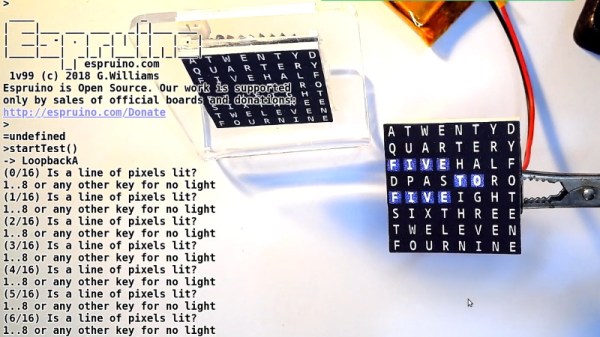
Now, thanks to [Gordon Williams], these decidedly modern timepieces just got a lot more accessible. His word clock is not only small enough to fit in the palm of your hand, but it’s the easiest-to-build one we’ve ever seen. If you were ever curious about these gadgets but didn’t want to put in the the time and effort required to build a full scale version, this diminutive take on the idea might be just what Father Time ordered.

The trick is to attach the microcontroller directly to the backside of an 8 x 8 LED matrix. As demonstrated by [Gordon], the Bluetooth-enabled Espruino MDBT42Q fits neatly between the rows of pins, which need only a gentlest of persuasions to get lined up and soldered into place. Since the time can be set remotely over Bluetooth, there’s not even so much as an additional button required. While driving the LEDs directly off of the digital pins of a microcontroller is never recommended, the specifics of this application (only a few of the LEDs on at a time, and not for very long) means he can get away with it.

Of course, that just gets you an array of square LEDs you blink. It wouldn’t be much of a word clock without, you know, words. To that end, [Gordon] has provided an overlay which you can print on a standard inkjet printer. While it’s not a perfect effect as the light still comes through the ink, it works well enough to get the point across. One could even argue that the white letters on the gray background helps with visibility compared to just the letters alone lighting up.

If you’re not in the market for a dollhouse-sized word clock, fear not. We’ve got no shortage of adult sized versions of these popular timepieces for your viewing pleasure.

Continue reading “Is That A Word Clock In Your Pocket?”

Understanding Math Rather Than Merely Learning It

There’s a line from the original Star Trek where Khan says, “Improve a mechanical device and you may double productivity, but improve man and you gain a thousandfold.” Joan Horvath and Rich Cameron have the same idea about improving education, particularly autodidacticism or self-learning. They share what they’ve learned about acquiring an intuitive understanding of difficult math at the Hackaday Superconference and you can watch the newly published video below.

The start of this was the pair’s collaboration on a book about 3D printing science projects. Joan has a traditional education from MIT and Rich is a self-taught guy. This gave them a unique perspective from both sides of the street. They started looking at calculus — a subject that scares a lot of people but is really integral (no pun intended) to a lot of serious science and engineering.

You probably know that Newton and Leibniz struck on the fundamentals of calculus about the same time. The original papers, however, were decidedly different. Newton’s approach was more physical and less mathematical. Leibniz used formal logic and algebra. Although both share credit, the Leibniz notation won out and is what we use today.

Continue reading “Understanding Math Rather Than Merely Learning It”

Airbus To Halt Production Of The A380; Goodbye To An Engineering Triumph

Eleven years ago, the Airbus A380 entered commercial service with Singapore Airlines. In the time since then it has become the queen of the skies. It’s a double-decker airliner, capable of flying 550 passengers eight thousand nautical miles. Some configurations of the A380 included private suites. Some had a shower. This is the epitome of luxury, a dream of flying with long-stemmed glasses, a movie, and a pleasant dream in mid-air.

Now, after the cancellation of A380 orders by Emirates, Airbus has announced it will end production of this massive, massive plane. No, it’s not the last flight of the Concorde, but it is the beginning of the end of an era. The biggest and most impressive planes just aren’t economical; it’s possible to fly three 787s across the globe for a single flight of an A380. The skies won’t fall silent, but soon the A380 will be no more.

Continue reading “Airbus To Halt Production Of The A380; Goodbye To An Engineering Triumph”

Hackaday Podcast 006: Reversing IPod Screens, Hot Isotopes, We <3 Parts, And Biometric Toiletseats

What’s the buzz in the hackersphere this week? Hackaday Editors Elliot Williams and Mike Szczys recap their favorite hacks and articles from the past seven days. In Episode Six we cover an incredible reverse engineering effort Mike Harrison put in with iPod nano replacement screens. We dip our toes in the radioactive world of deep-space power sources, spend some time adoring parts and partsmakers, and take a very high-brow look at toilet-seat technology. In our quickfire hacks we discuss coherent sound (think of it as akin to laminar flow, but for audio), minimal IDEs for embedded, hand-tools for metalwork, and the little ESP32 bot that could.

Links for all discussed on the show are found below. As always, join in the comments below as we’ll be watching those as we work on next week’s episode!

Take a look at the links below if you want to follow along, and as always, tell us what you think about this episode in the comments!

Direct download (60 MB or so.)

Continue reading “Hackaday Podcast 006: Reversing IPod Screens, Hot Isotopes, We <3 Parts, And Biometric Toiletseats”

Building A Semiautomatic Swag Launcher

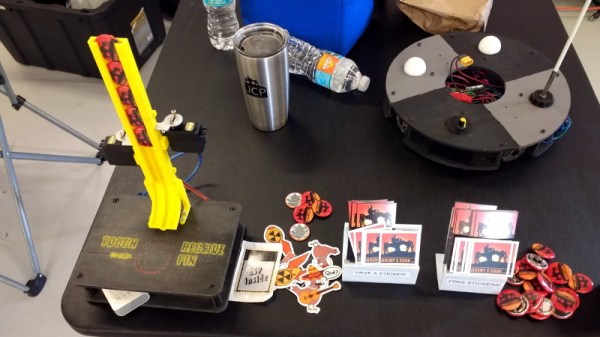
Regular readers of Hackaday have certainly seen the work of [Jeremy Cook] at this point. Whether you remember him from his time as a writer for this fine online publication, or recognize the name from one of his impressive builds over the last few years, he’s a bona fide celebrity around these parts. In fact, he’s so mobbed with fans at events that he’s been forced to employ a robotic companion to handle distributing his personalized buttons for his own safety.

Alright, that might be something of a stretch. But [Jeremy] figured it couldn’t hurt to have an interesting piece of hardware handing out his swag at the recent Palm Bay Mini Maker Faire. Anyone can just put some stickers and buttons in a bowl on a table, but that’s hardly the hacker way. In the video after the break, he walks viewers through the design and construction of this fun gadget, which takes a couple unexpected turns and has contains more than a few useful tips which are worth the cost of admission alone.

Outwardly the 3D printed design is simple enough, and reminds us of those track kits for Matchbox cars. As you might expect, getting the buttons to slide down a printed track was easy enough. Especially when [Jeremy] filed the inside smooth to really get them moving. But the goal was to have a single button get dispensed each time the device was triggered, but that ended up being easier said than done.

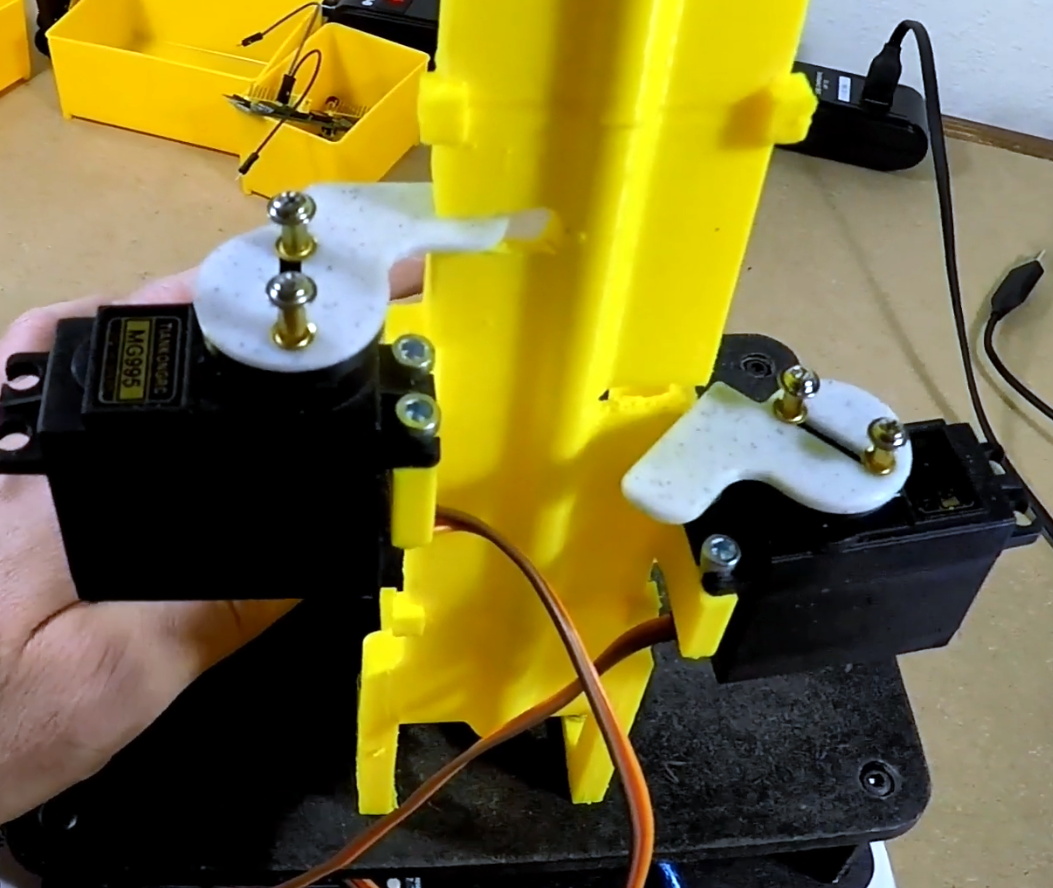
The first attempt used magnets actuated by two servos, one to drop the button and the other to hold up the ones queued above it. This worked fine…at first. But [Jeremy] eventually found that as he stacked more buttons up in the track, the magnets weren’t strong enough to hold them back and they started “leaking”. This is an excellent example of how a system can work perfectly during initial testing, but break down once it hits the real world.

In this case, the solution ended up being relatively simple. [Jeremy] kept the two servos controlled by an Arduino and a capacitive sensor, but replaced the magnets with physical levers. The principle is the same, but now the system is strong enough to hold back the combined weight of the buttons in the chute. It did require him to cut into the track after it had already been assembled, but we can’t blame him for not wanting to start over.

Just like the arcade inspired candy dispenser, coming up with a unique way of handing out objects to passerby is an excellent way to turn the ordinary into a memorable event. Maybe for the next iteration he can make it so getting a button requires you to pass a hacker trivia test. Really make them work for it.

Continue reading “Building A Semiautomatic Swag Launcher”