SCCSI2SD card in a sound board

Making A Vintage 1990s Sound Board Do Rapid Fire Silently

Sometimes a mix of old and new is better than either the old or new alone. That’s what [Brad Carter] learned when he was given an old 1990s sound board with a noisy SCSI drive in it. In case you don’t know what a sound board is, think of a bunch of buttons laid out in front of you, each of which plays a different sound effect. It’s one way that radio DJ’s and podcasters intersperse their patter with doorbells and car crash sounds.

Before getting the sound board, [Brad] used a modern touchscreen table but it wasn’t responsive enough to get a machine gun like repetition of the sound effect when pressing an icon in rapid succession. On the other hand, his 1990s sound board had very responsive physical buttons but the SCSI hard drive was too noisy. He needed the responsiveness of the 1990s physical buttons but the silence of modern solid state storage.

And so he replaced the sound board’s SCSI drive with an SD card using a SCSI2SD adaptor. Of course, there was configuration and formatting involved along with a little trial and error to get the virtual drive sizes right. To save anyone else the same difficulties, he details all his efforts on his webpage. And in the video below you can see and hear that the end result is an amazing difference. Pressing the physical buttons gives instant sound and in machine gun fashion when pressed in rapid succession, all with the silence of an SD card.

A SCSI2SD card is a nice off-the-shelf solution but if you want something a little more custom then there’s a Raspberry Pi SCSI emulator and one which uses a Teensy with a NCR5380 SCSI interface chip.

Continue reading “Making A Vintage 1990s Sound Board Do Rapid Fire Silently”
GPL Violations Cost Creality A US Distributor

One of the core tenets of free and open source software licenses is that you’re being provided source code for a project with the hope that you’ll “pay it forward” if and when you utilize that code. In fact some licenses, such as the GNU Public License (GPL), require that you keep the source code for subsequent spin-offs or forks open. These are known as viral licenses, and the hope is that they will help spread the use of open source as derivative works can’t turn around and refuse to release their source code.

Unfortunately, not everyone plays by the rules. In a recent post on their blog, Printed Solid has announced they are ending their relationship with Chinese manufacturer Creality, best known for their popular CR-10 printer. Creality produces a number of printers which make use of Marlin, a GPLv3 licensed firmware that runs (in some form or another) a large majority of desktop 3D printers. But as explained in the blog post, Printed Solid has grown tired with the manufacturer’s back and forth promises to comply with the viral aspects of the GPL license.

Rather than helping to support a company they believe is violating the trust of the open source community, they have decided to mark down their existing stock of Creality printers to the point they will be selling them at a loss until they run out. In addition, for each Creality printer that is sold Printed Solid has promised to make a $50 USD donation to the development of Marlin saying: “if Creality won’t support Marlin development then we will.”

As is often the case when tempers are high and agreements break down, Printed Solid has also pulled back the curtain a bit as to the relationship they have had thus far with the manufacturer. According to the blog post, Printed Solid claims that some models of Creality printers have had a 100% fault rate, and that the company needed to repair and tweak the machines before sending them out to customers. The not so subtle implication being that Creality printers have been benefiting from the work Printed Solid has been doing on their hardware, and that purchasing a unit direct from the manufacturer could be a dicey proposition.

We’ve previously covered an issue with Creality’s CR-10S printer that required the end-user to replace an SMD capacitor just to get reliable results out of the machine, and of course we’ve talked of the extra work that’s often required when wrangling a low-end Chinese printer. It’s even more disheartening when you realize cheap machines sold by shady manufacturers are pushing open source manufacturers out of business.

Let The Musical Instrument Challenge Begin!

Today is the start of the Musical Instrument Challenge. This newest part of the 2018 Hackaday Prize asks you to go far beyond what we’re used to seeing from modern musical instrumentation. Twenty entries will be awarded $1,000 each and go on to compete in the final round of the Hackaday Prize.

Imagine music without the electric guitar amp, violin, two turntables and a microphone, the electric drum pad, or in the absence of autotune. Maybe that last one made you groan, but autotune is a clever use of audio manipulation and when used to augment the music (rather than just to correct off-key voices) it shows its value as a new tool for creativity.

Musicians have always been hackers. The story of Brian May’s handmade guitar — the Red Special — is one of not being able to buy it, so he built it. Unlocking emotion in the listener has always meant finding new and different ways to use sound. This is a natural motivator to re-imagine and invent new ways of doing that. That first hand-built guitar got him in the door, but iterative improvements to the tremolo bar, the pickups, and even just the mechanical engineering of the neck made it a new instrument that you’ve heard in every Queen performance since.

So what’s next? What does a brand new instrument, interface, tool, or trick look like? That’s what we want to see from this Hackaday Prize challenge. From instrument makers to the people who write software for sampling, synthesizing, sequencing, and manipulating sound, we’re looking for things that let others make music. These creations are the tools of the trade that help more people unlock their musical creativity. Show off your work by sharing all the details of your design, and demonstrate the music you can make with it.

You have until October 8th to put your entry up on Hackaday.io. The top twenty entries will each get $1,000 and go on to the finals where cash prizes of $50,000, $20,000, $15,000, $10,000, and $5,000 await.

FOSSCON 2018: Hacking The Indego Bike Sharing API

It’s often said that necessity of the mother of invention, but as a large portion of the projects we cover here at Hackaday can attest, curiosity has to at least be its step-mother. Not every project starts with a need, sometimes it’s just about understanding how something works. That desire we’ve all felt from time to time, when we’ve looked at some obscure piece of hardware or technology and decided that the world would be a slightly better place if we cracked it open and looked at what spilled out.

That’s precisely the feeling Eric O’Callaghan had when he looked out the window of his Philadelphia apartment a few years back and saw something unusual. Seemingly overnight, they had built an automated Indego bike sharing station right across the street. Seeing the row of light blue bicycles sitting in their electronic docks, he wondered how the system worked, and what kind of data they might be collecting. He didn’t need to rent a bike, he hadn’t even ridden one in years, but he suddenly had a strong urge to go across the street and learn as much as he could about this system.

He recently presented those findings during FOSSCON 2018 at the International House in Philadelphia, in the hopes that others might be interested in getting involved. Currently Eric is one of the only people who’s investigating the public data Indego offers, and as his personal MySQL database has now surpassed 15 million rows of data, he’s hoping to get some developers with big data experience into the fray. His approach to making this data useful is an interesting one which I’ll dive into after the break.

Continue reading “FOSSCON 2018: Hacking The Indego Bike Sharing API”

Self Folding Origami From A 3D Printer

If you’ve done much 3D printing, you probably curse how plastic warps as it cools down and heats. There’s nothing more upsetting than watching a six hour print start curling off the bed and starting its inexorable march to the trash can. However, researchers at Carnegie Mellon have found a way to harness that tendency to warp with heat to make self-folding structures like those seen in the video below. There’s a paper about how it works available, too.

The Thermorph process uses commercially-available 3D printers, but requires special software. You might wonder why you would want to fold, say, a rose, when you could just print it as a fully-formed 3D model. The paper suggests that printing self-folding structures is faster and can save up to 87% on print times for the right models.

Continue reading “Self Folding Origami From A 3D Printer”

Selling Everything, Moving To Asia, And Setting Up A Company

Today I don’t have a hack for you. I have a story, one that I hope will prove useful to a few of you who are considering a move to Asia to chase opportunities here.

Seven years ago, I was a pretty stereotypical starving hacker. I had five jobs: A full-time dead-end job in biotech, and four part-time or contract gigs that were either electronic hardware design or programming. I worked perhaps 50 hours a week, and was barely past the poverty line – I was starting to wonder why I spent so much time in school. I saw the economic growth in Asia as an attractive but risky opportunity.

Check out that image above…France? No, this is Shenzhen and let’s face it: many exciting things are made there (even the copies). After a short visit to the region, I decided to take that risk but not in Shenzhen. I sold everything I owned and moved from Canada to Vietnam and started a company. Over the last seven years things have worked out well, although I certainly wish I had known more about the process before I got on a plane. This article is about the general path I took to get where I am. Obviously I don’t know the legal framework of every country in Asia, but speaking in generalities I hope that I can cover some interesting points for the curious and adventurous.

Continue reading “Selling Everything, Moving To Asia, And Setting Up A Company”

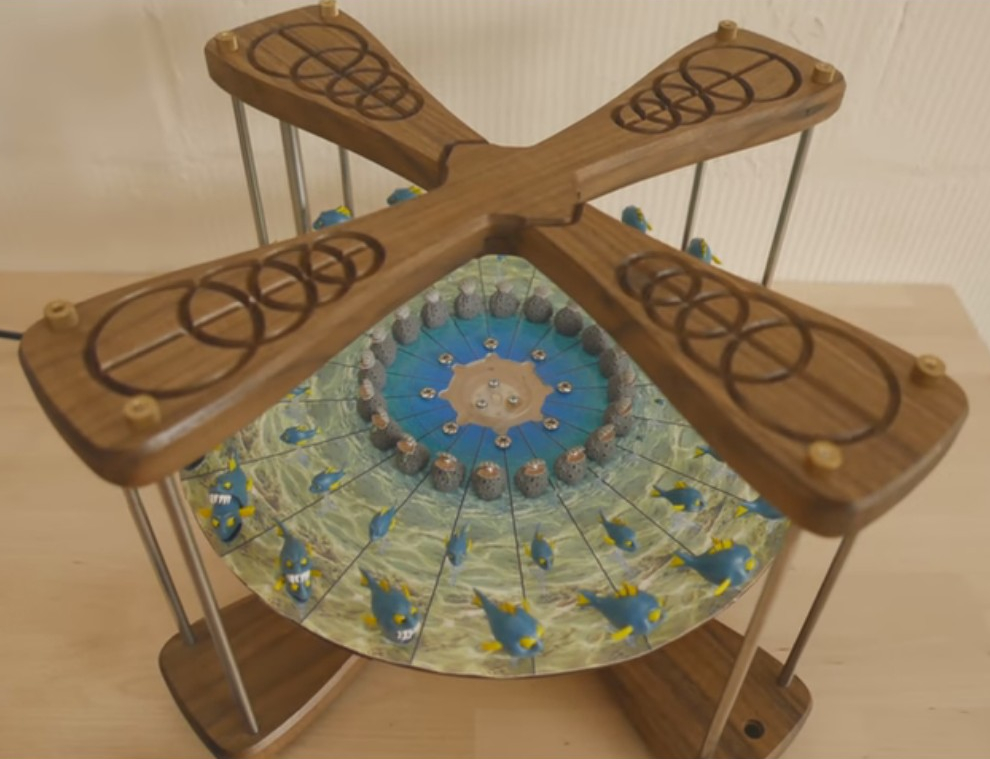
4-Mation Fish eats fish

Time-Stretching Zoetrope Animation Runs Longer Than It Should

3D printers have long since made it easy for anyone to make 3-dimensional zoetropes but did you know you can take advantage of a 4th dimension by stretching time? Previously the duration of a zoetrope animation would be however long it took for the platform to rotate once. To make it more interesting to watch for longer, you filled out the scene by creating concentric rings of animations. [Kevin Holmes], [Charlie Round-Turner], and [Johnathan Scoon] have instead come up with a way to make their animations last for multiple rotations, longer than three in one example. If you’re not at all familiar with these 3D zoetropes, you might want to check out this simpler version first.

4-Mation Fish eats Fish zoetropeTheir project name is 4-Mation but they call the time-stretching technique, animation multiplexing. One way to implement it is to use one long spiral beginning in the center and ending on the platform’s periphery. It’s the spiral path which make the animation last longer.

In their Fish eating Fish animation, the spiral is of a small fish which exits a clam at the center and gets progressively larger as it spirals outward until it swallows another fish located in a ring at the periphery. Of course when you look at it with a properly timed strobe light, there is no spiral. Instead, it appears as though a bunch of fish move more-or-less radially out from the center. The second video embedded below walks through the animation step-by-step, making it easier to follow the intricacies of what’s going on.

Other features include built-in strobe lighting and both manual and phone app control. This project is a product for a kickstarter campaign and so normally, details of the electronics would be absent. But clearly [Kevin] is familiar with Hackaday and sent in some additional info which you can find below, along with the videos.

Continue reading “Time-Stretching Zoetrope Animation Runs Longer Than It Should”