Friday Hack Chat: The Incredible BeagleBoard

Over the last year or so, the BeagleBoard community has seen some incredible pieces of hardware. The BeagleBone on a Chip — the Octavo OSD335x — is a complete computing system with DDR3, tons of GPIOs, Gigabit Ethernet, and those all-important PRUs stuffed into a single piece of epoxy studded with solder balls. This chip made it into tiny DIY PocketBones and now the official PocketBeagle is in stock in massive quantities at the usual electronic component distributors.

For this week’s Hack Chat, we’re talking about the BeagleBoard, BeagleBone, PocketBeagle, and PocketBone. [Jason Kridner], the co-founder of BeagleBoard and beagle wrangler, will be on hand to answer all your questions about the relevance of the Beagle platform today, the direction BeagleBoard is going, and the inner workings of what is probably the best way to blink LEDs in a Linux environment.

Topics for this Hack Chat will include the direction BeagleBoard is going, the communities involved with BeagleBoard, and how to get the most out of those precious programmable real-time units. As always, we’re taking questions from the community, submit them here.

As an extra special bonus, this week we’re giving away some hardware. Digi-Key has offered up a few PocketBeagle boards. If you have an idea for a project, put it on the discussion sheet and we’ll pick the coolest project and send someone a PocketBeagle.

join-hack-chat

Our Hack Chats are live community events on the Hackaday.io Hack Chat group messaging. This Hack Chat will be going down noon, Pacific time on Friday, October 13th. Wondering why the Brits were the first to settle on a single time zone when the US had a more extensive rail network and the longitude so time zones made sense? Here’s a time zone converter! Use that to ponder the mysteries of the universe.

Click that speech bubble to the right, and you’ll be taken directly to the Hack Chat group on Hackaday.io.

You don’t have to wait until Friday; join whenever you want and you can see what the community is talking about.

Making Ice Cream With Heavy Metal

After his last project left him with an eleven-pound block of aluminum, [Jason] got to thinking of what most of us would in that situation: fresh made ice cream. His mind was on the frozen concoctions of the aptly named Cold Stone Creamery, a mall food court staple where a chilled stone is used to turn fresh ingredients into made to order sundaes.

[Jason] did the math and found that an eleven-pound chunk of aluminum can absorb a little over 67,000 joules, which is over twice the energy required to freeze 100 g of water. In place of water he would be using cream, condensed milk, and strawberries, but believed there was a large enough safety factor to account for the differences between his ingredients and pure water.

His first attempt didn’t go exactly as planned, but with his Flir One he was able to back up his theoretical numbers with some real-world data. He found that he needed to start the aluminum block at a lower temperature before adding his ingredients, and through experimentation determined the block only had enough energy to freeze 30 g of liquid.

In the end [Jason] was satisfied with the frozen treat he managed to make from the leftovers of his radial mill project, but theorizes that an ever better solution would be to use a brine solution and drop the aluminum block all together.

Of course, if putting food on a slab of metal from your workshop doesn’t sound too appealing, you could always go the NASA route and freeze dry it. Either method will probably make less of a mess than trying to print objects with it.

Building The Hackaday Superconference Badge

The best hardware conference is just a few weeks away. This is the Hackaday Superconference, and it’s two days of talks, an extra day of festivities, soldering irons, and an epic hardware badge. We’ve been working on this badge for a while now, and it’s finally time to share some early details. This is an awesome badge and a great example of how to manufacture electronics on an extremely compressed timetable. This is badgelife, the hardware demoscene of electronic conference badges.

So, what does this badge do? It’s a camera. It has games, and it’s designed by [Mike Harrison] of Mike’s Electric Stuff. He designed and prototyped this badge in a single weekend. On board is a PIC32 microcontroller, an OV9650 camera module, and a bright, crisp 128×128 resolution color OLED display. Tie everything together with a few buttons, and you have a badge that’s really incredible.

So, how do you get one? You’ve got to come to the Hackaday Superconference. This year we’re doing things a bit differently and opening the doors a day early to get the hacker village started with badge hacking topped off by a party that evening and everyone coming to Supercon is invited! This is a badge full of games, puzzles, and video capture and isn’t something to miss. We have less than 30 tickets left so grab your ticket now and read on.

Continue reading “Building The Hackaday Superconference Badge”

Dollar Tree LED Bulb Tear Down

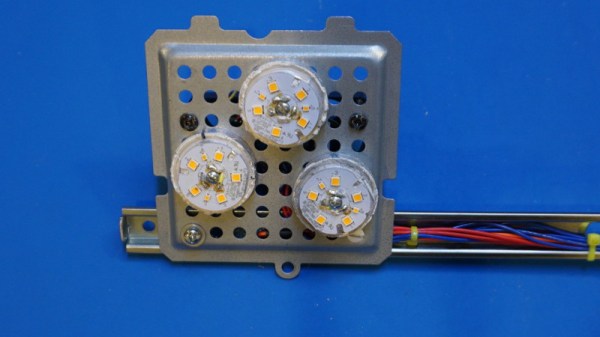
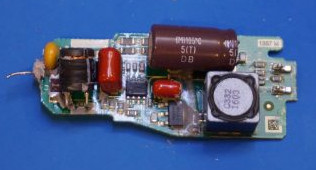
It is hard to remember now, but there was a time when electronics were expensive. [Adrian Black] found some 9W (60W equivalent) LED light bulbs at the Dollar Tree (a U.S. store where everything costs a dollar). Naturally, they cost a dollar, and he wanted to see what was inside of them. You can see the resulting video, below.

Apparently where [Adrian] lives there is a subsidy paid to retailers for selling LED lighting, so you may not be able to get the same bulbs at that price. Still, the price of these bulbs has dropped like a rock over the last few years.

Continue reading “Dollar Tree LED Bulb Tear Down”

2.5D Printing?

Casio — the company famous for calculators, watches, and calculator watches — is touting a 2.5D printer. We aren’t sure we are impressed with the marketing hype name, but it is an interesting innovation for people prototyping new designs. The printer can create material that appears to be leather, fabric, and other materials. With some additional work, the printer can even mimic hard materials like stone or wood. You can see a video about the machine below.

The Mofrel printer uses special “digital sheets” that appear to be thick paper or PET plastic, but are really a sandwich of different materials. When you heat an area of the sheet, particles inside the sandwich expand allowing the printer to apply a texture.

Continue reading “2.5D Printing?”

Addition On The Strangest Vacuum Tube

[Uniservo] made a video of a tube he’s been trying to acquire for a long time: a Rogers 6047 additron. Never heard of an additron? We hadn’t either. But it was a full binary adder in a single vacuum tube made in Canada around 1950. You can see the video below.

The unique tubes were made for the University of Toronto Electronic Computer (UTEC). A normal tube-based computer would require several tubes to perform an addition, but the additron was a single tube that used beam switching to perform the addition in a single package. [Uniservo] points out how the tube could have revolutionized tube computing, but before it could really appear in real designs, transistors — and later, integrated circuits — would take over.

Continue reading “Addition On The Strangest Vacuum Tube”

Cleaning Up A Low-Cost Buck-Boost Supply

Cheap DC-DC converters have been a boon on the hobbyist bench for a while now, but they can wreak havoc with sensitive circuits if you’re not careful. The problem: noise generated by the switch-mode supply buried within them. Is there anything you can do about the noise?

As it turns out, yes there is, and [Shahriar] at The Signal Path walks us through a basic circuit to reduce noise from DC-DC converters. The module under the knife is a popular buck-boost converter with a wide input range, 0-32 VDC output at up to 5 amps, and a fancy controller with an LCD display. But putting the stock $32 supply on a scope reveals tons of harmonics across a 1 MHz band and overall ripple of about 66 mV. But a simple voltage follower built from a power op-amp and a Zener diode does a great job of reducing the spikes and halving the ripple. The circuit is just a prototype and is meant more as a proof of principle and launching point for further development, and as such it’s far from perfect. The main downside is the four-volt offset from the input voltage; there’s also a broad smear of noise at the high end of the spectrum that persists even with the circuit in place. Centered around 900 MHz as it is, we suspect a cell signal of some sort is getting in. 900 kHz.

If you haven’t checked out the videos at The Signal Path, you really should. [Shahriar] really has a knack for explaining advanced topics in RF engineering, and has a bench to die for. We’ve covered quite a few of his projects before, from salvaging a $2700 spectrum analyzer to multiplexing fiber optic transmissions.

Continue reading “Cleaning Up A Low-Cost Buck-Boost Supply”