
CES 2017 is finally over, but one question has yet to be answered: which Internet of Thing is Best Internet of Thing?
Continue reading “CES2017: Which Internet Of Thing Is Best Internet Of Thing?”

CES 2017 is finally over, but one question has yet to be answered: which Internet of Thing is Best Internet of Thing?
Continue reading “CES2017: Which Internet Of Thing Is Best Internet Of Thing?”
If you been following Hackaday lately, you’ve surely noticed an increased number of articles about IoT-ifying stuff. It’s a cool project to take something old (or new) and improve its connectivity, usually via WiFi, making it part of the Internet of Things. Several easy to use modules, in particular the ESP8266, are making a huge contribution to this trend. It’s satisfactory to see our homes with an ESP8266 in every light switch and outlet or to control our old stereo with our iPhone. It gives us a warm fuzzy feeling. And that’s completely fine for one’s personal projects.
But what happens when this becomes mainstream? When literally all our appliances are ‘connected’ in the near future? The implications might be a lot harder to predict than expected. The near future, it seems, starts now.
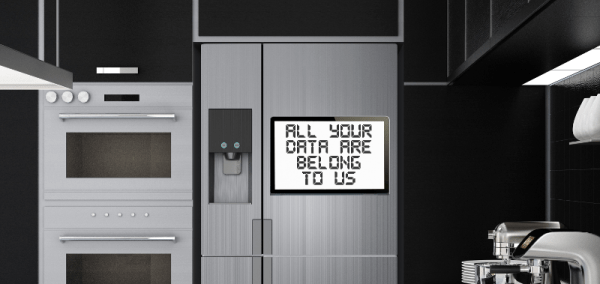
This year, at CES, LG Electronics (LG) has introduced Smart InstaView™, a refrigerator that’s powered by webOS smart platform and integrated with Amazon’s Alexa Voice Service.
… with webOS, consumers can also explore a host of WiFi-enabled features directly on the refrigerator, creating a streamlined and powerful food management system all housed directly on the front of the fridge door. Amazon’s Alexa Voice Service gives users access to an intelligent personal assistant that, in addition to searching recipes, can play music, place Prime-eligible orders from Amazon.com…
This is ‘just’ a fridge. There are other WiFi-enabled appliances by now, so what? Apparently, during the LG press conference last Wednesday, the company marketing VP David VanderWaal said that from 2017 on, all of LG’s home appliances will feature “advanced Wi-Fi connectivity”.
Notice the word advanced, we wonder what that means? Will ‘advanced’ mean complicated? Mesh? Secure? Intelligent? Will our toaster finally break the Internet and ruin it for everyone by the end of the year? Will the other big players in the home appliances market jump in the WiFi wagon? We bet the answer is yes.
Here be dragons.
[via Ars Technica]
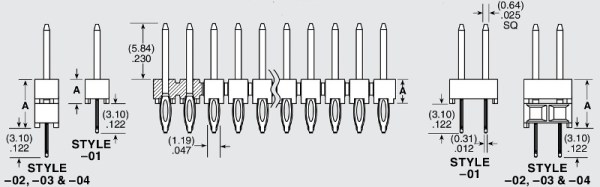
One of the features of the Raspberry Pi Zero is that it arrives with no GPIO header pins installed. The missing pins reduce the price of the little computer, as well as its shipping volume. A task facing most new Pi Zero owners has therefore been to solder a set of pins into the holes, and indeed many suppliers will sell you the pins alongside your new Zero.
The British Pi accessories supplier Pimoroni think they may have a solution to this problem, with a set of solderless pins that the user is expected to fit by tapping both pins and Pi with a hammer. Each pin is designed to deform under pressure, and grip the through-plated walls of the hole in the PCB. In reality they are push-fit pins designed to be fitted with a press or a special tool, but since the average Zero buyer will have neither they supply a small laser-cut jig and give instructions to tap carefully with a pin hammer or similar. They have a demonstration as part of their regular Bilge Tank podcast, which we’ve included below the break.
Pins like these can be quite reliable when installed with the proper tools. They are often used in military and aerospace systems. In this case though, we expect that a chorus of you will be limbering up to comment that it would be far better to solder the connector, and we can’t help agreeing with you. Of course this product isn’t really marketed at Hackaday readers. Instead, the target market of a board like the Zero are children. For them soldering may well be a step too far. We can’t help wondering though whether hammer installation will deliver a reliable enough contact, and whether we’ll see a horde of youngsters whose Pi HATs don’t work due to dodgy connectors. Aside from the ones who’ve broken their Zeros with hammering that was a bit enthusiastic, that is.

[David Krum] is associate lab director at the Mixed Reality Lab at the Institute for Creative Technologies at USC. That puts him at the intersection of science and engineering: building cool virtual reality (VR) devices, and using science to figure out what works and what doesn’t. He’s been doing VR since 1998, so he’s seen many cool ideas come and go. His lab was at the center of the modern virtual reality explosion. Come watch his talk and see why!
Continue reading “David Krum: The Revolution In Virtual Reality”

What does a Hackaday writer do when a couple of days after Christmas she’s having a beer or two with a long-term friend from her university days who’s made a career in the technical side of digital broadcasting? Pick his brains about the transmission scheme and write it all down of course, for behind the consumer’s shiny digital radio lies a wealth of interesting technology to try to squeeze the most from the available resources.
In the UK, our digital broadcast radio uses a system called DAB, for Digital Audio Broadcasting. There are a variety of standards used around the world for digital radio, and it’s fair to say that DAB as one of the older ones is not necessarily the best in today’s marketplace. This aside there is still a lot to be learned from its transmission scheme, and from how some of its shortcomings were addressed in later standards. Continue reading “Anatomy Of A Digital Broadcast Radio System”
If you’ve never set up a telescope in your back yard, you’ve never been truly disappointed. The Hubble can take some great shots of Saturn, nebulae, and other astronomical phenomena, but even an expensive backyard scope produces only smudges. To do astronomy properly, you’ll spend your time huddled over a camera and a computer, stacking images to produce something that almost lives up to your expectations.
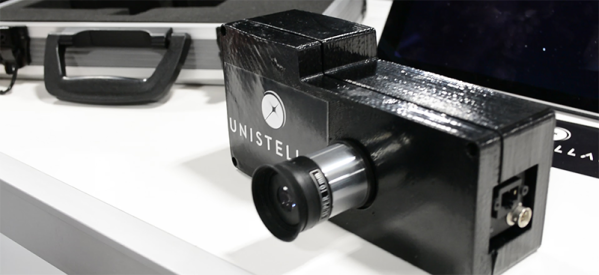
At CES, Unistellar introduced a device designed to fit over the eyepiece of a telescope to do all of this for you.
According to the guys at Unistellar, this box contains a small Linux computer, camera, GPS, and an LCD. Once the telescope is set up, the module takes a few pictures of the telescope’s field of view, stacks the images, and overlays the result in the eyepiece. Think of this as ‘live’ astrophotography.
In addition to making Jupiter look less like a Great Red Smudge, the Unistellar module adds augmented reality; it knows where the telescope is pointing and will add a label if you’re looking at any astronomical objects of note.
While I wasn’t able to take a look inside this extremely cool device, the Unistellar guys said they’ll be launching a crowdfunding campaign in the near future.
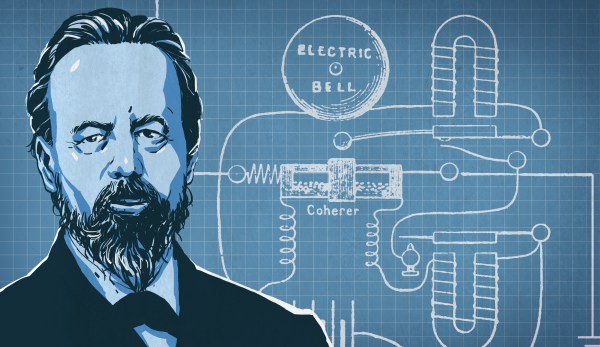
It is said that “success has many fathers, but failure is an orphan.” Given the world-changing success of radio in the late 19th and early 20th centuries, it’s no wonder that so many scientists, physicists, and engineers have been credited with its invention. The fact that electromagnetic radiation is a natural phenomenon that no one can reasonably claim to have invented sometimes seems lost in the shuffle to claim the prize.
But it was exactly through the study of natural phenomena that one of the earliest pioneers in radio research came to have a reasonable claim to at least be the inventor of the radio receiver, well before anyone had learned how to reliably produce electromagnetic waves. This is the story of how a Russian physicist harnessed the power of lightning and became one of the many fathers of radio.









