Staying In And Playing Skyrim Has Rarely Been This Healthy

Looking to add some activity to your day but don’t want to go through a lot of effort? [D10D3] has the perfect solution that enables you to take a leisurely bike ride through Skyrim. A standing bicycle combines with an HTC Vive (using the add-on driver VorpX which allows non-vr enabled games to be played with a VR headset) and a Makey Makey board to make slack-xercise — that’s a word now — part of your daily gaming regimen.

The Makey Makey is the backbone of the rig; it allows the user to set up their own inputs with electrical contacts that correspond to keyboard and mouse inputs, thereby allowing one to play a video game in some potentially unorthodox ways — in this case, riding a bicycle.

Setting up a couple buttons for controlling the Dragonborn proved to be a simple process. Buttons controlling some of the main inputs were plugged into a breadboard circuit which was then connected to the Makey Makey along with the ground wires using jumpers. As a neat addition, some aluminium foil served as excellent contacts for the handlebars to act as the look left and right inputs. That proved to be a disorienting addition considering the Vive’s head tracking also moves the camera. Continue reading “Staying In And Playing Skyrim Has Rarely Been This Healthy”


Capacitors Are Simple, Right?

It is easy to dismiss passive components like resistors and capacitors as a boring subject. [James Lewis] of KEMET Capacitors would disagree. He gave a talk about capacitor tech that is both approachable and in-depth.

Like every other component we use, we always think of them as perfect. But just like wires have resistance and inductance that we often ignore, capacitors have different imperfect characteristics that you need to be aware of.

Ceramic capacitors, for example, lose capacitance over time. Different ceramic material have different temperature sensitivity. Aluminum capacitors don’t last forever. Voltage applied to a capacitor can change its value as much as 50%.

[James] also talks about polymer electrolytics and super capacitors. His burning question: Is there any truth to the old guideline that you should derate capacitors by 50%? Want to know what he thinks? Watch the video below. Speaking of burning, he tackles the touchy subject of tantalum capacitors. The image at the top is a test Kemet ran on their own parts at reverse polarity well beyond spec. All of them are blown but only some look burnt. That’s a mystery well worth watching the talk.

Continue reading “Capacitors Are Simple, Right?”

Physical Kill Switch For Rogue Applications

Necessity is the mother of invention, but sometimes frustration is as good a motivator. [Maciej] does a bunch of statistics in his day job using SPSS. silaczLike most complicated pieces of software, it can get hung, and the only way to stop it is to manually kill the running processes. Apparently, that happened one time too many for [Maciej].

He took matters into his own hands, repurposing a big red emergency-stop button for the task. It’s mounted on a jar, and the microcontroller inside is configured as a USB keyboard. When he mashes the button, it opens the “Run…” menu and types out taskkill spssengine.exe for him.

We can totally see the therapeutic value of such a device. Plus, in case SPSS is gobbling up his system memory and everything’s approaching standstill, the vital seconds saved by the microcontroller’s quick-typing fingers could be a lifesaver.

A Jailbreak For Every Kindle

[Geekmaster] wrote in to tell us about a new hack for the Amazon Kindle. It’s a jailbreak. Universal jailbreak for almost every eInk Kindle eReader eOut eThere.

This jailbreak is a pure software jailbreak for the Kindle Paperwhite 2, the Kindle Paperwhite 3, Kindle Touch, Kindle Voyage, and Kindle Oasis. If you’re keeping track, that’s any 6th, 7th, or 8th generation device, running any firmware version. Already the jailbreak has been tested by over one thousand people, after the cloud served up half a Terabyte of jailbreak image downloads. That’s extraordinarily popular for a device that hasn’t seen much action of late.

Several years ago, [Geekmaster] made a name for himself – and for [NiLuJe], [KNC1], and other developers over at the Mobileread forums – for jailbreaking the Kindle Paperwhite. This jailbreak was, and is extremely simple; just upload a file to the root directory, restart, and the Kindle is jailbroken. The latest development extends this to nearly all Kindle models, while still being as easy to deploy as the original hack from four years ago.

If you’re looking for something to do with a neat jailbroken device with an eInk screen, they make a great serial consolethermostat, and wallpaper.

Hackaday Prize Entry: Selfie Bot Let’s You Vlog Hands Free

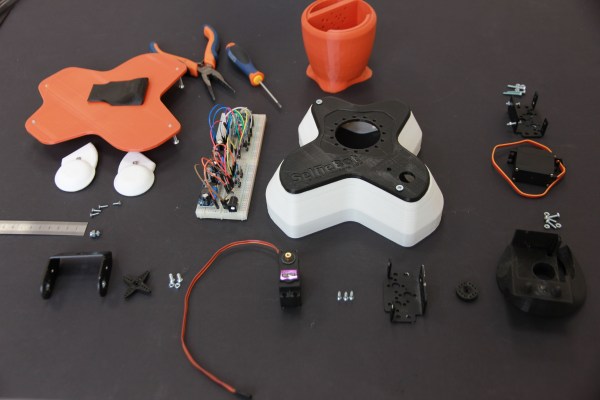
[Sergey Mironov] sent in his SelfieBot project. His company, Endurance Robots, sells a commercial version of the bot, which leads us to believe that in a strange and maybe brilliant move he decided to just sell the prototype stage of the product development as a kit. Since he also gave away the firmware, STLs, BOM, and made a guide so anyone can build it, we’re not complaining.

The bot is simple enough. Nicely housed hobby servos in a 3D printed case take care of the pan and tilt of the camera. The base of the bot encloses the electronics, which are an Arduino nano, a Bluetooth module, and the support electronics for power and motor driving.

To perform the face tracking, the build assumes you have a second phone. This is silly, but isn’t so unreasonable. Most people who’ve had a smart phone for a few years have a spare one living in a drawer as back-up. One phone runs the face tracking software and points the bot, via Bluetooth, towards the user. The other phone records the video.

The bot is pretty jumpy in the example video, but this can be taken care of with better motors. For a proof-of-concept, it works. A video of it in action after the break.

Continue reading “Hackaday Prize Entry: Selfie Bot Let’s You Vlog Hands Free”

Digital Opponent In An Analog Package

Unsatisfied with the present options for chess computers and preferring the feel of a real board and pieces, [Max Dobres] decided that his best option would be to build his own.

Light and dark wood veneer on 8mm MDF board created a board that was thin enough for adding LEDs to display moves and for the 10mm x 1mm neodymium magnets in the pieces to trip the reed switches under each space. The LEDs were wired in a matrix and connected to an Arduino Uno by a MAX7219 LED driver, while the reed switches were connected via a Centipede card. [Dobres] notes that you’ll want to test that the reed switches are positioned correctly — otherwise they might not detect the pieces!

Continue reading “Digital Opponent In An Analog Package”

Converting A Lawnmower Engine To Run On Compressed Air

Our most likely exposure to a steam engine these days will probably come courtesy of a railway locomotive. A machine capable of immense power and probably with significant complexity and engineering  in its construction, something the majority of us will only ever be able to see at second-hand. But there was a period when steam engines were much more accessible, before internal combustion engines and electric motors took on the task of automating hard work you would have found small stationary steam engines in all corners of industry.

These engines are on a scale much more easily embraced by hackers and makers, and though vintage stationary engines are thin on the ground these days there are a significant number of people pursuing their construction by converting modern petrol and diesel engines to a more old-fashioned medium.

[Lindsay Wilson] has a lawnmower engine which a few years ago he converted with the addition of a sleeve valve to run on compressed air. It’s not a steam engine because creating a safe and legal steam boiler is an expensive process, but despite this it amounts to the same thing. The engine in question is a small sidevalve single cylinder Suffolk Punch lawnmower engine from which he has removed and blocked the valve gear, and added a sleeve valve powered by a linkage from the crankshaft and using the spark plug hole as an inlet and outlet. He provides a lot of detail on the sleeve valve’s construction, and it really is a surprisingly simple arrangement. We might look for a harder metal than copper pipe for the guide in which it runs though.

The video below the break shows the engine being run up after a period of storage. It’s an effective device, easily capable of taking more air than his compressor can supply.

Continue reading “Converting A Lawnmower Engine To Run On Compressed Air”