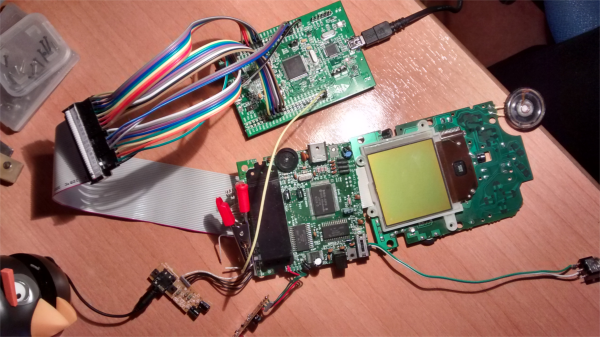
Phone Gyroscope Signals Can Eavesdrop On Your Conversations

A gyroscope is a device made for measuring orientation and can typically be found in modern smartphones or tablet PCs to enable rich user experience. A team from Stanford managed to recognize simple words from only analyzing gyroscope signals (PDF warning). The complex inner workings of MEMS based gyroscopes (which use the Coriolis effect) and Android software limitations only allowed the team to only sniff frequencies under 200Hz. This may therefore explain the average 12% word recognition rate that was achieved with custom recognition algorithms. It may however still be enough to make you reconsider installing an app that don’t necessarily need access to the on-board sensors to work. Interestingly, the paper also states that STMicroelectronics currently have a 80% market share for smartphone / Tablet PCs gyroscopes.

On the same topic, you may be interested to check out a gyroscope-based smartphone keylogging attack we featured a couple of years ago.

The Counter-Strike Airsoft Robot

F6R9THZHR4SR0HV.MEDIUM

[Jon] and his brother converted an RC car into a robot that can fire airsoft pellets into the air. The little motorized vehicle was disassembled and a handheld was attached to the top. A pulling mechanism was put in place and a safety procedure was added to make sure no accidents occurred.

The chassis stand was created to hold the handle. The setup was then tested at this point, and a Raspberry Pi server was configured to have a camera that would act as the eyes for the robot. Once everything was in place, the wheels hit the ground and the vehicle was able to move around, positioning itself to aim the servos at a designated target. Footage was transmitted via the web showing what the robot was looking at.

A video of the remote-controlled counter-strike robot can be seen after the break. You could consider this your toy army. That makes this one your toy air force.

Continue reading “The Counter-Strike Airsoft Robot”

FPGA With Open Source Propeller 1 Running Spin

fpga-running-p8x32a-and-sidcog

Open Sourcing something doesn’t actually acquire meaning until someone actually uses what has been unleashed in the wild. We’re happy to see a working example of Propeller 1 on an FPGA dev board. That link takes you to a short description and some remapping of the pins to work with a BeMicro CV board. But you’ll want to watch the video below, or rather listen to it, for a bit more explanation of what [Sylwester] did to get this working.

You’ll remember that Parallax released the Propeller 1 as Verilog code a few weeks back. This project first loads the code onto the FPGA, then proves it works by running SIDcog, the Commodore 64 sound emulation program written in Spin for p8x32a processors.

We do find this to be an interesting first step. But we’re still waiting to see what type of hacks are made possible because of the newly available Verilog code. If you have a proof of concept working on other hardware, certainly tell us about it below. If you’ve been hacking on it and have something you want to show off, what are you waiting for?

Continue reading “FPGA With Open Source Propeller 1 Running Spin”

Alphabet Clamps

Why Are We Limited To Just C-Clamps?

For decades, nay, centuries, we have been limited to the C-clamp, one of the most versatile, useful and perhaps most recognized tool. But why does C get all the glory? What of the other 25 letters?

People of my generation, my father’s generation, and my grandfather’s generations have clamped with one letter, and one letter only. But why C? And why now?

Here at Clamp-Co we thought we needed a change. So we set out to develop an entire line of Alphabet Clamps.

[Robb Godshaw] is the mastermind behind this revolution in clamping technology. Designed to German standards (DIN 1451), and made in America, the Alphabet Clamp set provides unrivaled clamping functionality for work in the industry, at the shop, or even at home. Perhaps the most functional previously unheard-of clamp is the U-Clamp, providing a deep throat for those extra hard to reach parts.

Continue reading “Why Are We Limited To Just C-Clamps?”

Lucid Dreaming With Plastic Milk Cartons

milk-carton-mask-layoutBeing aware that oneself is in a dream can be a difficult moment to accomplish. But as [Rob] showed on his blog, monitoring the lucid experience once it happens doesn’t have to be costly. Instead, household items can be fashioned together to make a mask that senses REM sleep cycles. We were tipped off to the project by [Michael Paul Coder] who developed an algorithm to communicate inside a dream.

[Rob] cut up plastic milk cartons for this ‘DreamJacker’ project and attached a webcam to produce a simple way to detect eye movements. A standard game adapter with a triangular array of white LED’s was added to the plastic cover in order to provide the necessary illumination needed for the camera. After testing it out, he switched to red light to balance sensitivity issues. Another iteration later and [Rob] attempted to create hypnagogic imagery during the drowsiness state that occurs right before falling asleep. He did this by fitting a single tri-color LED that he scrapped from Christmas lights that were dumped on his street.

The mask is tied to the back of the head with shoelaces, and acts like an eye patch during Wake Back to Bed sessions (WBTB). The end result produces an eerie looking graph of eye twitching taken throughout the night. We would be interested confirming that this setup helps the user experience a lucid dream, so it might be time to make our own.

Since writing his post, [Rob] has since adapted a mouse for use inside the mask cup to integrate with the LucidScribe REM FIELD-mouse plugin developed by [Michael Paul Coder].

Hackaday Retro Edition: Browser Wars On Solaris

sunn After seeing an earlier Hackaday post on old, old Unix systems loading up our retro edition, [Eugenio] decided he would play out the late 90s browser wars on a few machines of his own. Yes, it’s Internet Explorer vs. Netscape in a fight to the death. No <blink> or <marquee> tags were involved, but a Sun Ultra 5 was. We’re looking at the peak of the workstation world circa 1999 here, and only one browser would emerge victorious (it’s neither IE nor Netscape, btw).

The Solaris 9 system [Eugenio] has supports both Internet Explorer 5 and shipped with Netscape 4. Compared to the functionality of modern browsers, both IE5 and Netscape 4 are ancient and terrible. Remember kids, even the scroll wheel on a mouse is a relatively new invention.

Our retro edition doesn’t have any CSS, Javascript, or any of the new Web weirdness, so everything loaded as it should. One interesting problem [Eugenio] encountered was an inverse color desktop when the IE5 window was in focus. Bringing another window into focus returned the desktop to the right color. I guess Netscape wins the Solaris browser war.

[Eugenio] also dug out an old VT320 terminal and connected it to a Vaio x505 (the same approximate vintage as the Sun Ultra 5). This worked beautifully in both 80 and 132 column mode.

We’re always looking for new submissions of old computers loading up our retro site. We haven’t had many minicomputers loading the site, so dig out those Vaxxen and send something in.

Continue reading “Hackaday Retro Edition: Browser Wars On Solaris”

Kruger’s Zippo Remote

FWHLN99HZ2IV5DF.MEDIUM

Inspired by the detonator in the Captain America: The First Avenger movie, [Jon] modified a normal Zippo lighter to activate a relay on a receiver module. His instructables shows how to create such a device by adjusting the insert in such a way that if someone flipped it open, all they would see would be a flint wheel, flint, wick, and all that stuff; nothing would be abnormal. In order to do this, the components would have to be perfectly concealed.

To acquire a remote signal, [Jon] used the whole metal case as an antenna instead of replacing the wick with one. An antenna pin on an RF module was attached to the insert to get the necessary effect. The flint wheel was then turned into a button and a notification LED was installed. Once the code was uploaded and a receiver module was fashioned together, the end product produced a flash of sparks on the other end.

This hack was made for educational use, and is only meant for demonstration purposes.

Continue reading “Kruger’s Zippo Remote”