Tie Tack Sends Morse Code Seasons Greetings

morse-code-tie-tack

For [Davide Gironi] made a holiday tie tack this year. It’s not made to look like Santa Claus, Frosty, or a Christmas tree. He simply wishes you a Merry Christmas (‘Buon Natale’ in Italian) by flashing the message in Morse code.

Two LEDs have been added to a plain tie tack. It is tethered to the logic circuitry that provides power and drives the red and blue lights accordingly. As you can see in the video after the break, red signifies the end of a letter, and long or short blue flashes correspond to dashes or dots. This doesn’t require much horsepower so he’s gone with an 8-pin ATtiny13 microcontroller (you might be able to find one of these in a light bulb if you look hard enough). The rest of the equipment includes a few resistors, a push button, and a coin cell for power. [Davide] uses a byte-packing technique he learned from a different project to store each letter as an 8-bit packet which means there’s plenty of room to store your message in the chip’s memory.

Continue reading “Tie Tack Sends Morse Code Seasons Greetings”

Web-based TI Graphing Calculator Emulator

You can leave the TI graphing calculator at home thanks to this web-based TI-83 and TI-84 emulator. As with pretty much all emulators, this depends on a ROM image from the actual hardware to work. But if you have one of the supported calculators (TI-83+, TI-83+ SE, TI-84+, or TI-84+SE) you can dump the image yourself and this should work like a charm.

[Christopher Mitchell] calls the project jsTIfied because he wrote it in JavaScript and HTML5 (that’s where the js comes from) and it’s based on the Texas Instruments line of hardware (hence the capital TI). After agreeing that you’re not getting any ROMs from his site you can choose the file to load on your browser. The image of the calculator has working buttons and will show the boot screen just like the real thing. You can use it like normal but you can load load up programs for the environment. See this demonstrated after the break.

We’ve seen some arguments online about the price of the TI line over the years. Prices haven’t dropped much over the decades even though they’re making pretty much the same hardware. It’s cool to see someone figure out how to emulate the hardware — and on a web interface to boot! But we’re left wondering why TI isn’t selling an equivalent app for iOS and Android or at least leveraging what must be millions in each production run for a lower retail price?

Continue reading “Web-based TI Graphing Calculator Emulator”

Sump Pump Monitor Emails And Raises Alarm If Water Rises

sump_pump_overview

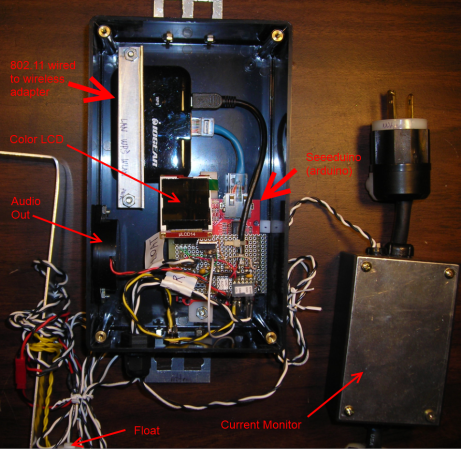
[Matt] literally finds himself in a sticky situation. There’s an oil slick in his sump well. These wells work in conjunction with drain tiles to pump water away from the foundation of a house. Unfortunately the tar that was used to waterproof the outside of his foundation is also washing into the sump and gumming up the works. The system he built will sound an audio alarm and send an email if something goes wrong with the sump pump.

He’s monitoring for two different issues. One technique uses a float valve to sense if the water is too high, signalling that the mechanism controlling the pump has malfunctioned. The other is a current monitor that senses if the sump pump has been running too long (caused by the sump’s water sensor getting stuck in the on position). The one thing he didn’t want to do is control the pump directly as a bug in his code will easily result in a flooded basement. We have the same concerns when considering building a DIY thermostat (an error there could mean frozen water pipes leading to flooding).

Solar Powered Wifi Radiation Sensor

Solar Radiation Detector

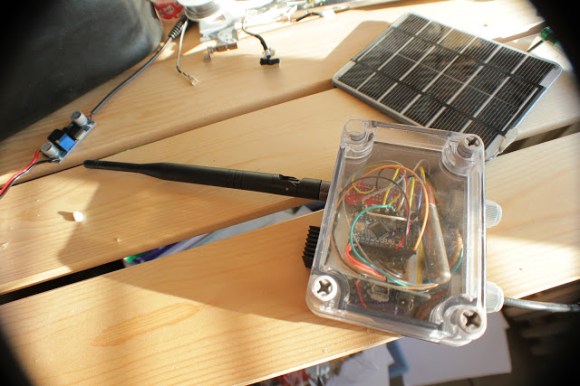
[Manish] packed lots of functionality into this radiation sensor module. The device is completely solar powered and weatherproof, so it can be mounted anywhere. It uses a Geiger Muller tube to monitor radiation and connects to the internet using wifi network to report the readings.

The design uses an Arduino Pro Mini to perform the monitoring and reporting. Wifi connectivity is provided by a RN-XV wifi module. A solar panel, Adafruit’s solar charger, and a LiPo battery are used to provide power to the device. It’s enclosed in Adafruit’s IP-66 rated weatherproof enclosure.

A custom Geiger Muller tube interface is used to interface with the tube. The interface is simple and cheap. It provides the high voltage required to drive the tube, and circuitry needed to detect the ionization events.

Once the device is connected to the internet, it uploads data directly to Cosm. This service lets the data be shared using Twitter, or accessed using an API. The project shows how to build a wireless networked sensor that directly connects to the internet for about $100.

An Absurdly Clever Thermal Imaging Camera

Thermal imaging cameras, cameras able to measure the temperature of an object while taking a picture, are amazingly expensive. For the price of a new car, you can pick up one of these infrared cameras and check out where the drafts are in your house. [Max Justicz] thought he could do better than even professional-level thermal imaging cameras and came up with an absurdly clever DIY infrared camera.

While thermal imaging cameras – even inexpensive homebrew ones – have an infrared sensor that works a lot like a camera CCD, there is a cheaper alternative. Non-contact infrared thermometers can be had for $20, the only downside being they measure a single point and not multiple areas like their more expensive brethren. [Max] had the idea of using one of these thermometers along with a few RGB LEDs to paint different colors of light around a scene in response to the temperature detected by an infrared thermometer sensor.

To turn his idea into a usable tool, [Max] picked up an LED flashlight and saved the existing LED array for another day. After stuffing the guts of the flashlight with a few RGB LEDs, he added the infrared thermometer sensor and an Arduino to change the color of the LED in response to the temperature given by the sensor.

After that, it’s a simple matter of light painting. [Max] took a camera, left the shutter open, and used his RGB thermometer flashlight to paint a scene with multicolor LEDs representing the temperature sensed by the infrared thermometer. It’s an amazingly clever hack, and an implementation so simple we’re surprised we haven’t seen before.

Accurate Timers With An AVR

timer

An awful lot of microcontroller projects use timers to repeat an action every few minutes, hours, or days. While these timers can be as accurate as a cheap digital wrist watch, there are times when you need a microcontroller’s timer to measure exactly, losing no more than a few milliseconds a day. It’s not very hard to get a timer to this level as accuracy, as [Karl] shows us in a tutorial.

The problem with keeping time with a microcontroller has to do with the crystal, clock frequency, and hardware prescalers of your chip of choice. [Karl] started his project with an ATMega168 and a 20 MHz crystal and the prescaler set at 256. This made the 78.125 interrupts per second, but the lack of floating point arithmetic means one second for the microcontroller will be 0.9984 seconds to you and me.

[Karl]’s solution to this problem was to have the ATMega count out 78 interrupts per second for seven seconds, then count out 79 interrupts for one second. It’s not terribly complicated, and now [Karl]’s timers are as accurate as the crystal used for the ‘168’s clock.

Tentacles And Phalanges Made From Drinking Straws

arnie

He human hand is one of the most impressive pieces of machinery – biological, mechanical, or otherwise – that you’ll ever lay eyes on.  With two dozen degrees of freedom, the hand can gently caress the most fragile flower petal without bruising it, or beat a hammer into an anvil with tremendous force. Simulating the human hand, however, is quite a challenge that requires dozens of servos and complex mechanical linkages. [Tomdf] over on Instructables is able to create hands, tentacles, and other weird biological contraptions using spring-loaded drinking straws and custom-made 3d printed joints.

[Tomdf] got the idea for drinking straw phalanges after seeing a few 3D printed drinking straw connectors meant to be used for creating 3D objects out of disposable plastic tubes. After designing a new spring-loaded joint for drinking straws, [Tomdf] is able to add a few lengths of thread to serve as ligaments to control the segments of drinking straws. It’s a similar setup to the horrible demon spawn we saw at Maker Faire last year, but far more extendable for any project that might pop into your head.

You can check out the drinking straw tentacles in action after the break.

Continue reading “Tentacles And Phalanges Made From Drinking Straws”