An Interview With Laen (the Force Behind Dorkbot PDX)

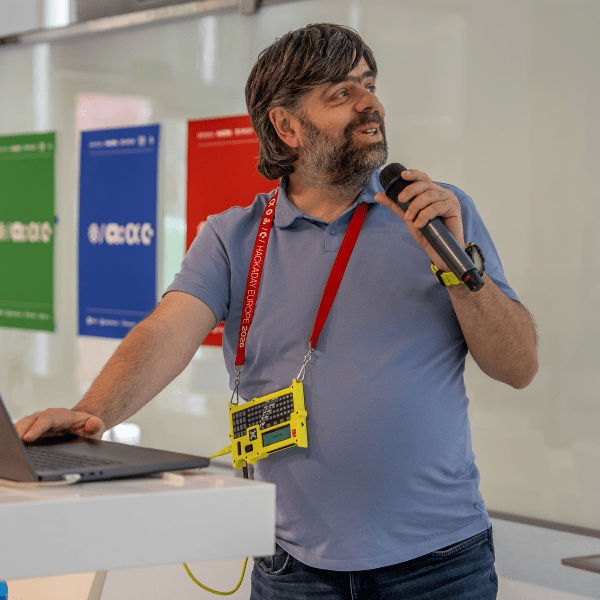
[PT] recently interviewed [Laen], the man who makes it cheap and easy for hobbiests to have small PCBs manufactured. He created Dorkbot PDX’s PCB group order, a rapid turn PCB service which we see used in projects all the time (pretty much any purple PCB has gone through [Laen]).

Turns out his real name is [James Neal]. He’s a sysadmin by trade but deals in recreational circuitry at night. We were surprised to learn that the service has been rebranded. Its new name is OSH Park and it’s got a purple website with a new submission system. In the interview he discusses the genesis of the service. Inspired by a group parts order (that’s a mouthful!) with other hackers in Portland he saw a need for boards on which to mount them. The service has grown so much that he was spending 2-4 hours per night panelizing the designs. He made the wise choice to include an automated submission service in the new website that takes care of most of this work for him.

The rest of the interview spans a large range of topics. [Laen] shares his feelings on getting the boards manufactured domestically. He speaks briefly on the future of the service, and riffs on why open source hardware has value to him.

Quadrotor Opera Begs For Lasers And Pink Floyd

In case quadrocopters aren’t cool enough, here’s an orchestrated quadrotor light show that was shown at the Cannes Lions International Festival of Creativity this last week. With 16 quadrotors and a few can lights, it’s a light show not to be missed.

This quadrotor show was created by a collaboration between KMel robotics and Marshmallow Laser Feast. The guys behind KMel are the same brilliant minds behind this nanocopter swarm that can play the [James Bond] theme. For this light show, the guys at KMel Robotics used a Vicon motion capture system to coordinate the flock of quadrotors, as seen in this picture.

With a servo-controlled mirror on the bottom of each quatrotor, each vehicle in the fleet is able to reflect beams of light around the stage and into the audience. Now it’s only a matter of time until a setup like this is used for a showing of Laser Floyd.

Tip ‘o the hat to [cesar] for sending this one in. Via IEEE Spectrum.

Edit: They’re not can lights. After watching in 1080p, [Impulse405] is pretty confident they’re High End studio spots or a wash with a tight focus. Thanks for keeping us honest, [Impulse405]!

Resurrecting A PS3 Controller That Won’t Charge

[SJM4306] grabbed a used PlayStation 3 from a game store that was going out of business. He got a pretty good deal on what had obviously been the floor model for a number of years. The one real problem was the controller that came with it. The thing was so filthy that he literally used gloves to disassemble and sanitize it. It worked just fine after that,until he discovered that it wouldn’t charge from the USB port as it’s supposed to. But he managed to replace the charging circuitry with some of his own.

When cleaning the insides of the controller he found there were numerous deposits of sludge which he attributes to spilled soda. This must have damage one of the chips responsible for charging because he was probing an unstable 2V rather than the regulated 5V which should be coming in on the USB lines. His solution was to desolder the USB port in order to separate its 5V pin from the PCB. He then etched a tiny board to host a MAX1555 charging IC. With the new hardware in place the controller is back in action.

Using An HD44780 Character LCD With The Raspberry Pi

[Tech2077] is one of the lucky ones who already got his hands on a Raspberry Pi. He’s been looking into different interface options with the GPIO header and just posted a guide to using an HD44780 character display with the RPi. We like this approach because instead of doing some hard-core LCD work he’s using prototyping equipment you probably already have on hand.

Getting a character LCD running should be really simple. The gotcha is the logic level gap between the devices. If you’ve been working with Arduino, your add-ons are probably meant for a 5V power rail  and logic levels. The RPi outputs 3.3V logic. You could use a level converter (you’d need at least 7 pins to be converted in this case) or you can be a bit more clever. [Tech2077] grabbed an I2C port expander that uses just 2 of the RPi lines to address even lines of the display (four data bits plus three control bits). This is a bit of a hack, as the 3.3V logic is 0.2V below the recommended minimum for a digital 1 on the port expander. But it seems to work just fine! If it didn’t, a couple of NPN transistors would do the trick as well.

Addressing the new peripheral is just a matter of loading the i2c module and writing some Python.

Building A Pick And Place With 3D Printed Parts

For the last few months, [HeliumFrog] has been building a SCARA bot to serve as the basis for a pick and place machine. Somewhat amazingly, this is the first robot of its kind to be printed on a 3D printer.

A SCARA-type robot is an articulated arm perfectly suited for transferring components from tubes and reels to a PCB. [HeliumFrog] began his build with an arm with large gears in joints driven by stepper motors and toothed belts. The Z axis was originally driven with a lead screw, but after a thoughtful redesign that was changed over to another toothed belt.

We’ve seen our share of DIY pick and place machines, but most of those have been based on a traditional X/Y Cartesian frame. [HeliumFrog]’s SCARA bot should be – theoretically, at least – faster and more accurate while taking up a smaller footprint in the workshop.

[HeliumFrog] is more or less done with the basics of his build, and is now moving on to building a plastic extrusion tool head for his SCARA bot. Very cool, and should make this robot capable of self-reproduction for under £400 (~$600).

You can check out a video of this articulated arm bot after the break.

Thanks, [Kyle] for sending this one in.

Continue reading “Building A Pick And Place With 3D Printed Parts”

MakerFaire K.C.: Incredible Wasp Wings

First off let me say that the Redbull contest has consumed ALL of my time and I haven’t been able to get these Makerfaire coverage posts out as quickly as I’d hoped. Please be patient, there are several more to come I promise.

As I was walking around, I glanced up and saw a really cool set of wasp wings on a mannequin flapping away. The motion was quite nice, but I was really blown away when they folded down to a different position when not in use. I managed to track down the creator at the even and asked him some questions.

[Jordy] was commissioned to build these as part of a costume. He started by just googling ornithopter designs and ended up coming up with a rather nice contraption. Many of the bits are 3d printed specifically to his needs, including the drive gears. This must have saved tons of time and effort. As you can see in the video after the break, the motion is really nice and the fact that they fold down is really cool.

Continue reading “MakerFaire K.C.: Incredible Wasp Wings”

VGA Message Board Displays SMS Without A Computer

[Achu Wilson’s] latest creation is a VGA message board which is written to via SMS text messages. This doesn’t sound too interesting at first, until you find out he’s doing this with a microcontroller rather than a PC. All of the complexity is in the code that drives the VGA. He managed to do it without any jitter while using an 8-bit microcontroller.

But first, the cellular side of things. A GSM modem takes care of connectivity. To communicate with the modem [Achu] used an ATmega8. He mentions the he could have used a much smaller uC, like an ATtiny, but this is what he had lying around. When a message is received the ATmega8 feeds the characters to an ATmega16 which is driving the VGA monitor. Rather than deal with the analog voltages necessary to run a color display he simply ganged the three color lines together and drives them from one of the microcontroller pins. This results in white and black which correspond to voltage or no voltage.

You can see him showing off the system in the clip after the break.

Continue reading “VGA Message Board Displays SMS Without A Computer”