Forever.fm: Infinite Beat-matched Music

Forever.fm is [Peter]’s combination of SoundCloud and The Echo Nest that plays a continuous stream of beat-matched music. The result is a web radio station that just keeps playing.

[Peter] provided a great write up on how he built the app. The server side is Python, using the Tornado web server and Tornadio2 + Socket.IO for handling live updates in the client. To deal with the challenge of streaming audio, he wrote a LAME interface for Python that handles encoding the raw, beat-matched audio into MP3 blocks. These blocks are queued up and sent out to the client by the web server.

Another challenge was choosing songs. Forever.fm takes the “hottest” songs from SoundCloud and creates a graph. Then it finds the shortest path to traverse the entire graph: a Travelling Salesman Problem. The solution used by Forever.fm finds an iterative approximation, then uses that to make a list of tracks. Of course, the resulting music is going to be whatever’s hot on SoundCloud. This may, or may not, match your personal tastes.

There’s a lot of neat stuff here, and [Peter] has open-sourced the code on his github if you’re interested in checking out the details.
The New Template Has Arrived!

When we decided that our template needed a remake several years ago, we knew it was going to be a long and difficult process. We offered you a chance to give us some input in a recent post and now we are releasing the first iteration of the new template.

For those that saw the mockups and gave us your opinion, you will be happy to see we actually listened to many thoughts and incorporated them in our final design.  We worked with some people at Google to determine what features should be tossed and what to keep, and what we have ended up with, is what you see. We also acknowledge that not everyone will love the change, but we feel it is a move in the right direction. We’re really happy how it has ended up.

I want to offer a special thanks to [Stephanie Froehner] who put tons of time into making this template pretty, even if it has been hacked and slashed a bit since then.

Join me after the break for an explanation of some of the new features and upcoming features.

Continue reading “The New Template Has Arrived!” →

Large Area X-ray Detector

This is an x-ray detector built by [Ben Krasnow]. It’s an interesting combination of parts working with an oscilloscope. The result is an audible clicking much the same as you would hear from a Geiger counter

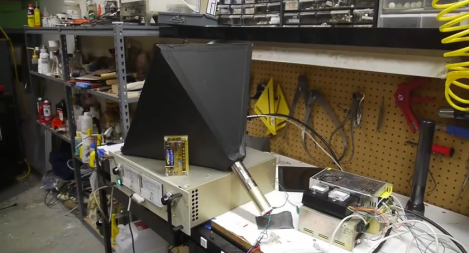
He’s measuring backscatter, which is the reflection of x-rays on other objects. Because the signal will be quite weak compared to waves emitted directly from an x-ray source he needed a large collector to measure them. He started by gutting an x-ray image intensifying cassette. This has a phosphor layer that glows when excited by x-rays. The idea is that the glowing phosphors do a better job of exposing film than direct x-rays can. But [Ben’s] not using film. He built that pyramid-shaped collector with the phosphor material as the base. At the apex of the pyramid he mounted a photomultiplier tube (repurposed from his scanning electron microscope) which can detect the excited points on its surface. His oscilloscope monitors the PMT, then issues a voltage spike on the calibration connector which is being fed to an audio amplifier. Don’t miss his presentation embedded after the break.

[Ben] mentions that this build is in preparation for a future project. We’d love to hear what you think he’s working on. Leave your guess in the comments section.

Continue reading “Large Area X-ray Detector” →

Python Script Lets You Monitor Multiple Serial Devices At Once

Not knowing what’s going on inside of your electronics projects can make it quite difficult to get the bugs out. [John] was bumping up against this problem when working on wireless communications between several devices. At just about the same time his friend came up with a script with lets you monitor multiple serial devices in one terminal window.

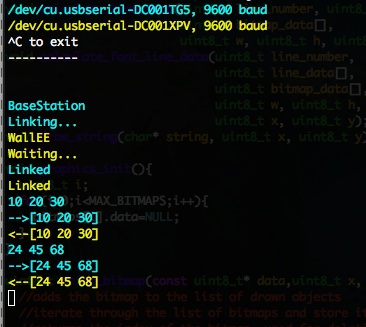
We’re used to using minicom, a Linux package that does the job when working with serial connections of all kinds. But [John] is right, we’re pretty sure you can only connect to one device per minicom instance. But [Jim’s] Python serial terminal (available in this git repository) allows you to specify multiple devices as command line arguments. You can even use wildcards to monitor every USB connection. The script then automatically chooses a different color for each device.

The image above is from [John’s] wireless project. Even without any other background this shows how easy it is to debug this way rather than tab back and forth between windows which gets confusing very quickly.

POV Wheels For A Longboard

If you don’t mind working with really small components this POV wheel project for a longboard will certainly attract some attention.

The name of the game here is small and cheap. Small because the wheels are only 72mm in diameter (about 2.8 inches). Cheap because [Ch00f] wants to produce and sell them locally. He went with an ATtiny24 microcontroller driving fifteen LEDs. Obviously this will present a problem as the uC uses a 14-pin SOIC package and that’s just not enough I/O to drive the LEDs individually. Add to that the issue of storing patterns to be displayed and you start to run out of program memory very quickly.

But obvious he pulled it off. The image above shows the wheel displaying the CT logo (for ch00ftech.com) and there are several other patterns shown off in the clip after the break. The LEDs are multiplexed, but the wheel spins fast enough that this turns out to be okay. The rotation is measured by an IR reflectance sensor aimed at the stationary axle. A CR2032 powers the device, with some counterweights added to keep the wheel balanced.

Our only concern is the fragility of the exposed electronics. But if you hit the right BOM price we guess you can just replace the board as needed.

Continue reading “POV Wheels For A Longboard” →

Raspberry Pi Driven Polargraph Exhibits High Precision Drawing Ability

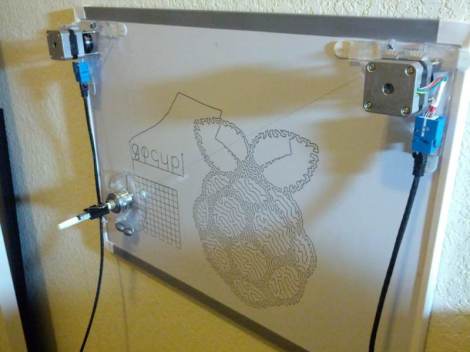
This polar graph draws some amazing shapes on a dry erase board. Part of that is due to the mounting brackets used for the two stepper motors and the stylus. But credit is also due for the code which takes velocity into account in order to plan for the next set of movements.

The Go language is used to translate data into step commands for the two motors. This stream of commands is fed over a serial connection between the RPi board and an Arduino. The Arduino simply pushes the steps to the motor controllers. The inclusion of the RPi provides the horsepower needed to make such smooth designs. This is explained in the second half of [Brandon Green’s] post. The technique uses constant acceleration, speed, and deceleration for most cases which prevents any kind of oscillation in the hanging stylus. But there are also contingencies used when there is not enough room to accelerate or decelerate smoothly.

You can catch a very short clip of the hardware drawing a tight spiral in the video embedded after the break.

Continue reading “Raspberry Pi Driven Polargraph Exhibits High Precision Drawing Ability” →

AVR Minecraft Server Lets You Toggle Pins From The Virtual World

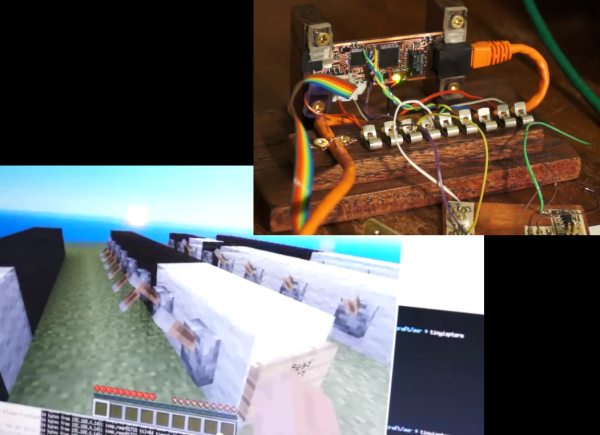
Wanting to test his skills by building a webserver [Cnlohr] decided to also code a Minecraft server which allows him to toggle pins from inside the game. The rows of switches seen above give him direct access to the direction register and I/O pins of one port of the ATmega328.

The server hardware is shown in the image above. It’s hard to tell just from that image, but it’s actually a glass substrate which is [Cnlohr’s] specialty. He uses an ENC424J600 to handle the networking side of things. This chip costs almost twice as much as the microcontroller next to it. But even in single quantities the BOM came in at under $20 for the entire build.

In the video after the break [Cnlohr] and a friend demonstrate the ability for multiple users to log into the Minecraft world. The simulation is fairly bare-bones, but the ability to affect hardware from the game world is more exciting than just pushing 1s and 0s through some twisted pairs.

Continue reading “AVR Minecraft Server Lets You Toggle Pins From The Virtual World” →