Yet Another PCB Quadcopter

Like most people out there, we’re fascinated by these little buzzing and hovering quadrotors. We’ve really enjoyed the recent trend of miniaturizing them and using PCBs as the frame itself. As [scolton] points out in his instructible, his isn’t the first, the smallest, or the lightest, but he does have some great information and a few tricks up his sleeve that make this a fun project to check out. The 4pcb measures 6.5 inches from motor shaft to motor shaft diagonally. It weighs 138 grams and, with its current batteries,can fly for roughly 8 minutes.

A nice thing about the 4pcb is that it includes brushless motor drivers into the design. Apparently that isn’t very common. What we really like though is the massive amount of reference material [scolton] provides. Not only could you download everything necessary to recreate his work, he links to so many other projects and resources you could probably expand in any direction your heart desires. If you’re considering a quadcopter build in the near future, you might want to bookmark this one.

Continue reading “Yet Another PCB Quadcopter”

The Dronitar; A Scrap Made Motorized Sitar

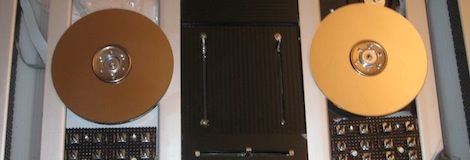
This peculiar instrument, called the Dronitar,  is completely made from scrap. Interestingly, it sounds pretty good. You can hear the dronitar in action in the video after the break.The call this a  “2 stringed” instrument,and most who are instrumentally savvy will find a bit of confusion here. They are referring to the string that you play as well as a small string that is struck against the other by a motor to create the droning effect. The result sounds very much like a sitar mixed with a bit of surfer rock styling.  You’ll note that they’re even using a second motor as the pickup!

Continue reading “The Dronitar; A Scrap Made Motorized Sitar”

LayerOne Badge Hacking Twofer

Here’s a pair of LayerOne Badge hacks that actually included the RC as intended by the badge designers.

First up, we have the autonomous RC car built by [Arko]. He calls it Stanley Jr. as an homage to the Stanford DARPA Grand Challenge vehicle. It uses an Arduino shield to add a servo with an ultrasonic rangefinder on it. The lets the vehicle drive a bit, stop and scan the horizon, then drive some more. The hope is the rangefinder will keep it from running into anything. There’s a quick test run embedded after the break.

On the right is the badge hack which [Zjpahle] finished up after the contest was already over. He also chose to go with an Arduino shield, this time it’s an IMU board. But he added a standalone Arduino board to the vehicle which drives some EL wire (ground effects) and adds IR sensors to the front of the car. The IR sensors are for obstacle avoidance, and the IMU lets him tilt his badge for direction control.

We looked at the winner of the badge hacking competition on Wednesday. That hack didn’t involve the car, but used the badge as a Morse Code beacon.

Continue reading “LayerOne Badge Hacking Twofer”

Catch Neighborhood Speeders With Your Webcam

[John] is keeping the neighborhood safe by keeping an eye out for speeders. Well, he’s really keeping a webcam out for speeders. His technique doesn’t use radar or lasers. He’s processing webcam frames in Python to calculate speed.

It comes down to some basic image manipulation. He firsts gathers the images necessary to make the calculations by using a motion-detecting webcam program called YawCam. The images are analyzed to establish which parts have changed between frames; this gets rid of all the stationary objects. Now the frames can be compared to establish the distance in pixels. By calibrating the shot through measurements of the target area, this data can be directly converted into actual distance. It is then compared with the timestamps from each frame to arrive at speed. This can be used for vehicles on the street like we see above, or more whimsical measurements like pet turtle progress.

ATtiny85 Sketch Flashing Rig

We’re happy to see Arduino enthusiasts championing the use of smaller hardware when the need for a full-blown ATmega-based board just isn’t there. [Chris] has been doing just that, using ATtiny85 chips in his projects. But he’s tired of hooking jumper wires to flash the sketches. He finally got around to etching this ATtiny85 programming adapter.

If the project is not pin hungry, an ATtiny85 can run Arduino sketches without the need to port the code. The best news is that the Arduino board you used to prototype the project can be used as the programmer for the standalone chip. Here that’s a Boarduino, and [Chris] laid out a double row of female pin headers for quick plug-in. To the right you can see the DIP socket for the target chip. Although this works perfectly well, we would have liked to also see the inclusion of a 2×3 AVR ISP programming header which could be used with the full range of AT chips.

Hackerspace Intros: Freeside Hackerspace In Atlanta Georgia

When I announced that I would be traveling through some areas of the southeast this summer, [Slade] from Freeside Atlanta emailed me to set up a stop at their hackerspace. I am very happy he did too, because this place was really cool. [Steven Sutton] agreed to walk us through the facility and did a great job of being the tour guide.

Continue reading “Hackerspace Intros: Freeside Hackerspace In Atlanta Georgia”