A Wireless MAME Coffee Table Controller

MAME coffee table plan

Although we’ve featured quite a few MAME controllers here, we thought we’d feature one more. It’s only a well-drawn mechanical plan at this point, but if the results are anything like the model or detail drawing, we will be quite impressed.

One thing that is of particular interest is the planned parts list. Amongst them are the typical joysticks, buttons, and even a trackball. What may be new to some of our readers is the bluetooth arcade controller by [Wayne and Layne] opensource hardware kits. Although they aren’t cheap at just under $80, and requre an Arduino Mega for use, this is nonetheless an interesting control option. The maximum button presses may be another limiting factor at 6, but it should be a cleaner solution than cannibalizing one or more wireless controllers.

Of course, we’d be negligent if we didn’t at least give you a link to a completed MAME controller. Be sure to feast your eyes on these images if you’d like some finished controller eye candy or check out the pic after the break!

Continue reading “A Wireless MAME Coffee Table Controller”

Excavate Your Basement Using RC Equipment

basement excavation

Although it could be debated as to whether or not this is a “hack,” since the equipment used is built for excavation, the scale of it seems deserving of a mention. In the linked article, [Joe] is quoted as saying, “the common misconception here is that the RC’s are not here to excavate my basement, but rather the basement excavation project is here for the RC’s.”  This could be a motto for most makers/hackers in that projects are frequently not done for the resulting product, but for the experience of making something your own.

According to [Joe], he excavates 2 – 3 cubic yards per year with his little RC vehicles.  Living in Canada as a rancher and farmer, he’s required to be near his home to feed his hungry animals even during the cold winter months. During this time, there can be very little to do. After sometimes working 16 hour days during the summer, he needed something to keep him occupied close to home. Be sure to check out the excavation video after the break, or check out the original article for even more pictures and video! Continue reading “Excavate Your Basement Using RC Equipment”

The Minotaur’s Revenge: Dueling Labyrinths

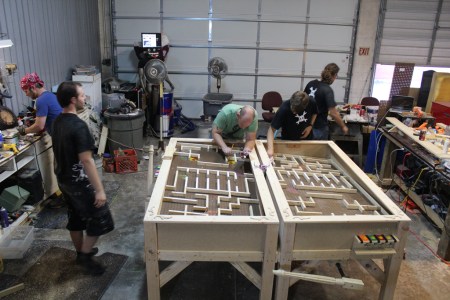
In case you hadn’t noticed, we participated in a contest recently. The RedBull Creation contest. The basic idea was that they gave us 72 hours to build something based on a theme. The whole thing would be streamed live as the 12 teams competed. The theme was “game of games” and the rules were pretty basic. It had to be a game with a clear winner (nothing too general), it had to be safe, and it had to fit in their shipping container.

Our project is called “the minotaur’s revenge”, and is basically a set of dueling labyrinths. A pair of giant tilting mazes that have to be controlled while attempting to trigger traps on your opponents table. We knew that watching us screw some wood together for 3 days would be painfully dull, so we put extra effort into keeping our feed amusing. We had scheduled events like a fire breather, grafitti artists, people in costume, and strange things happening all the time. We took time to answer questions and converse with our watchers. It paid off, our feed was usually host to double the viewers of any other feed.

Keep reading for a full writeup on how everything was made, along with a ton of pictures and some video.

Continue reading “The Minotaur’s Revenge: Dueling Labyrinths”

Only You Can Kick A Child’s Balls Into Space

We had a lot of fun with that title. Of course when you’re talking about launching a thousand ping pong balls into space there’s no end to the puns which can be made. But this is actually a fantastic initiative to get people of all ages excited about science and near-space experiments. [John Powell] offers school children the opportunity to send an experiment into space. He’s Kickstarting the next launch, which is scheduled to take place in September. This way each entrant can fly their project for free, then get the results and a certificate back once the weather-balloon-based hardware is recovered.

There is one size restriction for the program. Each experiment must fit inside of a ping pong ball. But you’ll be surprised what can be accomplished. [John] reports that the most simple, yet interesting project is to place a small marshmallow inside the ball. As it rises through the atmosphere it will grow to fill the entire ball, then be freeze-dried by the the extreme temperatures. Some are not so low-tech. There’s an image of a tiny PCB holding a DS1337 and some sensors. It’s an atmospheric data logger that will provide plenty of information to analyze upon its return.

[via Hacked Gadgets]

Decoding NOAA Weather Radio With An Arduino

The National Oceanic and Atmospheric Administration is responsible for broadcasting the signals used in weather radios. They use a protocol called Specific Area Message Encoding (SAME) and [Ray Dees] recently published an Arduino library that lets you decode the SAME message packets.

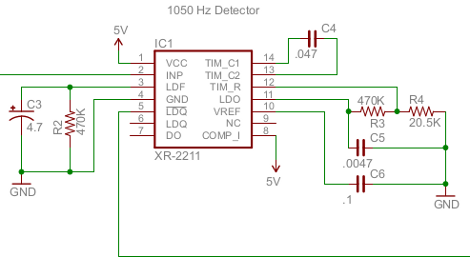
He doesn’t provide a method of tuning the radio signal, but at first you can use the audio samples he points to. The actual broadcasts happen on one of seven frequencies between 162.400 MHz and 162.550 MHz but the tones are also broadcast on TV and Radio alerts. Once you have the audio it is fed into a pair of XR-2211 Tone decoders. This provides just three interface pins for the Arduino to watch.

The annoying noise that grabs your attention at the beginning of a weather alert, or test of the alert system is actually what the SAME data packets sound like. From those tones this system will be able to decode what type of alert is being issued, and the geographic locations it affects. If you interested in more info about SAME head over to the Wikipedia article on the topic.

Bending A Home Security Control Panel To Your Will

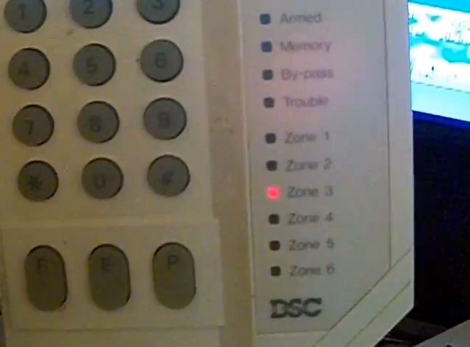
Does your home have a security system but you don’t subscribe to the monitoring service to make it work? Rip that baby off of the wall and do something with it, or just build your own system around it. If you have a DSC PC1500RK control panel [CaitSith2] shows us how easy it is to control the buttons, LEDs, and buzzer. If you’ve got a different model this is still a good jumping off point to start your own reverse engineering.

There are only four connections that need to be made. [CaitSith2] is using an Arduino for the demonstration. He connected the red wire to voltage, the black wire to ground, the yellow wire (clock) to digital pin 3 and the green wire (data) to digital pin 2. A communication cycle starts by setting the data line high, then clocking out eight bits to capture keypresses. 16-bits are then clocked in to set the LEDs and drive the buzzer. This is shown in the video after the break as well as documented in his sample code. We’ve embedded the sketch after the break to preserve it in case the pastebin code goes missing in the future.

Continue reading “Bending A Home Security Control Panel To Your Will”

Building A Coffee Roaster From Junk

[Rxdtxd] has tried his hand at roasting coffee beans in a frying pan. It works but he can only roast small batches at once. What he really needed was a large-scale roaster that would have no problem with a few pounds of the green beans all at once. He ended up building this large-scale coffee roaster out of junk parts.

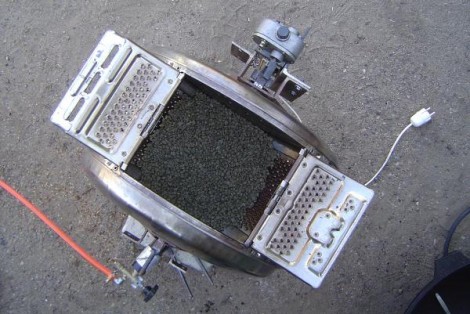
The vessel which holds the beans is the drum from a top-loading washing machine. It was headed for the junk pile, but the fully-enclosed drum is perfect for this purpose. After acquiring it [Rxdtxd] set out welding a frame that would hold either side by the pivot points. He used a geared motor to automate the process. The output shaft on the gear box is meant to drive a chain, but he just welded some pieces onto the gear to use as a coupling.

In the picture above he’s giving the roaster a thorough testing with about ten pounds of beans. A portable gas stove placed below the rotating drum supplies the heat. After the beans have reached the desired darkness he pours them out into a large skillet to cool. Take a peek at the roasting action in the clip after the break.

Continue reading “Building A Coffee Roaster From Junk”