USB Dongle Generates And Enters Your Passwords So You Don’t Have To

usb-password-dongle

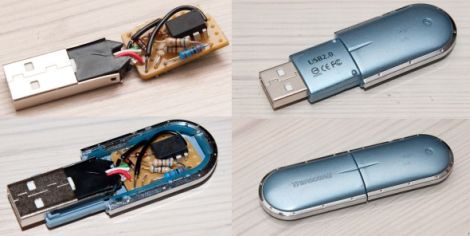
Like many businesses out there, [Joonas Pihlajamaa’s] employer requires him to change his password every few months. Instead of coming up with a complex, yet easy to remember password again and again, he built a small USB device to do the work for him.

He dismantled an old USB memory stick, fitting it with an ATtiny85 with its required components on a small piece of perfboard. Using the knowledge he gleaned from his previous USB HID tinkering, he programmed the ATtiny to act as a USB keyboard which enters his password for him whenever he plugs it in.

The USB dongle not only types his password in for him, it can generate a new password with a few simple keystrokes whenever he desires. Obviously it merely takes someone getting their hands on his USB stick to compromise security, but it does beat a Post-It under the keyboard any day.

Continue reading to see a short video of his USB password dongle in action, and be sure to swing by his site for more details on how it was all put together.

Continue reading “USB Dongle Generates And Enters Your Passwords So You Don’t Have To”
Antique Phone Provides A Soundtrack Perfect For Restoring Old Cars

crank-phone-music

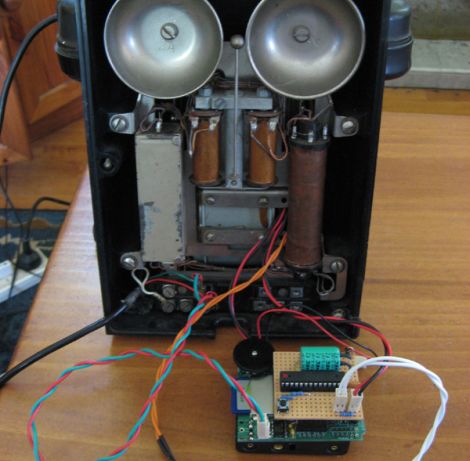
[Simon] is in the middle of restoring/building himself an Austin 7 Special out in his garage, and like most tinkerers, found that music helps to move the process along. He happened to have an old Bakelite generator phone out in the garage as well, and figured that he might as well have it do something other than simply hang on the wall.

Playing music from the 1930 seemed like a fitting enough task, so he picked up an Adafruit Waveshield and spent some time wiring it up to the old telephone. His new radio works simply enough, piping .wav files through the handset, provided someone has cranked the phone’s generator recently.

While cranking the generator is required to play music, the Arduino is actually powered off a pair of AA batteries. The cranking is all cosmetic, but he did program the Arduino to slow the music down every once in awhile, requiring that the generator be turned to get things back up to speed.

It really is a neat way to repurpose the old phone, and we like the fact that [Simon] did not gut it to put this project together.

Continue reading to see a short video of his new music player in action.

Continue reading “Antique Phone Provides A Soundtrack Perfect For Restoring Old Cars”

Dell Streak Screen Repair Yields A Few Welcome Surprises

dell-streak

[Rupert’s] friend cracked the screen on his beloved Dell Streak 5 phone and handed it off to see if [Rupert] could repair it. He says that the glass replacement was a relatively straightforward affair – a process he documented in thorough detail worthy of iFixit.

He did come across a few interesting tidbits along the way, including an Atmel Mega168P hanging out on the broken screen’s digitizer board, which now resides in his parts bin. The most intriguing thing [Rupert] discovered however was that the phone’s on-board memory chip wasn’t soldered in as he would have expected. Instead, he found a standard microSD slot with a 2GB card in tow. He didn’t happen to have a larger card on hand, but after researching a bit he did find out that swapping the card is a relatively simple process.

If you happen to have one of these phones sitting around, or come across a damaged unit at any point, it definitely seems worth it to resurrect it and change the factory card out for something along the lines of a 32GB model. We certainly wouldn’t complain if we had a rooted 32GB Streak kicking around!

Quadrotor Squadron Plays The [James Bond] Theme Song In Preparation For World Domination

quadrotor-james-bond-theme

If you weren’t already a big fan of quadrotors by this point, we’re pretty sure the video below will get you on the bandwagon in no time flat.

The video was debuted this past week at the TED2012 conference, giving [Daniel Mellinger, Alex Kushleyev, and Vijay Kumar] from the University of Pennsylvania GRASP Lab, a chance to show off their amazing robotics work. The team used a set of autonomous quadrotors to play the [James Bond] theme, complete with keyboard, drums, cymbals, guitar, and maracas.

The coordination of the robots undoubtedly took an incredible amount of time to orchestrate, but after watching the video we think it is well worth the effort. Now of course you can’t simply input a piece of sheet music into the quadrotor control system and expect them to play it, but we imagine that time will arrive before you know it!

Continue reading to see the [James Bond] theme song in full, and be sure to swing by the U Penn site to read more about the project.

Thanks to everyone who sent this one in!

Continue reading “Quadrotor Squadron Plays The [James Bond] Theme Song In Preparation For World Domination”

Easy Workout Logging With Ethernet-enabled Exercise Bike

It will be easy to keep your exercise routine on track if you don’t have to do anything at all to log your workouts. [Reefab] developed this add-on hardware for his exercise bike that automatically logs his workout on the Internet.

He’s using RunKeeper to store and display the workout data. They offer a token-based API which [Reefab] implemented in his Arduino sketch. The hardware to grab data from the exercise bike is quite simple to set up. A rare-earth magnet was added to the fly-wheel with a reed switch positioned next it in order to measure the number and speed of rotations. This is exactly how a consumer bicycle computer works, needing just one accurate measurement corresponding to how far the bike travels with each revolution of that wheel.

In addition to the networked-logging feature [Reefab] included a character display so you can follow your speed and distance data during the workout.

DyIO Is A Huge Robotics Development Board

[Kevin] wrote in to tell us about the robotics development platform he’s been working on for the last few years. He calls his device the DyIO, and looks like an extremely easy way to get a robot up and running quickly.

Because the DyIO stands for Dynamic Input & Output, [Kevin] thought it was important to put 24 separate IO pins in his build. These pins can serve as 24 digital inputs or outputs, a few analog inputs and PWM outs, or even DC motor controls.

What’s really interesting is the SDK that [Kevin] and his team chose to build. With this SDK, you can program the DyIO in Java or just about any other language you would want. Already, [Kevin] and his team have built a few interesting projects around the DyIO, like a hexapod robot and animatronic pokemon. While we’re sure something awesome beyond imagination is waiting to be built with the DyIO platform, you can check out these already-completed builds after the break.

Continue reading “DyIO Is A Huge Robotics Development Board”

Weekly Roundup 3/3/11

In case you missed them the first time, here are our most popular posts from the past week:

In first place is a post about a video by [Rear Admiral Grace Hopper] where she talks about how to visualize a nanosecond using a piece of copper wire.

Coming in at second is one that we are pretty excited about here at HAD. The Raspberry Pi has finally launched! For those of you who haven’t been following its progress, this is a small (roughly the size of a credit card) Linux computer that costs only $35 for the better model! We can think of all sorts of things that we would like to use them for but alas, even we can’t get our grubby hands on them quite yet since they are already completely sold out.

Next we have a weather station for the virtual weather within Minecraft. This project uses a small LCD and an Arduino to tell you if you need to be wearing your virtual raincoat.

If you have been looking for a way to anodize titanium at home instead of sending out your parts to a service, here is a post for you.

Finally, we finish up with a post that we like a lot. It is about three remote controlled ‘airplanes’ that were flown near the Brooklyn Bridge that look a lot like people when seen from a distance.