Overclocking A Starfox Game Cartridge

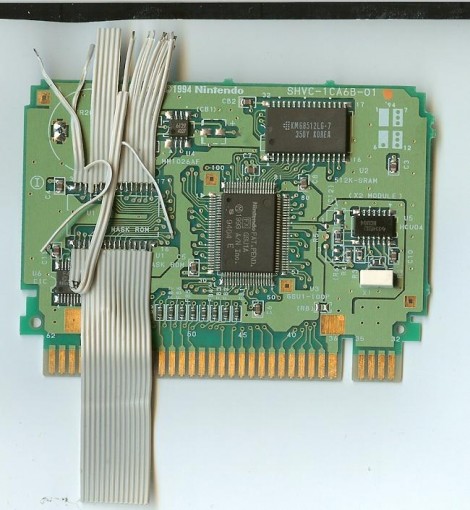
Some of our younger readers will never have experienced this before, but back in the day your video games would slow way down if there were too many moving objects on the screen. The original Castlevania comes to mind, but many will remember the problem while playing the fantastically three-dimensional Super Nintendo game Starfox. [Drakon] isn’t putting up with that hardware shortfall any longer, he hacked this cartridge to run at 42 MHz, twice as fast as the design spec.

We only occasionally look in on the cart hacking scene so it was news to us that three different versions of a pin compatible chip were used in this hardware. The first two suffer from the slowdown problem, but the final revision (SuperFX GSU 2) doesn’t. It can also be overclocked as high as 48 MHz but because of the video frame rate you won’t see added improvement with the extra 6 MHz.

[Drakon] used a Doom cartridge as a guinea pig because it offers the most RAM, and set to work rerouting the traces for the ROM chip to an EEPROM so that the hardware can be used with different games. He also took this opportunity to patch in the faster clock signal.

Telegraph Key Makes For A Fantastic Twitter Input

In the interests of interface archaeology, [Martin] sent in the Tworse Key, a telegraph key that posts to Twitter using Morse code. It’s a fantastic build that nearly looks like something out of the 1900s.

We’ve seen a ton of Morse keyboards over the years, but never one so well-engineered for a single purpose. The guts and brains of the Tworse Key is an Arduino Ethernet that connect to Twitter over the API. The Tworse Key automagically posts all the Morse messages to Twitter. The Tworse Key may have fallen off the table a few times in the past 24 hours, but we do see a few purposeful messages like ‘sos’ and [Bell]’s preferred telephone salutation.

We could say that nobody uses straight telegraph keys anymore, but outside a few hardcore CW HAM radio guys nobody uses Morse anymore. This isn’t meant to be used as an everyday input device, though. It’s more of an exercise in interface archaeology. That being said, an iambic key would be a far more ergonomic solution. Check out the video of the Tworse Key after the break.

Continue reading “Telegraph Key Makes For A Fantastic Twitter Input”

Using Google Documents As A Web Proxy

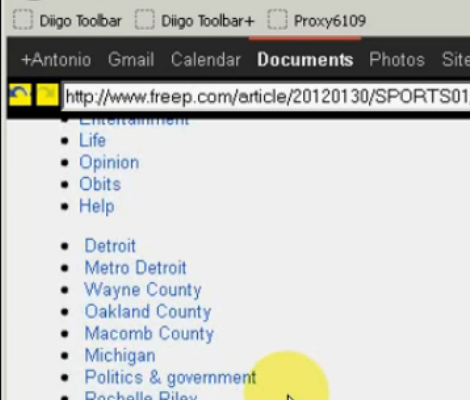
As weird as it might sound, there’s a way to use Google documents as a web proxy. The image above is a screenshot of [Antonio] demonstrating how he can view text data from any site through the web giant’s cloud applications. Certain sites may be blocked from your location, but the big G can load whatever it wants. If all you need is the text, then so can you.

The hack takes advantage of the =IMPORTDATA() function of Google Spreadsheet. We guess the command is meant to make import of XML data possible, but hey, that’s pretty much what HTML data is too, right? But what good it the raw webpage code in a spreadsheet? This is where [Antonio] made a pretty brilliant leap in putting this one together. He authored a bookmarklet that provies a navigation interface, hides the raw code which is stored in the spreasheet, and renders it in the browser. This ties together a user supplied URL, reloading data on the hidden spreadsheet and refreshing the window as necessary. See for yourself in the clip after the break.

Continue reading “Using Google Documents As A Web Proxy”

NAS Firmware Hack: Synology Running On QNAP Hardware

[XVortex] pulled off a pretty incredible firmware hack. He managed to get a firmware upgrade for Synology running on a QNAP machine. These are both Network Attached Storage devices, but apparently the Synology firmware is better than what QNAP supplies with their offerings.

The nice thing is that this is not a one-off hack. You can download the raw image and give it a spin for yourself. A few words of warning though. It will only work on models which use the Atom and ICH9R chipset, you’re out of luck if you have one sporting an ARM processor. You will also need to format the drives once the new firmware is flashed so do this before you fill them up.

This harkens back to the days when DD-WRT was first being run on Linksys routers. We don’t remember if that started with upgrade image hacks like this one uses, or if the source code was available (Linksys was compelled to release it once it was proven they were in violation of the GPL).

See a proof video of this hack after the break.

Continue reading “NAS Firmware Hack: Synology Running On QNAP Hardware”

3D Print In Wax, Cast In Metal

What does dry ice, ethonal, wax beads, and a blender have in common? It was the first attempts at making media for this wax 3D printer that [Andreas] has been building up. Wanting to produce 3D printed objects out of metal, and finding that direct metal laser sintering machines were still out of reach of reason, he set out to find a different way.

After trying a few different methods of making the powdered wax himself, he decided that it was much more time effective to just buy the stuff. Using the commercially available powered wax mixed with activated carbon, and a custom printer, the wax is blasted with a moderately high powered laser. More wax powder is applied over the freshly sintered layer, and the 3d part is built upwards. Once he has the part in wax, he can then make a mold of it and cast metal using the Lost Wax Casting method.

While the quality is not perfect, and you still need a roughly 2500$ laser setup (which was borrowed from his school) its surely a step into the future.

Join us after the break for a quick video.

Continue reading “3D Print In Wax, Cast In Metal”

Fractal Viewer Can Zoom And Enhance Like On CSI

This fractal viewer is a great way to get your feet wet with Field-Programmable Gate Arrays. The project will give you some experience working with video output, user input, and a whole bunch of math and memory management. [Hamster] built it using the Papilio Plus board which hosts a Spartan 6 FPGA. This continues his odyssey into the realm of hardware design; part of which we looked at back in December.

The arcade Megawing for the dev board gives him easy access to the controls needed to scroll and zoom on the fractal design. Calculations to generate the shape are being run at 240 MHz, with the VGA output running at 80 MHz. The device has enough horse power and SRAM to show an 800×600 pixel output with a 60 Hz refresh rate.

We really liked the logic diagram that [Hamster] drew up when planning how the calculations would be handled. It’s not overly complex, but it took us a while to conceptualize how everything fits together. It’s certainly an improvement from his last attempt as we couldn’t make heads or tails out of that flow chart.

If you’re just interested in the pretty shapes and colors there’s a demo embedded after the break.

Continue reading “Fractal Viewer Can Zoom And Enhance Like On CSI”

A SOPA We Still Can’t Get Behind

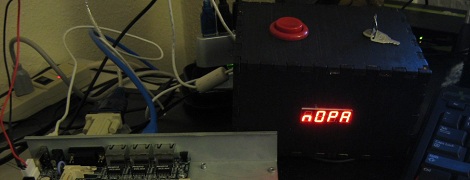
[Brad] had an extremely productive January 18th. Considering how many websites went dark to protest SOPA, we can’t blame him. While considering what he could get done if popular Internet time sinks went dark on command, [Brad] thought of the Stop Online Productivity Avoidance box. This build will redirect all traffic to sites like reddit, hacker news, and (gasp!) hack a day to a simple web page that asks the eternal question, “shouldn’t you be working right now?”

The box has two modes: in SOPA mode, the whole Internet is at [Brad]’s fingertips. In NOPA mode, an Arduino communicates with a Python script running on the router to pull up an Internet blacklist. A simple button would be too easy to override, so there’s a ‘nuclear mode’ that shuts off these time sinks for one hour. The only way around the blacklist is to restart the router, a process that takes 15 minutes and will kill the entire Internet for the duration. Not something you’d like to do if you’re slightly bored.

All the code for the SOPA box is up on github and you can check out [Brad]’s demo of the SOPA box after the break.

Continue reading “A SOPA We Still Can’t Get Behind”