Obstacle Avoiding Hexapod From Reused Parts


[Rob] built this hexapod one day when he had some free time after work. Just like the last hexapod we saw, he based the build on the Pololu design which uses three servo motors for surprisingly reliable movement.

The hardware is very straight forward. A Dorkboard serves as the brain. It’s a PCB that is wider on each side by the width of one female pin-header than a standard AVR 28-pin microcontroller. This gives easy access to all of the pins on the Arduino chip while making it small and light. You can see that a four-pack of batteries hangs below the servo motors to provide power.

Protruding above the 6-legger is a PING ultrasonic rangefinder. This adds autonomy to the little robot, which you can see running some obstacle avoidance routines in the video after the break. We’ve asked [Rob] if is able to share his code and will update this post if we hear back from him.

Update: Here’s a link to the sketch, and we’ve updated the picture with one that [Rob] sent to us.

Continue reading “Obstacle Avoiding Hexapod From Reused Parts”
One Really Big Quadcopter That Is Following In The Steps Of The Spruce Goose

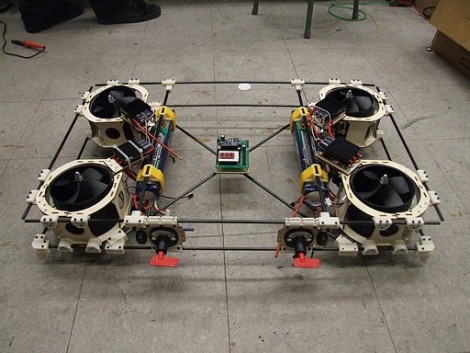
Behold the Land-Bear-Shark, a quadcopter on a rather grand scale. At a full eight kilograms it’s an easy target to compare the [Howard Hughes] behemoth, but in addition to the weight, this still has yet to make its first flight.

To give you some scale to the image above, the board at the center is an Arduino. It controls the beast, along with the help of a SparkFun IMU board which rides atop. Really, if any quadcopter of this size has a chance of working, this should be the one. The construction is beautiful, making use of carbon fiber rod along with 3D-printed connectors to assemble the frame. A lot of thought has gone into small things like conserving weight used on the landing gear, which are incorporated into the bottom corner brackets. The batteries are connected in a manner that makes them easy to adjust, acting as ballast for balancing the craft.

We’re keeping our fingers crossed that this will be more than the tongue-in-cheek title of the post which calls it a Quadrotor-shaped sculpture.

[via Adafruit]

Gambiologia – Brazilian Physical Item Hacking

Gambiologia, according to the source article, is the “science of Gambiarra.” For those not from Brazil, Gambiarra is “a Brazilian cultural practice of solving problems creatively in alternative ways with low cost and lots of spontaneity.” In other words, the hacking of real-world items. Gambiarra also has a connection to recycling, as instead of throwing something used out, it becomes something else new.

Although hacking may not be thought of as art in the traditional sense, [Fred Paulino] aims to change this with his exhibition of 20 Brazilian and international artists. A “Gambiologist” himself, he’s put together quite a collection of hacks and mods for the world to see. From computer monitors with eyes displayed on them, to a toilet held open with a two-by-four, his exhibit seems to cover a wide range of physical hacks, or Gambiarra.

Be sure to check out the article, as many of the hacks are quite clever or unusual (even if some may seem a bit unsafe). For more examples of hacking items into something new, check out this drill made out of a pencil sharpener or this remote control camera trigger using air freshener parts.

[Jeri Ellsworth] Builds A Software Radio

[Jeri Ellsworth] has been working on a direct conversion receiver using an FPGA as an oscillator and a PC sound card DSP. Being the excellent presenter she is, she first goes through the history and theory of radio reception (fast forward to 1:30), before digging into the meat of the build (parts 2 and 3 are also available).

Continue reading “[Jeri Ellsworth] Builds A Software Radio”

2011 CCC R0ket Badge

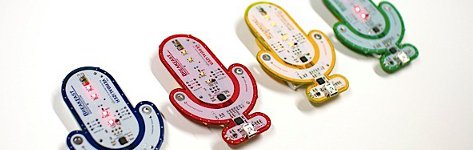
[Geekabit] wrote in asking if we’d seen the 2011 CCC badges yet. The answer is NO, we haven’t seen them because the image above is the only sneek peek we can find on their broken-certificate website. But we are glad that he shared the link with us, because it does tell the tale of what hardware and firmware features will be on this year’s badge.

Right off the bat we need to applaud them for several things. Most notably, the 3.7 volt 600 mAh LiPo battery which can be recharged via the USB port. It boasts an ARM Cortex M3 processor which is running what they call and ‘unbrickable’ bootloader that is programmed via the USB port. You can see there is an LCD screen which we’d guess is about 128×128 pixels (correct us if you know otherwise). You’ll be able to interact using a 5-way button, via the RF transceiver, and possibly using an optical interface but we’re not sure that feature made it into the final design. They’ve also rolled in a shield system for extra harware so that you can design your own add-ons before you get there.

As always, if you get your hands on one of these, we want to hear all about your project as well as get an overview of the stock badge and its features so don’t forget to drop us a line.

Update: [Never_gonna] left a comment with a link to a series of posts about r0cket development including a video which we’ve embedded after the break. Thanks!

Continue reading “2011 CCC R0ket Badge”

word_clouds_from_broacast_television

Analyzing TV’s Talking Heads With Processing

[Michael] from Nootropic Design wrote in to share an interesting and fun project he put together using one of the products his company sells. The gadget in question is their “Video Experimenter” shield which was designed for the Arduino. It is typically used to allow the manipulation of composite video streams via overlays and the like, but it can also serve as a video analyzer as well.

When used for video analysis, the board lets you decode closed captioning data, which is exactly what [Michael] did here. He decided it would be fun to scrape the closed captioning information from various shows and commercials to do a little bit of content analysis.

Using a Processing sketch on his Arduino, he reads the closed captioning feed from his cable box, keeping a count of every word mentioned in the broadcast. As the show progresses, his sketch dynamically constructs a cloud that shows the most commonly used words in the video feed.

The results he gets are quite interesting, especially when he watches the nightly news, or some other broadcast with a specific target audience. We think it would be cool to run this application during a political debate or perhaps during a Hollywood awards ceremony to discover which set of speakers is the most vapid.

if you’re interested in learning more about the decoding process, [Michael] has put together a detailed explanation of how the closed captioning data can be pulled from a video stream. For those of you who just want to see the decoder in action, keep reading to see a quick video demonstration.

Continue reading “Analyzing TV’s Talking Heads With Processing”

Hackaday Links: Tuesday, July 19th

Here’s another “useless machine” variant.  The trick to this one is that it has dual “fingers” and can work either way. Which way it turns off is selectable via a switch on the side, and the fingers can both be turned on to “fight” each other. Check out the video here.

This video depicts the assembly of a Gameboy MAME-style cabinet. For those wanting to try something like this, this video may fill you in on some of the required assembly techniques, such as how to put decals on the side of your cabinet.

This video featuring the “Autonomous Ultimate Wall-E” shows this robot’s navigational skills around the house.  Additionally, it has some nicely actuated arms.

The Verbalizer is a microphone designed to be used with Google’s voice search. It’s also designed with Arduino compatibility in mind and is open-source. Could be a good tool for your next hack.

These clever multimeter probes were built using pogo pins used in electrical test equipment. The springs inside of these pins help keep them planted firmly on the test point in question and reportedly gives a very good connection.