Converting From Clutter Closet To Dreamy Datacenter

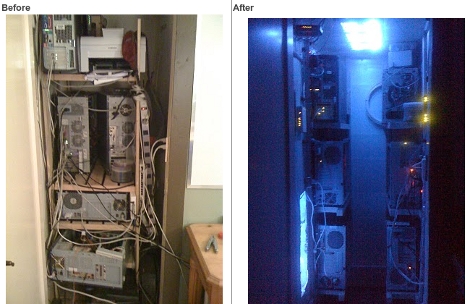
[DocDawning] had a nice home network up and running, but the messy pit housing the hardware made him avoid that part of the house. In an effort to cut down on noise, and clean up the clutter, he built himself a very nice data center inside a small closet.

One of the biggest changes in the setup provides adequate cooling. He cut a vent hole into a wall shared between the closet and a hallway. This was just the right size for a few large cooling fans which suck air into the enclosed space. But cool-air intake must be accompanied by hot-air outflow so he added an exhaust vent in the ceiling. This also received a trio of big fans, and as you can see above, the integrated LEDs act as a light source for the server farm.

The final part of the plan involved machine-specific brackets mounted to the walls of the enclosure. These racks were built out of 1×1 white wood. They hold the hardware in place leaving plenty of room to run cables. The new setup even opened up enough wall space to mount power and networking hardware. Now everything has its place, and [DocDawning] can finally close the door on his noisy servers.
Mayor Is A Hacker And Wants To Use DIY Parking Meters

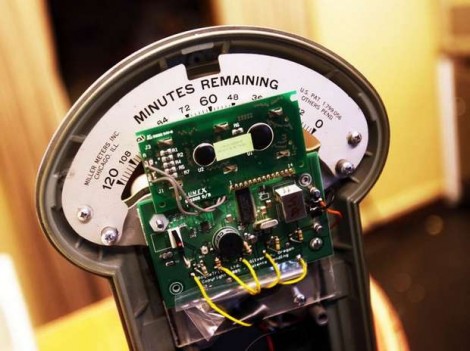
The Mayor of Silverton, Oregon is a hacker and wants to use roll-your-own hardware in the town’s parking meters. It’s not that he thinks he can do a better job than companies selling modern meters (although there have been notable problems with those), but he wants to retain the sentiment of the 1940’s era parking meters that are being replaced. Those meters are known as penny parking meters, because you can get 12 minutes of time for just one penny.

Many municipalities have gone digital with parking payment systems due to costs associated with servicing mechanical meters and collecting coins from each one of them. This hack aims to keep the look of the vintage meters, but replace the mechanical readout with a digital screen. The meter would still offer a reasonable parking deal; five minutes for free. Cost for replacing the internals is estimated at $150 per meter… which seems just a bit high if they are looking at a 250 unit run. The main problem that we see with the idea is that the original parking meter bodies don’t have a slot which can accept quarters.

[Thanks Rick]

Sequencer Built On A Cycle II FPGA Board

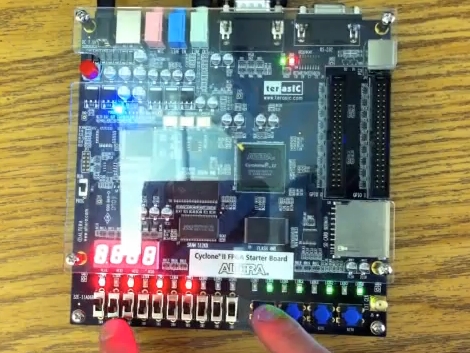
[Matt’s] finishing up his computer science degree. As part of a class assignment he programmed his own sequencer which runs on a Cyclone-II FPGA development board. We’ve embedded a video below the fold that shows you what it can do. The buttons and LEDs offered on the board actually allowed him to create a nice user interface. Each slide switch has a surface mount LED above it, giving feedback for which beats in the loop are on and off. There’s also a bank of momentary-push buttons seen in blue above. [Matt] uses these to tweak settings like the pitch that is stored for each slide switch. He even puts on a light show with the VGA output.

We’ve seen this Altera board before, used to drive a falling sands game. The hardware will run you around $200 but that’s not bad considering all of the fun things you can do with it.

Continue reading “Sequencer Built On A Cycle II FPGA Board”

Body Heat Sensing PC Security System

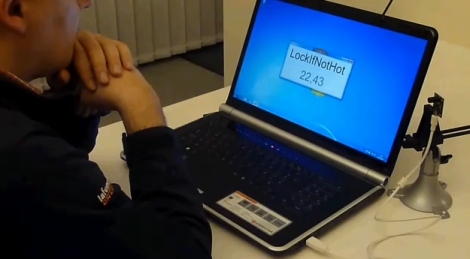
lockifnothot

[Didier Stevens] wrote in to tell us about a little piece of PC security software he put together recently. His application, LockIfNotHot, works in conjunction with your PC as well as an IR temperature sensor in order to lock your computer the moment you step away.

The theory behind the system is pretty simple. Basically, the IR temp sensor monitors when you are at your desk, sensing your presence by the heat your body gives off. As soon as you step away however, it locks the computer since the temperature of the surrounding area immediately drops. It’s pretty simple, but as you can see in the video below, it works quite well.

The software has configurable set points and timeout values, which make it flexible enough to adapt to your specific situation. He happens to use an off-the-shelf IR sensor, but we assume any USB temperature module will do the trick. If you happen to work with sensitive information but often forget to lock your workstation, this is the program for you!

Continue reading to see a quick demonstration of his software in action.

Continue reading “Body Heat Sensing PC Security System”

One-eyed, One-armed Metal Rolling Roomba Robot

roomba_robot

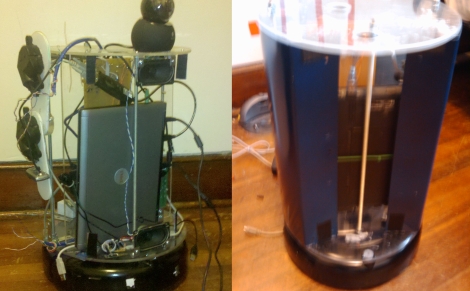
[Erik] was looking for a sturdy robotics platform and was initially considering the iRobot Create, until he found that he could score a Roomba Discovery series for a fraction of the price. The Discovery includes a battery, which is missing from the iCreate, though it also has all of the standard vacuum bits included as well.

He immediately removed all of the vacuum parts once he got his hands on the Roomba, and began adding the support structure to house the rest of his robot’s components. The robot is controlled via a small laptop which sits on top of the Roomba’s base, and features a panning and telescoping webcam to provide feedback to the operator.

The robot has been under construction for a little over a year now, and has had a few upgrades over that time. The original laptop was swapped out for a newer dual-core model, and the webcam was upgraded to a model featuring motion tracking. The whole thing has been skinned in thin sheet metal for a sleek look, and he has added a servo-driven arm as well.

The project is not quite complete, and he hasn’t really stated what he plans on using the robot for, but it looks good so far – we can’t wait to see it when it’s finished.

A Breakout Board For Your Android Phone

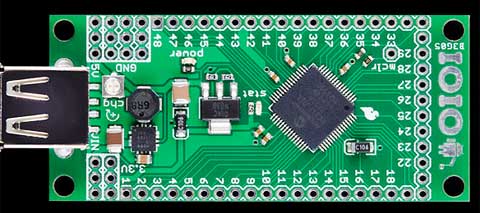
[sparkfun] announced a new board called the IOIO (pronounced “yo-yo”) this week that allows communication from your Android devices to your upcoming projects.

The board hasn’t been released yet; [sparkfun] is still pulling together documentation and waiting on their first production run. We do know that the board contains a PIC24F MCU, and will give your phone analog input,  and Digital I/O, PWM, I2C, SPI, and UART control. Communication with the board is over the USB port on your phone.

The brilliant thing about this board is that an external programmer isn’t required. Everything you connect to this board can be controlled from within Android apps. We covered Android development in a hackaday tutorial series before, so now it’s possible to put these skills to give your projects a touch screen, internet and bluetooth connections, a camera, or your phone’s accelerometers. Very slick.

Video of some basic functions demonstrating what possible with this board after the jump, but feel free to comment and tell us what you’d like to see done with this board.

Sticky Sweet Animatronic Peep Show

peeps_peep_show

With Easter quickly approaching, [Kyle] decided to finally build a project that is as tasty as it is wrong.

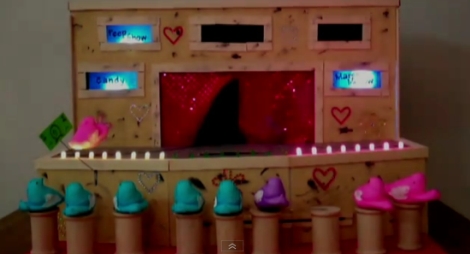
Behold, the Animatronic “Peep” show! Using nearly a dozen marshmallow Peeps, he constructed a stage for his “performers” and a seating area for their “clients”. The structure was built mostly from balsa wood and foamboard, featuring a retractable curtain, stage lighting, and music.

Once triggered, the embedded Arduino gets to work animating the stage lights and blaring “Cherry Pie” while the sugar-coated onlookers await their entertainment. The curtain is drawn back and a trio of winged dancers emerge one by one, ready to entertain the crowd.  The onlookers even offer up dollar bills to the dancers via a servo-mounted arm.

The project uses a total of 10 servos driven by the Arduino, along with an audio decoder chip to provide the proper ambiance for the marshmallow debauchery. [Kyle] says that he put together about 650 lines of code to get the whole thing running, but there doesn’t seem to be any way to download it at the moment – hopefully we’ll see something posted soon.

It might not be high-brow, but it sure beats blowing up old, stale Peeps in the microwave!

Stick around for a trio of videos demonstrating the Peep show as well as revealing some of the stage’s inner workings.

Continue reading “Sticky Sweet Animatronic Peep Show”