Super Brite LED Sneakers

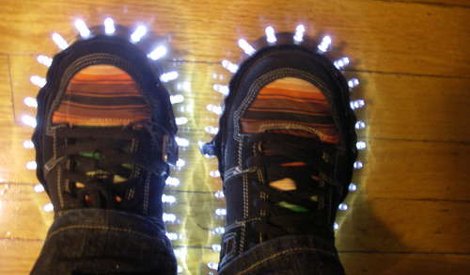
[i am jen] needed to spice up some shoes, and what better way to do that, than to spike them out in LEDs controlled by a micro controller. In order to make the LED strips, an inventive use of Velcro is applied. One half of the strip is secured to the shoes, while the other half gets a sheet of electrical tape on the sticky side. Small holes are then punched though the strip and the LEDs are then soldered.

Electronicswise the shoes are using a pair of 6 volt batteries, with no readily available holder, a “AA” battery holder is chopped to size and glued back together. Patterns are controlled by a Really Bare Bones Board Arduino, (which, even if your not an Arduino fan, is a cool little AVR breakout board for 28 pin chips) and cycles through different patterns using magnets and reed switches on the inside edges of the shoes.

Even if its not your style, check it out for a few good hacks and join us after the break for a short video.
Continue reading “Super Brite LED Sneakers”

IR-controlled Musical Alarm Clock

Music-Playing-Alarm-Clock

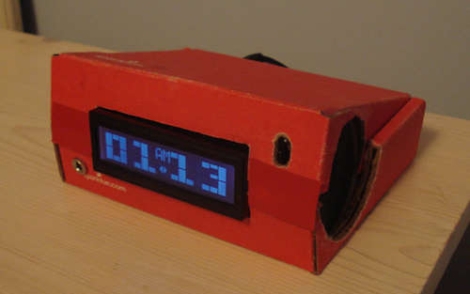
Forum user [Frank] shared with us his recent project, a musical alarm clock. More than just a simple alarm clock, his creation allows the user to load music onto a micro SD card, has alarm settings for each day of the week, and best of all, can be controlled using an IR remote. He uses a Teensy++ to control most of the clock’s functions including the display, delegating the time keeping to a DS1307 real-time clock. All of the audio playback is handled by a separate music decoder mounted on a breakout board.

His Instructables writeup is extremely detailed, with tons of annotations, pictures, diagrams, and source code available. He walks through each step in detail, making this a great learning guide for others looking to start in on AVR programming.

His final presentation is a great lesson in recycling, though unfortunately a bit lackluster, as the clock is packaged in an old SparkFun cardboard box. He does mention that there were some time constraints towards the end, which may explain this choice – it would be nice to see a revised version of this clock packaged in a nice plexi case.


Shockingly Fun Quiz Game

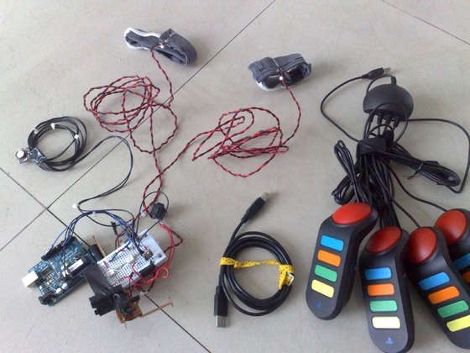
Gather your friends round the living room for a head-to-head quiz game. This one’s not quite as nice as you might think. Get an answer wrong and you’re going to get the Venkman treatment thanks to the stored electricity in a disposable camera flash circuit. [Israel] runs the game questions from a Windows machine, and uses a set of four USB joystick buzzers that let each contestant ring in. They all wear a cuff that houses electrodes for negative-reinforcement upon an incorrect answer. Since every contestant answers each question it won’t be long before you hear the uncomfortable yelp of failure from your guests. This seems a little bit more fair than shocking people for not calming their minds, but the video from that hack is still one of our all-time favorites.

Pactuator: Mechanical Pac-Man Frame

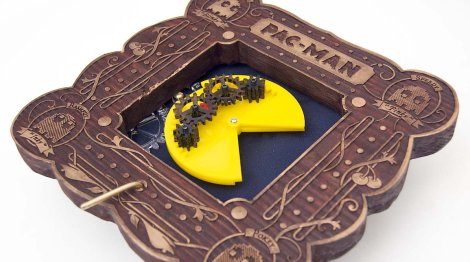
As a proof of concept for his long term work in progress “The Pac-Machina” (an electro-mechanical reimagining of a Pac-Man cabinet), [Jonathan] needed some way to make a mechanical Pac-Man, flappy jaw and all. After working through a couple different design possibilities, he decided on an interesting setup which includes using a cog with only half its teeth to make the mouth open and close. Unfortunately, NAMCO BANDAI has asked him nicely not to sell these as kits, but he has helpfully included just about all that is required to make one of these from scratch. [Jonathan] even cut and laser etched his own faux-Victorian frame to keep his proof of concept Pac-Man ready until needed for the main project.

What Development Board To Use? (Part Two)

We asked for responses to our last Development Board post, and you all followed through. We got comments, forum posts, and emails filled with your opinions. Like last time, there is no way we could cover every board, so here are a few more that seemed to be popular crowd choices. Feel free to keep sending us your favorite boards, we may end up featuring them at a later date!

Continue reading “What Development Board To Use? (Part Two)”

Kinect Home Theater Control

kinect_home_theater

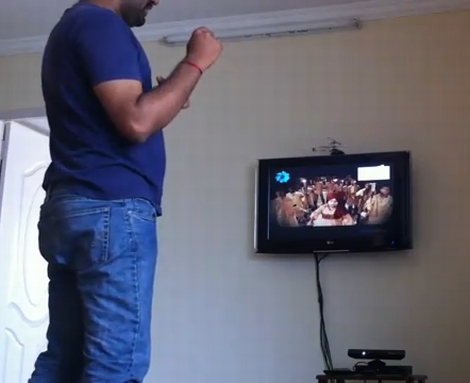
[Harishankar] has posted a video on his blog demonstrating the ability to control devices using the Microsoft Kinect sensor via IR. While controlling devices with Kinect is nothing new, he is doing something a little different than you have seen before. The Kinect directly interfaces with his Mac Mini and tracks his movements via OpenNI. These movements are then compared to a list of predefined gestures, which have been mapped to specific IR functions for controlling his home theater.

Once the gestures have been acknowledged, they are then relayed from the Mac via a USB-UIRT to various home theater components. While there are not a lot of details fleshed out in the blog post, [Harishankar] says he will gladly forward his code to you if you request it via email.

Thanks to [Peter] for the tip.

Pedal Powered EL Wire Bike

el_wire_bike

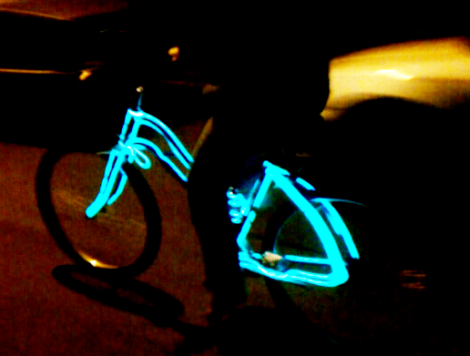
Instructables user [samsmith17] wanted to cover his bike with EL wire for this year’s Burning Man, but he didn’t want to mess with the hassle of using batteries as a power source. Instead, he decided that his EL wire bike would be powered solely by the rider. In the interest of keeping things green, the entire build is made up of re-purposed parts, aside from the EL wire itself.

If you are not familiar, EL wire only lights up when AC current is supplied, so he decided to use a stepper motor to generate the current required. The stepper motor was mounted against his bike’s wheel, and wired backwards through the AC transformer portion of an old cell phone charger in order to step up to the required voltage. A rheostat was also added to the circuit in order to help prevent an over voltage condition, which could potentially damage or destroy the EL wire.

The end result is pretty cool to watch, and costs very little to boot. It would be nice to see someone expand on his project, adding additional wire colors and perhaps a few capacitors to keep the wire from going dark immediately after the wheels stop turning.

Continue reading to see a quick video of the completed project.

Continue reading “Pedal Powered EL Wire Bike”