PIC Spectrum Analyzer Uses Fast Fourier Transform Routine

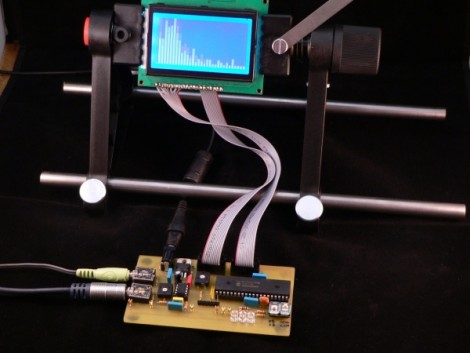
[Simon Inns] just rolled out his latest project, a PIC based spectrum analyzer. He’s using a Fast Fourier Transform routine crafted in C to run as efficiently as possible on the 8-bit chip. The video after the break shows that the results are quite pleasing, with just a bit of noticeable lag between the sound and the waveform representation on the graphic LCD. We found his notes about using an audio amplifier chip to be interesting. He utilizes the properties of an LM386 to move the input signals from a range of -0.5V to +0.5V into a very ADC friendly range of 0-5V.

Continue reading “PIC Spectrum Analyzer Uses Fast Fourier Transform Routine”
Developing An Electronic Board Game

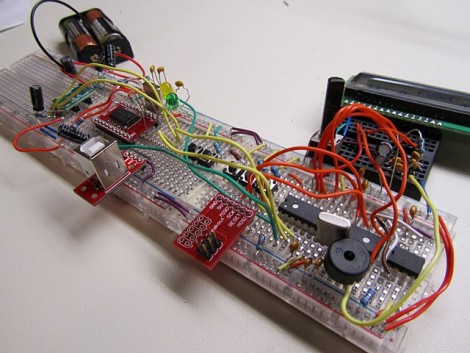
[Zach] enjoys playing the game Catch Phrase, but the complexity of the words makes this game a no-go for the little ones. We remember that the game used to be mechanical, using paper disks with the words on them. Those would be easy to recreate with your own dictionary set, but since it has transitioned to an electronic unit that option is out the window. So [Zach] decided to build his own version of the game that lets you use custom word sets after drawing inspiration from another Catch Phrase hack.

He’s calling it AVRphrase since it uses an AVR ATmega328. You’ll also find five buttons, a piezo buzzer, and a character LCD included in the design. He saw the project all the way through to the end, having a PCB manufactured, and installing it in a project box. A demonstration of the finished game can be seen after the break. [Zach] ended up with 9 working units at a cost of about $30 each.

Continue reading “Developing An Electronic Board Game”

Creating Art From An Old Christmas Tree

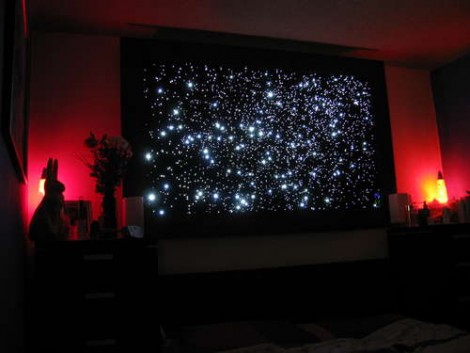
So you manged to get a great deal on a fake tree during the after Christmas sales, but what should you do with your old one? If it was lighted with fiber optics you can reuse the strands to create your own star map. [Mr Trick] shows how to disassemble one of these trees, grouping the fibers by length. He built a wood frame, then covered it with a layer of cardboard and another of black fabric. From there the painstaking process of routing the fibers in a way to looks convincing starts.[Mr Trick’s] final product uses multiple LED light sources and even includes RF control.

Think this project is large and time-consuming? Check out the same idea built into a bedroom ceiling.

IPhone Tilt Motion Controller

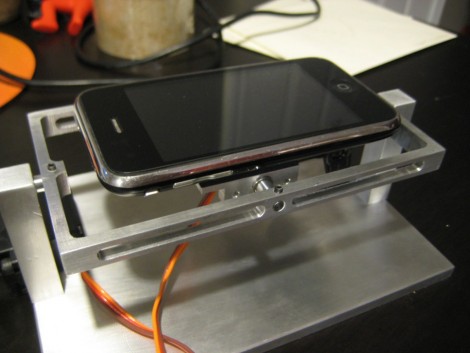
Here’s a mounting system that adds mechanical tilt control to the iPhone (link dead, try the Internet Archive version). It uses two servo motors to rotate along the X and Y axes. An analog joystick is used along with an Arduino to control the movement of the apparatus. As you can see in the video after the break, this works quite well when playing accelerometer-based games. But adding a joystick isn’t the end-goal of the project. [Shane] plans to point a camera at the iPhone and use image recognition to play games automatically. That sounds like a big bite the chew but we’ve seen this work with Guitar Hero so we’re optimistic.

Continue reading “IPhone Tilt Motion Controller”

A Look Back At DefCon 18 Badges

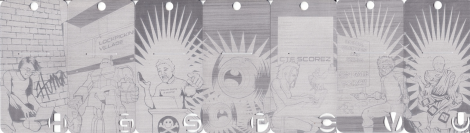
As he does every year, [Joe Grand] gave a talk explaining the development process for Defcon 18 badges. We looked in on these when details started trickling out back in July. They feature a neat bit of tech in the form of an LCD that acts much like ePaper. It doesn’t take any electricity to hold the image, only to change the display. This is a valuable feature for a battery powered device and allowed him to get about 9 days of juice out of a CR2032. This year’s badges also used laser-etched Aluminum as a substrate.

We’ve embedded the talk after the break and found it interesting enough to watch the entire hour. If you’re more interested in the hacks that came out of the badge, we’ve put together a playlist of videos [Joe] took while at the conference.

Continue reading “A Look Back At DefCon 18 Badges”

Fixing The Rovio Battery Charging Circuit

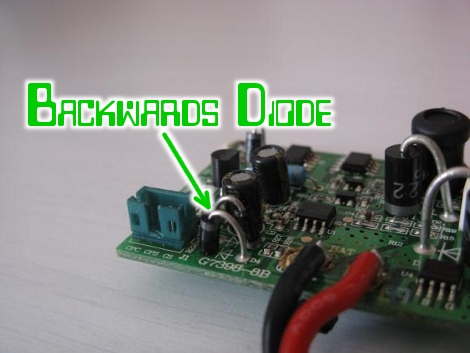
[Chris] was unhappy with the battery performance of his Rovio. It seems that he’s not alone, so he set out to reverse engineer the battery charging circuit to see if there was a fix. Boy is there, what he found is the diode above, apparently installed backwards when compared to the silk screen diode symbol. Now it’s entirely possible that the silk screen is wrong and this was fixed during assembly. We think that’s unlikely because if the closer of the two diodes was supposed to have the same polarity as the one next to it there should have been room to install them both in exactly the same orientation. [Chris] pulled out a soldering iron and changed the diode to match the silk screen. That fixed his problem and he’s now getting better performance than he ever has.

[From our comments section]

CES: Where Are They Now? CES Of Course!

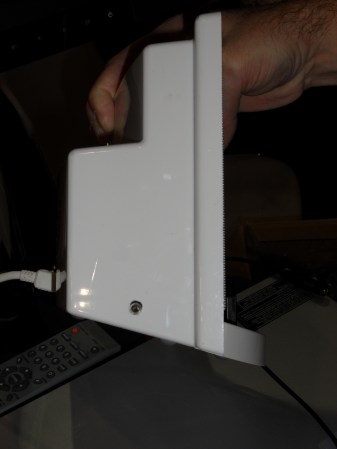
CES is a time for showcasing the latest and greatest innovative products. While the crowd milled around the iLounge there was one company who stood out amongst the rest. [Mike] from CableJive is making his debut on the biggest stage for innovation this year. Many of you will remember [Mike] from a post back in 2006, where he was fed up of with all of the good docks being for the apple products exclusively. He set out to fix this and, when talking with him, attributes his success to the coverage Hack a Day did on his project. CableJive has become so popular that he has hired staff that help him produce his products. All detailed information for their products can be found at their website.  The finished product is displayed after the break.

Continue reading “CES: Where Are They Now? CES Of Course!”