Keep Fun In Check With A Parental Count Down Timer

Gaming industry software engineer [Pedantite] writes in to let us know about his latest endeavor, an AVR based parental assistant timer: Good Times.   Looking for a new project that would be both useful and interesting, his wife suggested a “time out/ time’s up timer”. Like most of us [Pedantite]’s children are well studied in the arts of procrastination and mischief.  In the kids’ case this leads to time outs and break time running amok. The solution, in this case, is pretty much an advanced DIY egg timer with fun sounds.

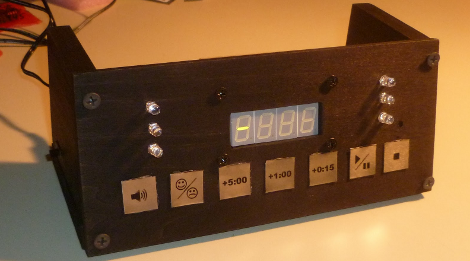
The timer sports all of your basic countdown-timer functions including a 4 digit 7-segment LED output display, stop light style LED indicators, and controls to start/pause and stop the count down. The count down time can be input via the +5 minute, +1 minute, and +15 second buttons. There is even a happy/sad button to toggle between “time out” and “break time” modes. Two Atmel micros power the device, an AT Tiny 2313V for the capacitive touch keypad and an AT Mega 644P for the display, audio, and time measurement.  There are a lot of excellent techniques used in the build, some which we have covered here:  Four 595 Shift registers for the display; A 4 bit r2r DAC for audio output.

[Pedantite] is still in the process of writing up the project in multiple posts, and would love to know what you all want to hear about. Check out his blog for details and a quick video of the timer in action! Also, if you are interested in capacitive buttons, check out part 2 of the writeup.

Bluetooth Headset Battery Swap Keeps Going And Going…

bluetooth_headset_battery

[Reginaldo] purchased a cheap Bluetooth headset adapter, and while it worked well with all of his devices, he was disappointed to find that the battery life didn’t quite live up to the manufacturer’s claims. Advertised as capable of operating for 10 hours, he discovered that the device would typically die after only 7. He wanted more from the headset, so he took things into his own hands and replaced it with a much larger battery (Google Translation).

His goal was to keep the modifications as cheap as possible, so he repurposed a lot of items he had sitting around the house. He used a battery out of an old cell phone, with a capacity over six times greater than that of his original headset battery. He built a charging circuit using a MCP73863 microchip, specifically designed for managing Li-Ion/Li-Poly batteries. The Bluetooth headset was dismantled and repackaged in the shell of a cheap “audio amplifier” that he had on hand, along with the new battery and charging circuit. A nifty Hackaday logo was included on the outside of the new battery case, and the project was deemed complete.

[Reginaldo] reports that he is quite happy with his battery retrofit. The new power brick only takes about half an hour longer to charge, but can now be used for approximately 44 hours before requiring a recharge – not too shabby!

Everything You Need To Know About Wall Warts

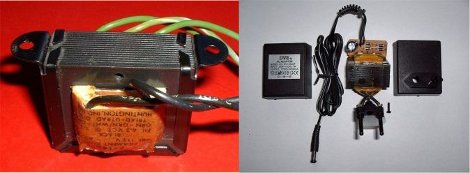
If you work with electronics at any skill level you need juice. [Jon] has a great, and clearly worded tutorial about Wall Wart Power Supplies with pretty much everything you need to know about those little black boxes hanging off of your outlets.

The whole thing starts off with the basics like transformers, rectification smoothing and regulation, then moves on to the different basic types, dedicating a page to linear, regulated and switching types, giving output performance charts under different situations.

Also included is a run-down of DC barrel jack structure so you get the right plug every time, wall wart type identification, a random sample comparison test, and a good selection of formulas to even keep the old hats reading along. Although you might want to set aside a little time at 9 pages and some Q/A in the comments, it might take a moment to read.

Reverse Engineering LED Vodka Bottle Displays

wireless_led_marquee

When [Tyler] heard about the LED matrix display that Medea Vodka was building into their bottles, he immediately wanted to get his hands on one. Who could blame him? Someone had finally combined two things we love dearly: booze and LEDs.

He struggled to find a bottle at any of his local stores for the longest time, but was absolutely stoked when he finally came across one of their reps promoting the brand while he was out shopping.

Once he got home, he pulled the display off the bottle and began poking around to see what made it tick. The display is made from a flexible PCB, and attached to the bottle with some clear elastic film. It is powered by two CR2032 batteries and controlled by a PIC16F chip, which pulls stored messages from a small Atmel EEPROM.

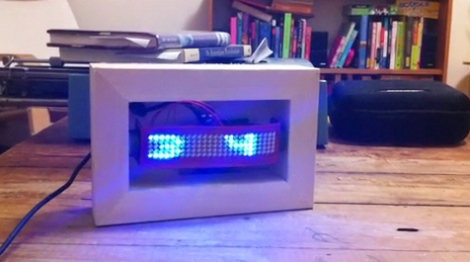
Once he figured out how to control the LED matrix, he uploaded his own fonts and added a LINX wireless module to remotely send messages to the board. He mounted it in a wooden frame and now uses it as a simple marquee display.

If you have one of these displays hanging around your house, be sure to swing by his site for schematics of his wireless interface board as well as the code he uses to drive the marquee. You can check out a video of the display in action there as well.

PID Sous-Vide Slow Cooker – Bon Appétit!

In search of a perfectly-cooked brisket, [Aaron] recently completed this DIY  PID-controlled sous-vide slow cooker. Sous-vide (French for “under vacuum”) is a cooking technique in which foods are typically vacuum-sealed and then cooked in a relatively low temperature water bath for an extended period of time. This is done to minimize temperature gradients throughout the food to ensure even cooking. Precise regulation of the water temperature is the key to ensuring that the results are exactly as desired – when cooking for many hours or days, even a few degrees discrepancy can greatly influence the final product.

A few months ago we featured a similar hack that utilized a simple switching temperature controller spliced into an extension cord.  Although probably sufficient for most aspiring “hacker-chefs”, the temperature was not as stable as it could be. The problem is that it takes time for the heat generated in the slow cooker’s heating element to reach the temperature probe (and food) suspended in the water bath.  By the time the probe reads the elevated temperature, the element is already too hot and the temperature overshoots the target. One way to mitigate this effect is to circulate the water to minimize temperature gradients, as is done in many of the expensive commercial units. In order to achieve similar results, [Aaron] instead created a PID controller that uses temperature feedback over time to precisely maintain the desired temperature and reduce any deviations resulting from outside disturbances.

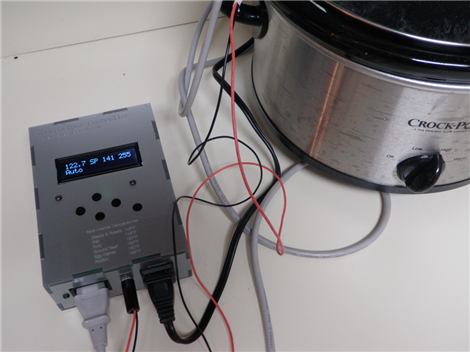
The build is covered in detail and looks great in a custom acrylic enclosure. All of the board schematics, enclosure layout files, and source code are available under Creative Commons licensing at the bottom of his blog page. A good deal of time is also spent addressing the actual PID programming and tuning – something that could be useful for many different hacks requiring precise feedback control.

The end result is a professional looking control box and a slow cooker that is able to maintain temperature within 1°F even while using a DS1820 temperature sensor that is only rated as accurate to 0.5°C (0.9°F). From the pictures it looks like [Aaron] has finally achieved brisket bliss! Now the only question remaining is: what is the best setting for reheating left-over pizza?

Xbox 360 Briefcase Is Ready To Go Wherever You Do

portable_xbox

Hackaday forum member [azazelcrey] recently wrote in to share his portable Xbox 360 build. This is not his first attempt at constructing one of these, as he completed his first portable console a few years back. This time, he has taken what he learned from the first go round, making his newest creation a bit cleaner and more compact.

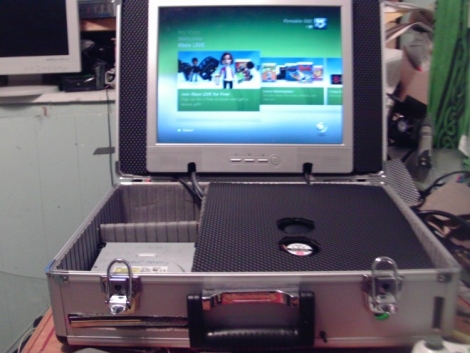
He sourced an LCD monitor with built-in speakers to use as the display, mounting it into a $20 metal-sided suitcase from Home Depot. He disassembled his Xbox and added it to the case, installing a couple extra fans to keep things cool. Some standard Xbox functions were externalized, allowing him to power on the console, load games, and synchronize controllers, all while keeping the briefcase shut.

This obviously isn’t something that you would carry on a train or bus for on-the-go gaming, but it’s a great way to travel with your Xbox as well as a handful of gear.  We imagine this rugged, fully-contained gaming center is quite useful for one-off Xbox LAN parties, and it seems like it would be a good way to get your game on if stuck overnight in a hotel.

Check out his web site if you are interested in seeing his first build or more pictures of this one.

Hacking Automated Hand Sanitizers With Ben Heck

benheck_sanitizer

If you have visited a hospital any time recently, you probably noticed quite a few automated hand sanitizer dispensers scattered throughout the hallways and in each patient’s room. Since hospital-acquired infections are a growing problem, there has been a push for all personnel to use these hand sanitizers regularly to lessen the likelihood of spreading disease.

In the most recent episode of his web show, [Ben Heck] took on the challenge of hacking one of these dispensers to use motion sensors in order to sense when hospital personnel are near, as well as to remind them that they should sanitize their hands on the way out.

He disassembled the dispenser to see how it operated, then worked on replacing the IR sensor pair with a set of motion detectors. He hooked the motion sensors to a Propeller board, which uses a separate add-on board for keeping time. Once the motion sensors are triggered, the passer-by is given a window of time before the machine notifies them to kindly sanitize their hands. All movements and sanitizer dispensing events are logged to an SD card connected to the controller, which can be reviewed to ensure policy compliance.

If you have about 20 minutes to spare it’s worth checking out, and if you are interested in more hand washing tech, check out this DIY hand dryer we featured a while back.