LED Dog Collar

LEDs make everything better, right? What about your dog? [Ken] tries it out on one of his frisky dogs who loves to run whenever she gets out with a LED dog collar. It’s an off the shelf dog collar sporting 5 blue LEDs, and is powered by an attiny2313 micro controller, which makes adding / changing light sequences quick, easy, and also allows for future upgrades. Small PCB’s are made and to help keep minor amounts of the wild from frying. the electronics parts are encased in hot glue, and the whole thing is powered by 3 AAA batteries.

While it’s an early test of the device, and there is more to come, like an automatic trigger as [Sunshine] bolts for the door, but it seems like a great help while chasing after a runaway dog in the dark.

Join us after the break for a quick video.

Continue reading “LED Dog Collar” →

NESBot Video Game Automation

nesbot

If you happen to enjoy video games, but don’t actually like playing them, boy do we have the hack for you! [pjgat09] shows us how, armed with an Arduino, you can force a Nintendo to play games by itself, not unlike an old-time player piano. The hack involves programming an Arduino to accept commands mapped out in “movies”, which are actually scripted sets of button presses that one would perform while playing a game. These sorts of scripts are available from TASVideo, a community specializing in “tool assisted” speed runs of video games. These movies are typically used with emulators, so there are some adjustments that need to be made in order to make them work with a console, since the button presses are mapped to each frame that is drawn on the screen. While we are not sure quite how useful this hack is, it is a pretty novel concept. You can see video of the 5-minute SMB speed run after the jump.

Continue reading “NESBot Video Game Automation” →

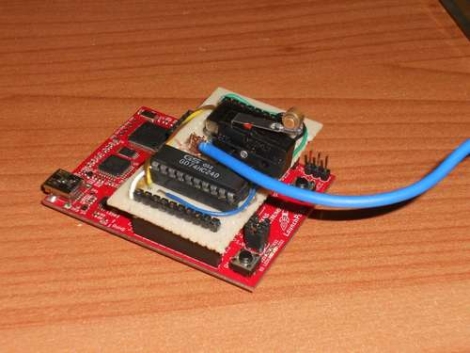
Launchpad Serial Morse Code Transmitter

LaunchPad-Serial-Morse-Transmitter

LaunchPad dev boards from Texas Instruments are cheap and easy to program, making them a great Arduino alternative if you can do without some of the bells and whistles. [ech0s] put his to good use by constructing a Morse code transmitter with dual operating modes. The transmitter can not only encode and transmit messages entered in a terminal client, it also allows the user to send messages by manually operating the key switch. Inspired by the high altitude balloon transmitter we featured last summer, this project uses similar components for signal amplification and transmission. Text can be entered in a Putty terminal window, which then is encoded into Morse by the MCU before transmission. At the moment, the speed of the radio transmission is about 15 WPM, which is reasonably quick. Even though his system performs quite well [ech0s] has some improvements planned, including having a proper PCB built as well as some software tweaks to improve buffering and bandwidth. Be sure to check out his video of the transmitter in action after the jump.

Continue reading “Launchpad Serial Morse Code Transmitter” →

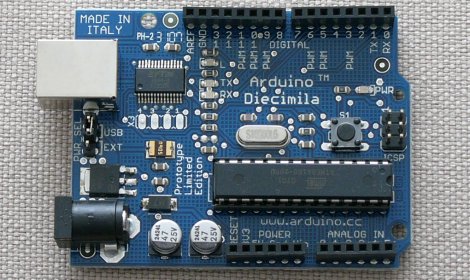
Today’s Arduino Minute

Sometimes projects are vast, complicated, and complex. Other times projects are a bit more on the simple. Today we thought we would share a couple projects with something in common that may be familiar sounding to the more experienced crowd, but may inspire a few readers new to the world of microcontrollers.

Continue reading “Today’s Arduino Minute” →

The CIA’s Amazing Bots

When you have a virtually unlimited budget, you can pull off some amazing things. This has become most evident recently as the CIA has been showing off some of its old tech. That dragonfly you see above is near life-size and actually flies. They hired a watch maker to build a tiny internal combustion engine to run it. That alone is pretty amazing, but this thing was actually flying in the 70’s. Upon further inspection of the wings, we actually have no idea how this sucker is supposed to fly. Despite our skeptical viewpoint, you can see a tiny clip of it flying after the break.  You can also catch a video of “charlie” the robot catfish.

[via Botjunkie]

Continue reading “The CIA’s Amazing Bots” →

RGB “Tilty Cube”

[Ben’s] introduction to microcontrollers was this fun little gift he calls the “tilty cube”. It is an acrylic box with 3 LEDs mounted inside that changes color based off of how you tilt it. Sounds like a fun toy, and a good project to learn with. [Ben] chose the PIC12F615 as the brains and laid it all out on a perfboard.  Since this was his first microcontroller experience he had to learn how to blink the LEDs, then figure out PWM etc. Though there is no video of the project in its finished state, since it was given away as a gift, we assume he figured it out pretty well.  He does state that the LEDs are dimmer than he had hoped and offers some thoughts on how he would do the entire project better next time.

Canon T1i/500d External Microphone Hack

canon_t1i_external_mic

Like most other DSLR cameras that feature video recording, the Canon T1i has a small built-in microphone with limited sound reproduction capabilities. [Robb] wanted better audio performance while taking video, but found the camera’s inability to use an external microphone to be a frustrating limitation. He decided to take matters into his own hands, and disassembled his camera in order to add an external microphone jack. The process is not overly complicated, as it requires little more than the installation of a switching microphone jack. You will however need to get your hands a bit dirty since it involves opening the camera, a bit of drilling, and some epoxy. Doing such things to your camera clearly voids the warranty, and with a $600 camera at stake, this hack is definitely not for the faint of heart. That said, if you desperately want to get better quality audio from your Canon T1i or 500d DSLR, be sure to check out his tutorial.