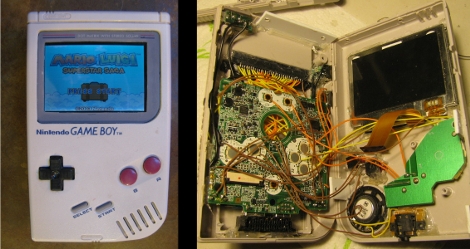
Original Shell Houses A Game Boy Advance SP

[Jackson] decided he wanted to give his original Game Boy a bit more power so he replace the internals with those from a Game Boy Advance SP. This keeps the case work to a minimum, as the original was larger than the SP. He kept the buttons, speaker, headphone jack, and power switch but modified the enclosure to use the volume, charger, and battery from the newer hardware. The cartridge connector was relocated to match the slot in the back half of the case, with the color screen being the biggest giveaway that someone’s monkeyed with the device. Not a bad use for a dead Game Boy, as least you’ll be playing this one instead of dedicating it to virtual storage.
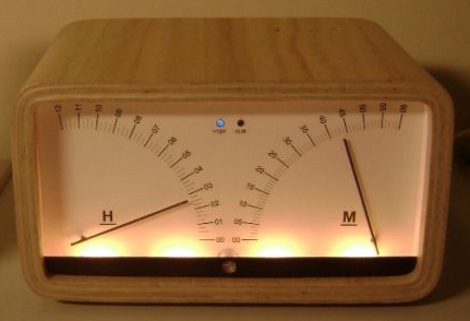

Meter Clock With Pleasing Design Considerations

[AndyO] embraced his inner geek by building this meter clock. It exhibits a lot of features that you’d want to see in a home-built timepiece, include over-complexity, abundant features, and RGB LEDs. We’re fascinated by the design he put into this. For instance, the two indicator LEDs on the clock face are not poking through the surface, but use brass tubes as light pipes. Also, the three buttons on the top are almost indistinguishable, and have an RGB back light that places a halo around each. The case itself was built by first making a form, then laminating thin sheets of wood (a difficult task due to the tight curves). The needles themselves are not actually meters, like the clock the inspired the build, but are attached to servo motors. This all comes together into a fascinating build, and a great writeup.

[Thanks Graham]

Knitting Machine Hack By Keypad Emulation

[Travis Goodspeed] and Hackaday alum [Fabienne Serriere] joined forces to develop an alternative interface for a knitting machine. They’re working with the Brother KH-930E machine. We saw [Becky Stern] use the same model by manipulating data on an emulated floppy drive for the device. [Travis] and [Fabienne] went a different route, and are emulating the keypad using an Arduino and a set of transistors.

They started by reverse engineering the keypad matrix using a continuity tester. Once they worked out the column and row layout they connected each to an NPN transistor. The Arduino sketch simulates button presses to set knitting bits for each row, with just one reset button for user input. This can be used to send data from a PC, or as a standalone system. Either way, it’s not only a great way to add functionality to the kitting machine, but a good example of how to interface with the keypad on just about any device.

Star Trek Inspired Pocket Doors

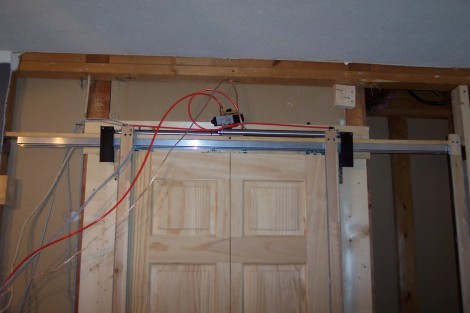
Do you have enough confidence in your hacking abilities to build a project into the walls of your home? [Marc] used his skills to build an air-powered sliding door for his bedroom. It is similar to the sliding door you’d find on the Enterprise, two sections that slide nicely into the wall to let you pass. Although the picture above shows the internals, he followed through and ended up with a fully finished room that looks fantastic. A compressor in the attic provides the pressure necessary to move the door sections. It is automated, but uses a button press or keypad combination to run instead of detecting motion. Of course, since he’s using a PIC microcontroller to drive the system there’s always room for future changes. Check out how great the finished look is in the video after the break.

Continue reading “Star Trek Inspired Pocket Doors” →

Hot Resistors Used For Color-changing Clock Face

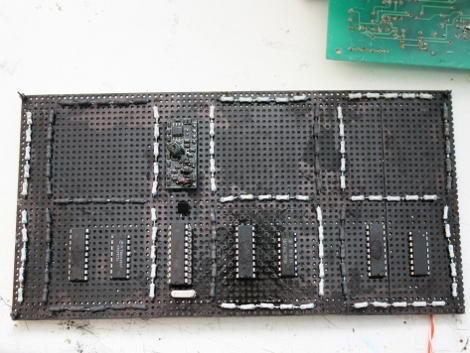
[Sprite_TM] built a full clock display using thermochromic paint. This picks up where he left off with his paint-based 7-segment display prototype. He never really saw that design through to a finished project, but he recently came across the leftover paint and decided to do something with it. Instead of making thin traces on a PCB he’s heating up resistors mounted on protoboard. Each resistor has been coated with the black/light grey paint after getting a rough sanding on the tops of the packages. Run around 500mW through a segment and they heat up enough to change the paint to light grey. Once shut off, the segments gradually fade over the next 60 seconds.

Breathing Motion Powered USB Charger

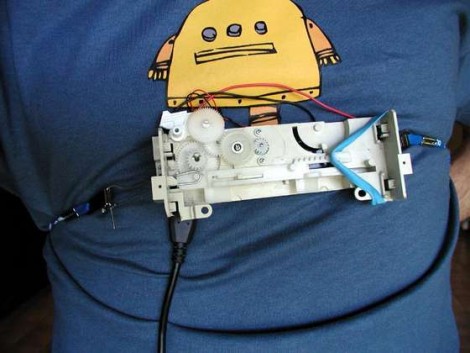
When your batteries run low you can use your body to recharge them. This contraption generates power from chest expansion while breathing. [Jmengel] used some gears from old optical drives to boost the RPM generated by a belt around your torso that he calls a thorax expansion coupler. When you breath in, that belt pulls on a plate that spins the gears, ultimately rotating a small motor. The AC current generated by that motor is run through a rectifier and a boost converter, then fed to a charging circuit.

Does it work? Not really, as this only outputs around 50 mW. But we like the twinge of Dune nostalgia we get looking at it. Wouldn’t this be a perfect addition to a stillsuit?

Classical VCR Head Jog Wheel

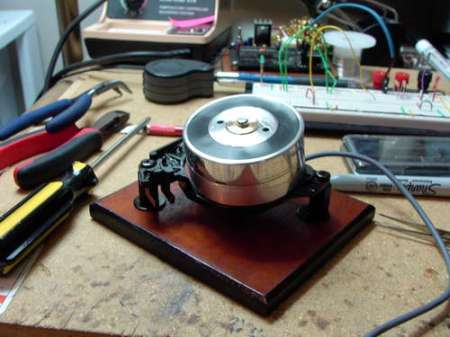
[Osgeld] takes on the classic VCR head jog wheel in this instructable. He has done a fantastic job not only in his build quality, but in the quality of the writeup. As he points out, the idea of using the head as a jog wheel isn’t new. His construction and build quality however have yielded a fantastic looking reliable device that we would be proud to have sitting on our desk.

As usual, the most interesting bits of the writeup are how he solved problems he encountered. For example, he’s using an optical mouse to detect the motion of the wheel. This requires that he print out a pattern to mount opposite the optical sensor. This sounds straight forward enough, but he found the results to be less than stellar. He documented his fix, basically reworking it in GIMP, so others can save some time. That is how tutorials should be. Great job [Osgeld].