Third-person Vehicle

Here is something we didn’t expect (NSFW). The machinima crew behind RedVsBlue, Rooster Teeth, actually did a hack!

The idea is simple enough, how could you experience driving a vehicle like in a video game – aka, third-person. With some steel bar, Canon 5D camera, and a 15inch monitor inside of a blacked out cab, they accomplished just that.

What surprised us the most, is the great difficulty and difference there is between the video game vehicle and the real life one. But all of us here at HAD know why; they need to replace the steering wheel with a joystick. While they’re at it they can make it wireless and remote-controlled. Finally a HUD would be easy enough to program (might we suggest processing). Oh dear lord, is the world ready for this!?

On-the-go Prototyping

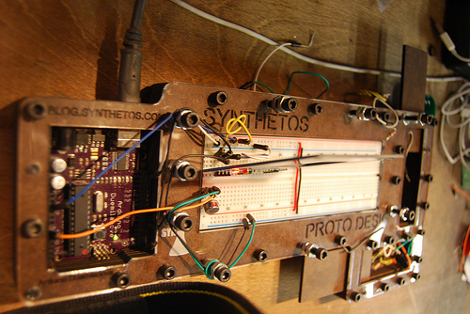
[Riley Porter] has been working on several different custom enclosure designs. Above, you can see his Proto Desk which holds a breadboard, Arduino, and has two recessed boxes with sliding tops for components and patch wires. He’s got a miniature version that gets rid of the breadboard, as well as slick-looking cases for the Bus Pirate, tinyISP, and face plates for word clocks.

Well, if you’ve got a laser cutter you should be using it right? We’ve seen [Riley’s] wares in the past; he wrote the guide for laser cutting solder stencils.

[Thanks Brian]

PC Fan Failure Alarm

[youtube=http://www.youtube.com/watch?v=Jznl8U9zzKM]

Need to monitor not only if a fan is running, but if it is running fast enough? Check out this PC fan failure alarm circuit. After several failed attempts using various circuits, they settled on a Schmitt trigger. They even show a couple variations including a manual reset and a relay instead of a buzzer.

[via HackedGadgets]

Peering In A The A4, The IPad’s Brain

Sure, tearing down devices to see what components are in there is fun. But tearing down the components themselves is even more fun. iFixit sent off their iPad guts to be laid bare after they were done with their iPad teardown. We’ve seen pictures of stripped chips in the past, but the work that Chipworks is doing for iFixit is quite amazing. Get the skinny on just about every part in there from the package markings and the die photos provided in their analysis.

The iPad has already been rooted, but you never know what power can be unlocked if you know what you’re working with. We’re thinking of the 50MHz to 100Mhz oscilloscope hack.

Solenoid Motor From A VCR Head

[youtube=http://www.youtube.com/watch?v=3nHX-66PGN0]

Here’s a solenoid motor you can build from a VCR head and some common components. It uses an LED and a light sensor, paired with an LM311 comparator to manage the switching of the motor. As the head turns, the LED shines on the sensor through a hole and triggers a TIP120 transistor to turn on the motor during the power stroke. Once the beam of light is broken, the transistor turns off the motor and the momentum carries it through its revolution until the next power stroke is activated.

We often say that “why” is the wrong question. [Bd5940] must feel the same way because he ends the video by saying: “it has no use, but definitely a conversation piece”. Yep, we’ve seen that before.

[Thanks James]

A Cop In Every Car

[Michael] designed this display board to mimic the appearance of a police car pulling you over. It resides in the rear window of his car (facing forward) as the controller board measures the speed of the vehicle. An Arduino grabs NMEA data from a GPS module and compares it with a table of speed limits. If you are speeding, based on your current location, the reds and blues flash as if you’re getting pulled over. The thrill of getting busted for a lead foot doesn’t sound like much fun to us but to each his own.

Incidentally, [Michael] is using the EM406 GPS module, the same one as the Frustromantic Box used.

Beginner Concepts: Electronic Jack-in-the-box

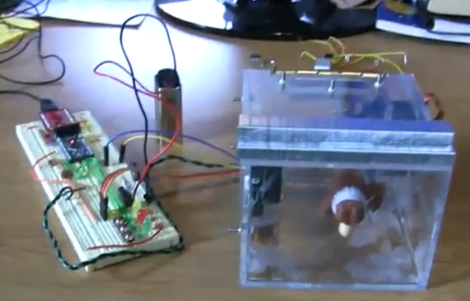
Behold the electronic Jack-in-the-box. Open the lid or enter the wrong combination and you’ll set off an alarm.  But if you get the right 6 combination code entered using the three buttons you’ll be rewarded with a little ditty and the appearance of the Jack (who lives in the box). [Jeremy Blum] designed this as part of his introduction to rapid prototyping class at Cornell University. See his description of the project after the break.

When he shared the link with us he mentioned that this might be a fun project for beginners and we couldn’t agree more. The design is easy to wrap your mind around using the provided schematic. The source code package includes PDF files that contain well commented code segments along with their descriptions. You can use this to get comfortable with driving a speaker and servo motor using an Arduino, as well as to read from two different types of inputs. We are especially interested in the hardware debounce implemented for the switch that detects if the lid is closed. Software debouncing is pretty much the standard these days but because an external interrupt is used to read the switch that method won’t work here.

If you’ve got an Arduino and few of these components why not give this a try?

Continue reading “Beginner Concepts: Electronic Jack-in-the-box” →