IM-ME Spectrum Analyzer

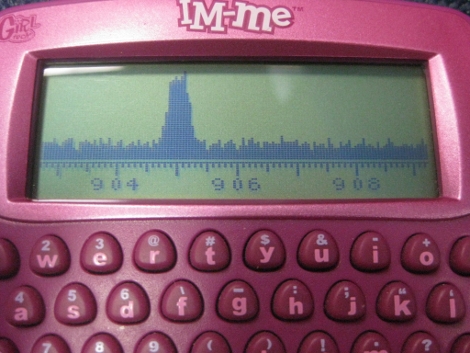
[Michael Ossmann] rolled out some firmware that makes his IM-ME into a Spectrum Analyzer. He met up with [Travis Goodspeed], who authored the IM-ME flashing guide, at SchmooCon and spent some time hacking wireless doo-dads in the hotel bar. Once he arrived home the new firmware was just a few coding sessions away from completion. It scans one frequency at a time, displaying the results in a 132 column graph on the screen. He also added a ribbon cable and header to the debug contacts so that future hacking would be as simple as plugging in the GoodFET.

[Thanks Jared and Travis]
Make Your Own OLEDS

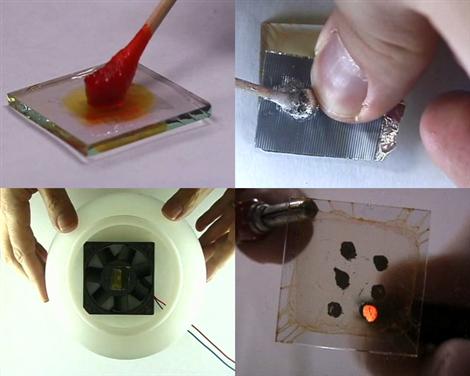
The University of Wisconsin is hosting a tutorial on how to make your own Organic Light Emitting Diodes. This is so amazingly awesome. We want you guys to make some. Someone make your own matrix and display some patterns on it and submit it. Please. Though we’ve seen lots of uses for OLED screens, we never really delved into the process of creating them. It looks much less complicated than we would have imagined.

[via MakeZine]

Bill Paxton Pinball

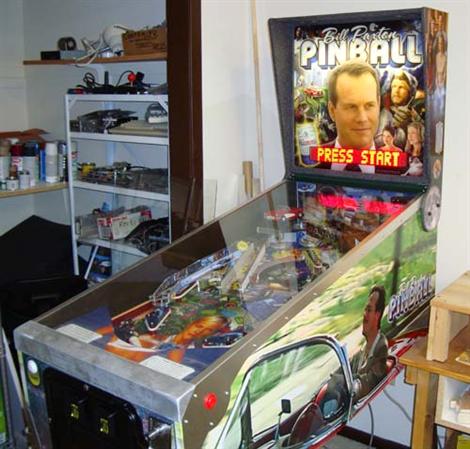
No, your eyes do not deceive you, you are looking at a [Bill Paxton] pinball machine. [Ben Heck], commonly known for his portable gaming system modifications has finally finished his pinball machine build. We’ve had our eye on it ever since [Jeri Ellsworth] challenged him to see who got theirs done first. As you can see, he’s done a fantastic job on the machine itself. He has also documented it fantastically, there’s a build log, a gallery, demonstration videos etc.

[thanks Matt]

Adding An Automotive Cold Air Intake

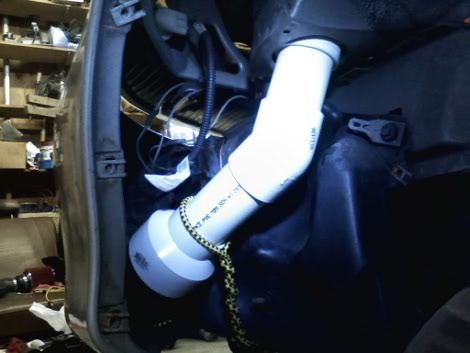
[Thomas] and a buddy were sucking down a few brews when they decided to hack their 2001 Chevy Cavalier for a bit better performance. If they could find a way to bring cooler air to the engine they speculated that they’d see an increase in efficiency. Instead of routing the air intake to a hood scoop, they took off the factory air filter and mounted a cold air filter in its place. PVC pipes were then used to create a delivery path from the front of the vehicle with the output in close proximity to the new filter. They tested their work and discovered a drop in intake temperature from 101 to 48 degrees Fahrenheit at 60 mph, and from 109 to 54 degrees Fahrenheit at 45 mph. Now the sedan runs better and generates more horsepower, all for around $35 in parts.

Electric-assist Bicycle Uses LiFePO4 Batteries

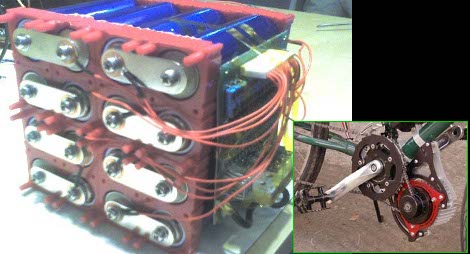
This bicycle add-on uses an electric motor to help you out. This way the motor takes advantage of the gearing normally available to the cyclist. What interests us most about the system is the DIY battery work they’re doing. The cells are using Lithium Iron Phosphate technology. The li-ion cells you’re used to seeing in consumer electronics are actually Lithium Cobalt Oxide. The Iron Phosphate flavor offers longer overall lifespan, better operation between charges over that life, and improved cold-weather performance.  The drawbacks include a 20-cycle break-in period and an affinity for trickle-charging versus faster charging methods.

The 48V cell seen above will provide 30-40 miles of travel between charges. We feel that getting the power plant out of our vehicles is an important step toward energy overhaul but it can only happen if the battery technology makes it possible. Then again, perhaps we’re barking up the wrong tree and should have placed our bets on compressed air.

[Thanks Tom]

Pure TTL Based Clock

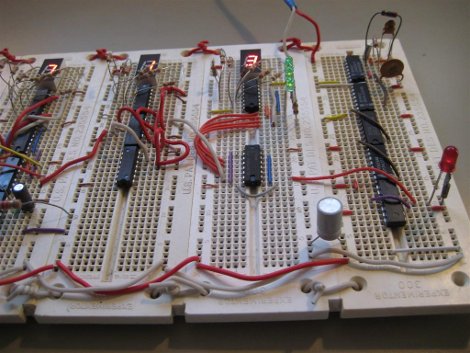
We’ll just say, [Kenneth] really likes clocks. His most recent is a pure 7400 series TTL based one, ie no microcontroller as seen in the past, here, here, and here. The signal starts out as a typical 32,768 crystal divided down to the necessary 1Hz, which is then divided again appropriately to provide hours and minutes.

As far as TTL clocks go, this is nothing too original; until it comes to his creative button interface. By using a not as sexy as it sounds multivibrator, he can produce a clean square wave instead of the figity signals produced from buttons to advance and set the time. Like always, he also provides us with a thorough breakdown of his clock, after the jump. Continue reading “Pure TTL Based Clock” →

Xbox 360 Laptop More Laptop-y Than Ever

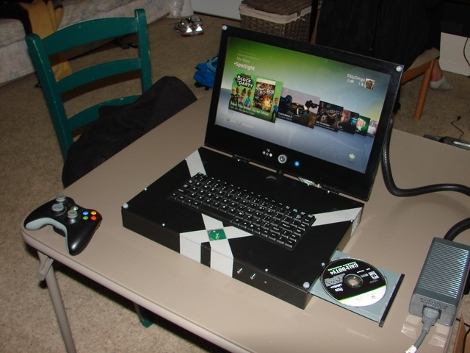
[TheTwoJ] and his friend built a laptop-form-factor Xbox 360. Their extensively documented process was inspired by [Ben Heckendorn’s] work. The result is a brick when folded up but a good-looking (albeit loud with 8 fans) gaming rig. There’s everything you would expect; LCD screen, integrated WiFi, camera, optical drive, and a full keyboard. These poor saps seem to have spent a portion of their student loan on the build but we understand how easy it is to let your budget get out of hand. They’re trying to recoup through eBay auction.

Take a look at the walk through after the break.  If you’ve got the spare dough, you can try your hand at this with our three part series on building an Xbox 360 laptop.

Continue reading “Xbox 360 Laptop More Laptop-y Than Ever” →