Berlin Hack Day

[vimeo http://vimeo.com/6668819%5D

This past weekend, Berlin played host to Music Hack Day – an event where attendants built and tested hacks, contraptions, and software all dealing with sound, music, or the distribution thereof. Some of the hacks are simply mind blowing to see built in only a day or two. Like the location based CitySounds.fm or Tracks on a Map – mapping out where your music is from. Or the music based games and composition tools, iLoveAcid squencer and MaschineFighter – adding some crazy fun to MIDI.

Oh, we almost forgot, we can’t go an entire post without mentioning something Arduino; named Xylobot – a set of servos powered by Arduino, tapping out rhythm on a xylophone (video above). Another Hack Day is planned so keep an eye out.

[Thanks robb]

Universal Credit Card In The Palm Of Your Hand

universal_credit_card

Do you remember the magnetic card spoofer in Terminator 2? It was a bit farfetched because apparently the device could be swiped through a reader and magically come up with working account numbers and pin numbers. We’re getting close to that kind of magic with [Jaroslaw’s] card spoofer that is button-programmable.

Building off of a project that allows spoofing via an iPod and electromagnet, [Jaroslaw] wanted something that doesn’t require a computer to put together the card code. He accomplished this by interfacing a 16-button keyboard and a character LCD with an AVR ATmega168 microcontroller. Card codes can be entered with the buttons and verified on the LCD. Of course this is still dependent on you knowing the code in the first place.

As you know, credit cards use this technology. We don’t think Walmart is going to be OK with you pulling this out in the checkout line, not to mention local five-oh. This technology is also used for building access in Universities, businesses, and hotels. If used in conjunction with some other spy technology you’ll be on your way to becoming a secret-agent-man.

Hacking USB Serial Port Adapters

keyspan_all (Custom)

The folks at Openschemes.com have written up an article on how to convert a USB serial port adapter to a low voltage serial interface for interfacing with microcontrollers. Though you can always just buy one, this is a fairly quick and cheap solution, especially if you are in a pinch or don’t have access to a retailer. The specific models you should watch for, are the ones with two chips, a microcontroller and a line translater.They go through the process of finding exactly where to patch in to add an extra interface. It only takes a couple wires and you are ready to go.

Not only can you use this as your serial connection to another microcontroller, but you can actually take control of the one on the board itself. If you load it with the drivers from TI, you gain access to the flash memory and can do whatever you want. They don’t go into much detail here though, stating that they’ll write another article on that.

We thought this little bugger looked familiar so we went digging through our archives.  Sure enough, we found this system in action back in January of 2008.

[via Hacked Gadgets]

Photographic Key Duplication

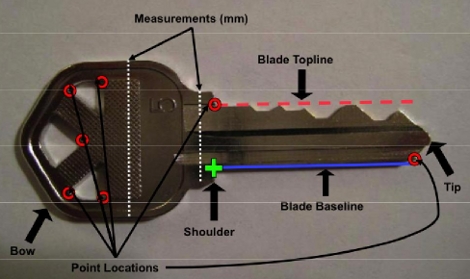
[Ben] and his associates over at the University of California at San Diego came up with a way to duplicate keys using a picture of them. They developed an algorithm that uses measurements from known key blanks to extrapolate the bitting code. Because the software is measuring multiple points it can correct the perspective of the photo when the key is not photographed on a flat surface, but from an angle.

They went so far as to test with cell phone cameras and using a telephoto lens from 195 feet away. In most cases, correct keys were produced within four guesses. Don’t miss their wonderful writeup (PDF) detailing how key bitting works, traditional covert duplication methods, and all the details of their process. The lack of available code prevents us all from playing secret agent (or felon) with this idea but [Ben] did mention that if there is sufficient interest he might release it.

Lock bumping showed us how weak our security is, but this is a bit scary.

[Thanks Mike]

Seawater Cooled Data Centers

swac-mauritius

Remember Mauritius from High School geography? We didn’t either, but apparently it’s a small island nation east of the southern tip of Africa. It seems they are trying to develop an industry in eco-friendly data centers. The plan is to use a pipeline to gather cold water from the ocean, run it two miles to the island, and use it as inexpensive cooling. Because rooms packed with servers generate copious amounts of heat it’s easy to see how this can reduce the cost of maintaining a data center.

The thing that struck us here is, how eco-friendly is this? The article mentions that this technology is fairly mature and is already used in several places. With that in mind, isn’t this just another way to raise the temperature of the oceans, or does the environmental savings of not using electricity or gas to produce the cooling offset this?

[Thanks Vesanies]

New Wii Drive Hardware Emulation

wii_drive_emulation

The Wii-Optical-Drive-Emulator (WODE) makes it possible to load Wii and GameCube ISO files from an SD card or USB storage device. This hack uses the ribbon cable for the optical drive to connect to the Wii, requiring no soldering. The WODE is based on an ARM9 processor, runs Linux, and features a backlit LCD screen and 4-way center click joystick. Storage can be hot plugged and then an ISO selected using the stick and LCD display. Selected ISO files appear in the game channel as if an original disc had just been inserted into the drive.

The developers claim that a Wii firmware upgrade will not be able to lock out the WODE. There is also a second ribbon-cable connector to use as a pass-through, giving the option to keep the optical drive hooked up if you so desire. Now the race is on for a replacement case that can house all of this new hardware and still look nice like the original. We wouldn’t be surprised to see a homebrew channel program that allows ISO selection without having to walk over to the console.

The original report (in dutch) is a dead link so here’s the Google cache copy translated. These links came via the translated Tweakers article (here’s the original Dutch). Video after the break. Don’t pirate video games!

[Thanks Roy]

Continue reading “New Wii Drive Hardware Emulation”

TI Lashes Out At Their Biggest Fans

ti

Texas Instruments has issued a DMCA notice to United TI, a group of enthusiasts. They had been cracking the keys that sign the operating system binaries in an attempt to gain access and possibly expand on the features. This seems, at least a little counter productive to us. Texas Instruments doesn’t sell the operating system separately do they? These people were buying their product and expanding on it. There is no difference in their income, except possibly a gain as people flock to the one they can modify. Maybe they are charging more for an expanded feature set that is crippled in the OS.

[via slashdot]