IKEA Linux Cluster


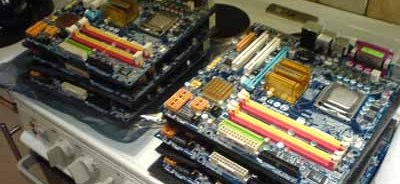
Building a render cluster doesn’t mean you have to spend a lot of money, even if you’re buying brand new hardware. [Janne] built this 6 unit cluster inside of a 6 drawer IKEA Helmer cabinet. He wanted the cluster to be low power and low cost. After finding a good price on 6 65nm Intel Core 2 CPUs, he found 6 cheap Gigabyte motherboards. The memory on each board was maxed at 8GB. With 24 2.4GHz cores consuming 400W, the power consumption and cost isn’t much more than a high end PC. Each board is running Fedora 8 and mounts an NFS share. Dr Queue is used to manage the render farm’s processes. [Janne] says jobs that previously took all night now only require about 10-12 minutes. The estimated capacity is 186Gflops, but plans are already in motion for a12Tflop version.

His site also has plans for an underwater camera housing like our recent post. If you want to see more IKEA abuse, check out IKEA Hacker, even if it’s not very technical.

[via Hackzine]

[UPDATE: yep, we duped ourselves]

Nintendo DS Music Creation

[youtube=http://www.youtube.com/watch?v=MQCZnwNr0ms&hl=en]
Homebrew developer [yaarglafr] recently released this video of his Protein DScratch in action. You can download a demo version here. The program simulates DJ scratching on the DS with an intuitive interface much like the ones on the touchscreen turntables we discussed the other day. It works well with any of the major DS slot devices; just run a DLDI patch on it and you’re good to go.

Continue reading “Nintendo DS Music Creation” →

LCD Projector Repair


[Kieth] picked up an Infocus projector only to find that it needed some repair. The polarizer on the blue light path was toast. When he parted out an Optoma projector he scored a polarizer that was just about right for the repair. It’s a good read even if you don’t have a projector in pieces at the moment. He ended up bending the mounting bracket a bit to hold the filter and got his projector fully up and running again.

Metalab’s LED Matrix Display


Our friends at Vienna’s Metalab have been working on this project quite a while. Soldering their hearts out to create an FPGA controlled monochrome LED dot matrix display. It’s 48×72 array totaling 3,456 LEDs, soldered by hand. It creates some serious geek bling thanks to an mplayer plugin developed just for the project and it runs up to 72fps. Build details and source code are on the project page. Be sure to check out the awesome video demo below.

Continue reading “Metalab’s LED Matrix Display” →

Underwater Camera Housings

Underwater cameras can produce some amazing photography, but who wants to pay for housing if you can make something yourself?

This underwater camera housing on Instructables doesn’t require a specific container, allowing you to choose anything you have around the house that’s watertight and large enough to fit your camera. A finger from a glove is added so you can still operated the controls. A similar project uses an insulated water jug, accommodating any camera that fits inside. Neither of these involve any camera mods.

Continue reading “Underwater Camera Housings” →

PIC Controlled Spray Paint


Most people make LEDs light up for their first microcontroller project. [Alex] built a “large scale dot matrix printer.” This beast is a PIC controlled ground graffiti machine. As it rolls across the ground it deposits strategically located bits of spray paint. Rather than use actual spray paint, he opted for a set of solenoid controlled nozzles that shoot the paint downward.

IControlpad, IPhone Gamepad


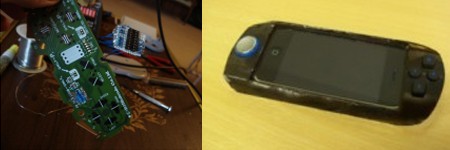
[CraigX] has been dabbling in iPhone accessories lately by adding a gamepad. Called the iControlpad it surrounds the iPhone making it look very PSP like. As anyone who has jailbroken and installed emulators probably knows, without feedback the touch screen based buttons are less than great.

The unit is currently a prototype however there are plans to produce and sell the units. They have received support from Zodttd, an organization that has created iPhone apps like snes4iphone and genesis4iphone. The developers also state they’ll provide source and SDK support. The sparse development blog announces their success using a hacked up SNES controller over the docks serial connector, but they provide absolutely no details.

[via Engadget]