Is A LEGO 3D Printer By Definition Self-replicating?

lego-3d-printer

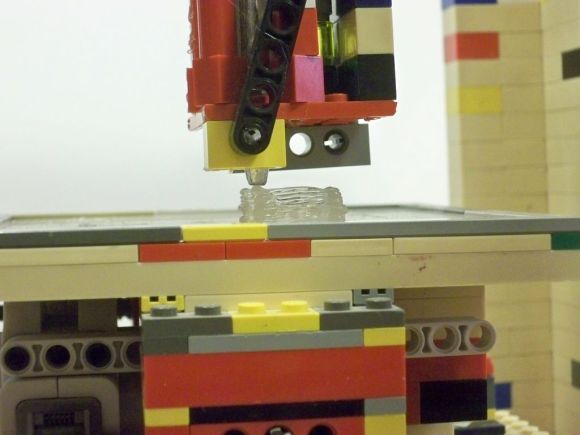
LEGO parts are plastic. 3D printers make parts out of plastic. So the transitive property tells us that a LEGO 3D printer should be able to recreate itself. This one’s not quite there yet, mostly because it doesn’t use plastic filament as a printing medium. Look close and you’ll probably recognize that extruder as the tip of a hot glue gun. If all else fails you can use the machine as a precision hot glue applicator.

The instructions to make your own version include the design reference and a few ideas for getting the most out of the glue dispenser. For the design phase [Matstermind] used LEGO Digital Designer. It’s basically CAD with the entire library of LEGO parts available as building blocks. from there he assembled the machine which is controlled by an NXT brick. He goes on to link to a few different printing mediums. There’s instructions for using crayons to make colored glue sticks, as well as a method of printing in sugar using the hot glue extruder.

We remember seeing one other LEGO 3D printer. That one didn’t use an extruder either. It placed blocks based on the design to be printed.

Continue reading “Is A LEGO 3D Printer By Definition Self-replicating?”
The Tiniest Arcade Cabinets You’ve Ever Seen

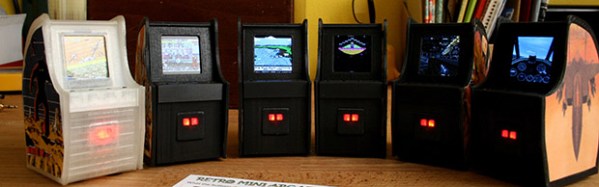
After perusing Amazon one day, [Dave] found a very interesting piece of kit: a small, 1.5″ digital picture frame. They’re not very complex, just an LCD, a few buttons to cycle the picture, and a battery to keep everything portable. He decided the best use of this tech would be a tiny arcade cabinet, featuring screen shots of the best games a darkly neon lit arcade of the late 80s had to offer.

After sourcing a few of these digital picture frames on eBay, [Dave] set to work disassembling the frames and designing a custom enclosure. He wanted a few specific features: controls in the right place, replaceable sides, and the glowing red eyes of a coin acceptor slot. [Dave] whipped a model up in OpenSCAD and sent the parts over to his printer.

The controls for the digital picture frame were connected to a quartet of tact switches on the control panel, and a red LED provides the glow from the coin acceptor. With a USB plug and the frame’s memory loaded up with screen shots, [Dave] has a fabulous desk toy.

All the relevant files are up on Thingiverse if you’d like to build your own.

3D Printed Dispenser Flings Treats At Your Pets

internet-connected-dog-treat-dispenser

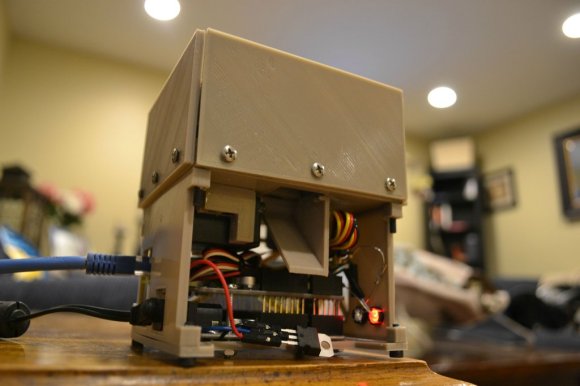
If you’re stuck in the virtual world like [Kevin Flynn] you can still make sure your pup is rewarded for good behavior. Just follow [Jwarp’s] design for this Internet connect dog treat dispenser.

We were actually a bit surprised by the demo video. It shows that the compact unit is more than capable of reliably dispensing one treat at a time. It started as a wood prototype which allowed him to tweak how the servo motors worked before laying out all of the 3D parts in Sketch Up. Two motors cooperate to get the job done. The first allows one treat to exit that shoot coming from the center of the hopper. The other stirs the remaining inventory to both position the next treat and loosen any jams.

Continue reading “3D Printed Dispenser Flings Treats At Your Pets”

We’ve Found The Awesome Singularity

tardis

Yes, that’s exactly what you think it is. A Transformer. That transforms into the TARDIS.

This masterpiece of pop culture is the work of [Nonnef] over on Instructables. After the inspiration to create this work of art struck, [Nonnef] started modeling this Transformer and TARDIS in clay to make everything fit together just right. After a good bit of 3D modelling, the Doctor’s robotic wife was ready for printing.

If you’re going to print one of these for yourself, be prepared for a very long print. [Nonnef] says the latest version took about 30 hours on his RepRap with a .35 mm nozzle. In the end nearly the entire Transformer came directly from a 3D printer, the only additional parts needed being a pen spring and a small screw. Paint is, of course, optional.

All the files are available on the Instructable.

3D Printing With Liquid Metals

Gallium

While 3D printers of today are basically limited to plastics and resins, the holy grail of desktop fabrication is printing with metal. While we won’t be printing out steel objects on a desktop printer just yet, [Collin Ladd], [Ju-Hee So], [John Muth], and [Michael D. Dickey] from North Carolina State University are slowly working up to that by printing objects with tiny spheres of liquid metal.

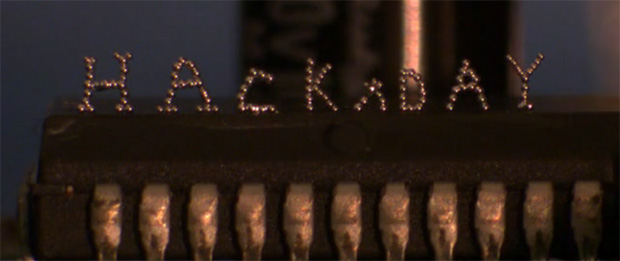
The medium the team is using for their metallic 3D prints is an alloy of 75% gallium and 25% indium. This alloy is liquid at room temperatures, but when exposed to an oxygen atmosphere, a very thin layer of oxide forms on a small metal bead squeezed out of a syringe. Tiny metal sphere by tiny metal sphere, the team can build up metallic objects out of this alloy, stacking the beads into just about any shape imaginable.

In addition to small metal spheres, [Collin] and his team were also able to create free-standing wires that are able to join electrical components. Yes, combined with a pick and place machine, a printer equipped with this technology could make true printed circuit boards.

Even though the team is only working on very small scales with gallium, they do believe this technology could be scaled up to print aluminum. A challenging endeavour, but something that would turn the plastic-squeezing 3D printers of today into something much more like the Star Trek replicators of tomorrow.

Video demo below, or check out [Collin]’s editing room floor and a vimeo channel. Here’s the paper if you’ve got a Wiley subscription.

Continue reading “3D Printing With Liquid Metals”

3D Printed Bike Shifter

Shifter

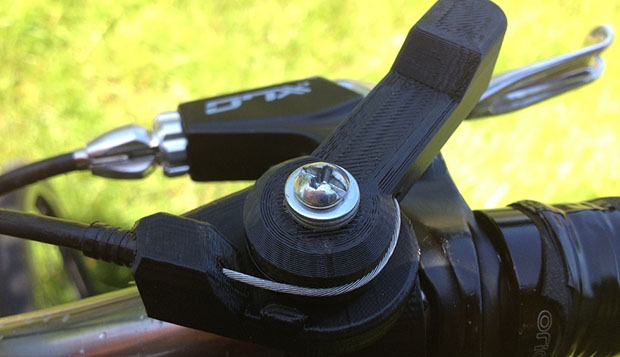
[Rich] is embarking on a fairly long bike trip in a few weeks – Seattle to Portland – and thought including some 3D printed gear on his ride would be a fun endeavor. His first idea was a printed belt drive, but the more he looked at that idea the less realistic it seemed. He finally hit upon the idea of creating a 3D printed bike shifter, and after an afternoon of engineering and printing, the shifter ended up working very well.

[Rich]’s shifter is actually a friction shifter. Instead of ‘clicking’ into position, this type moves the derailleur gradually. It’s much more tolerant of slight misalignment, and most touring bikes – the type that would embark on long journeys along the coast of the Pacific northwest – have these types of shifters.

Total printing time was about one and a half hours, and was attached to [Rich]’s bike with off-the-shelf hardware. He’s already put about 150 miles on his custom designed shifter with no signs of failure.

3D Printed Pip-Boy, Geiger Counter Not Included

pip

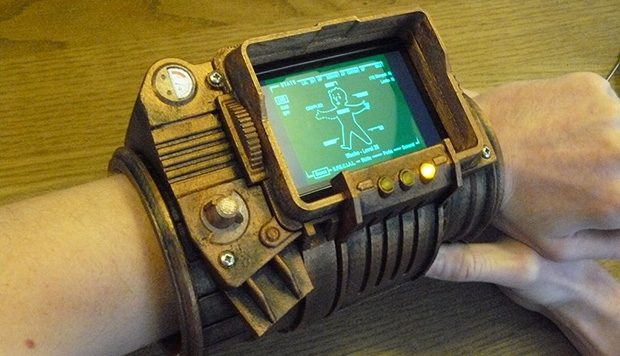
Yes, we all love portal guns and crowbars, but there’s one piece of video game paraphernalia that could conceivably be a useful piece of hardware for the modern technologist. It’s the Pip-Boy 3000, the wrist-wearable computer from Fallout, and now you can print on on your 3D printer.

All the pieces for this Pip-Boy are available over on Thingiverse. Included in those files are a dozen plastic parts that, when assembled, come together to form a wrist-mounted computer. You could, of course, print out a static image of a Pip-Boy screen for this build, but [dragonator] made a little addition to his model – he put in a space for a smartphone, so all your environmental sensors and inventory management also work with this 3D printed model.

This is far from the first wearable Pip-Boy we’ve seen, but it is the first that’s able to be fabricated on a 3D printer, and comes with the nice bonus of being the best phone case ever. It’s still a lot of work to put this together, but we’re going to say the results are fantastic.

You can check out the demo video of the Pip-Boy below.

Continue reading “3D Printed Pip-Boy, Geiger Counter Not Included”