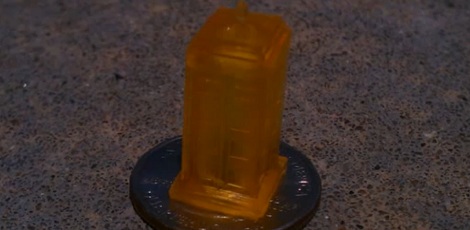
3D DLP Printer Builds An Orange TARDIS

This micro-sized TARDIS is the latest print from [Ron Light]’s Sedgwick 3D DLP printer. Yes, it’s orange, but the print quality for such a small object is pretty astounding.

The Sedgwick 3D printer is currently available as a kit on Kickstarter. For five hundred bones, the Sedgwick provides all the parts – minus a DLP projector and resin – to make your own miniature Type 40 with a broken chameleon circuit. There’s a lot more this printer can do, from miniature cathedrals to hollow geodesic spheres.

This is the latest in what will be a long line of DLP projector / resin 3D printers, and the most affordable one to date. The last one we saw was an awesome $2400 machine that included a projector and resin. At $500 for a projector-less kit, the Sedgwick still handily beats even the cheapest option we’ve seen so far.

[Ron Light] is from Kansas City, and our boss man [Caleb] ran into him at the KC Maker Faire a few weeks ago. You can check out that little interview and a few videos of the Sedgwick doing its thing after the break.
Continue reading “3D DLP Printer Builds An Orange TARDIS”

Printing Organs With A 3D Printer

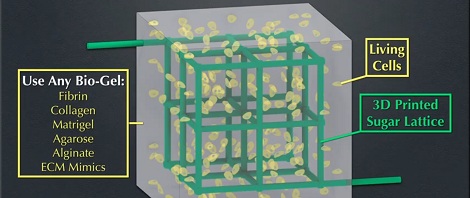
[Jordan Miller], [Christopher Chen], and a whole bunch of other researchers at the department of bioengineering at U Penn have figured out a way to print 3D tissues using a 3D printer. In this case, a RepRap modified to print sugar.

Traditional means of constructing living 3D tissues face a problem – in a living body, there’s a whole bunch of vasculature sending Oxygen and nutrients to the interior cells. In vitro, these nutrients can’t get to the cells in the core of a mass of tissue. [Jordan], [Chris], et al. solved this problem by printing a three-dimensional sugar lattice. After encasing this lattice in a gel embedded with living cells, the sugar can be dissolved and the nutrients pumped through the now hollow capillaries in the gel.

If you have access to Nature, the full text article is available here. There’s also a great video showing off this technique after the break.

Continue reading “Printing Organs With A 3D Printer”

Printing And Programming A Self-balancer

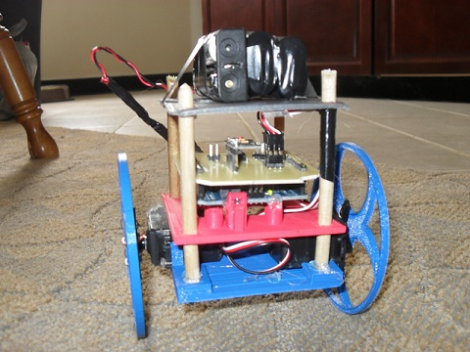
The Hackaday staff isn’t in agreement on 3d printers. Some of us are very enthusiastic, some are indifferent, and some wonder what if they’re as widely useful as the hype makes them sound. But we think [Jason Dorweiler’s] self balancing robot is as strong a case as any that 3d printing should be for everyone!

Don’t get us wrong. We love the robot project just for being a cool self-balancer. Seeing the thing stand on its own (video after the break) using an Arduino with accelerometer and gyroscope sensors is pure win. But whenever we see these we always think of all the mechanical fabrication that goes into it. But look at the thing. It’s just printed parts and some wooden dowels! How easy is that?

Sure, sure, you’ve got to have access to the printer, it needs to be well calibrated, and then you’ve got to make the designs to be printed out. But these hurdles are getting easier to overcome every day. After all, there’s no shortage of people to befriend who want nothing more than to show off their Makerbot/RepRap/etc.

Continue reading “Printing And Programming A Self-balancer”

Don’t Bring Your 3d Printer To MakerFaire

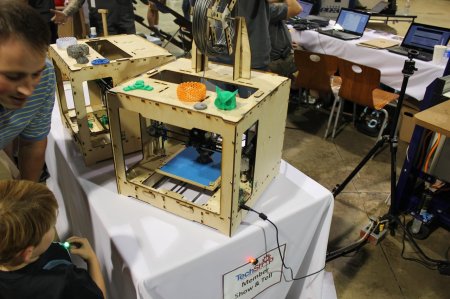
This could easily be called “the year of the 3d printer”. They are in the news, in every hackerspace, and at every event. This last one is the one I’m going to focus on here. All the coverage we’ve seen as well as our personal experience shows that MakerFaires are filled with 3d printers. At MakerFaire K. C., there were so many that I lost count. I didn’t even bother taking pictures or stopping to look after a while. Many were makerbots, though a few repraps were present too.

If you want to be noticed at MakerFaire, DON’T BRING A 3D PRINTER AS YOUR SOLE DISPLAY.

Continue reading “Don’t Bring Your 3d Printer To MakerFaire”

NC Maker Faire 2012: Machine Tools And 3D Printers

NC Maker Faire 2012 3D printer

There were quite a few 3D printers at the NC Maker Faire this year (like the [Fablicator], several [RepRap]s, and [MakerBot]s) as well as a few subtractive machining devices including a wood lathe, a [ShopBot] display (one of the sponsors), and my little CNC router. There was even a little [Eggbot] on display, which combines several CNC concepts into a really unique device for printing a picture on an egg.

Check out the video below for lots of examples of what was at the Faire. There’s always room for one more 3D printing or CNC machining enthusiast, so hopefully it inspired some makers to expand their capabilities! Continue reading “NC Maker Faire 2012: Machine Tools And 3D Printers”

Salvaged Robot Arm Makes A Big 3d Printer

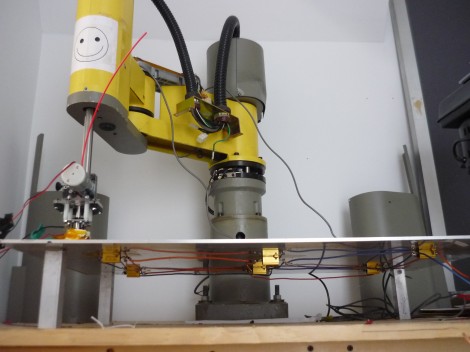
Wow, building a precision 3d printer is amazingly easy if you can get your hands on an industrial-quality robot arm. [Dane] wrote in to tell us about this huge extruder printer made from an ’80s-era SCARA robot arm. It is capable of printing objects as large as 25″x12″x6.5″.

This 190 pound beast was acquired during a lab clean out. It was mechanically intact, but missing all of the control hardware. Building controllers was a bit of a challenge since the it’s designed with servo motors and precision feedback sensors. This is different from modern 3d printers which use stepper motors and no feedback sensors. A working controller was built up one component at a time, with a heated bed added to the mix to help prevent warping with large builds. We love the Frankenstein look of the controller hardware, which was mounted hodge-podge as each new module was brought online.

You can see some printing action in the clip after the break. A Linux box takes a design and spits out control instructions to the hardware.

Continue reading “Salvaged Robot Arm Makes A Big 3d Printer”

Tearing Apart A Hot Glue Gun For A 3D Printer

If you’re building a 3D printer, the most complicated part is the extruder. This part uses a series of gears to pull plastic filament off of a spool, heats it up, and squirts it out in a manner precise enough to build objects one layer at a time. [Chris] made his own extruder out of a hot glue gun and made it so simple we’re surprised we haven’t seen this build before.

The basic operations of a plastic extruder – pushing a rod of plastic through a heated nozzle – already exists in a hot glue gun available for $3 at WalMart. To build his printer, [Chris] tor apart the hot glue gun and mounted the nozzle on a piece of plywood. The hot glue sticks are fed into the nozzle with the help of a 3D printed gear and a stepper motor driver.

After the break, you can see [Chris]’s hot glue gun RepRap printing a 10cm cube. It’s not fast, but the quality is exceptional, especially considering he made it out of a hot glue gun.

Continue reading “Tearing Apart A Hot Glue Gun For A 3D Printer”