Life Size Lancer Becomes Gears Of War Motion Controller

Gears of War is a franchise famous for its giant gun with a big chainsaw on the front. [Eric] laid his hands on a toy replica, and decided it had to become a usable motion controller for the game.

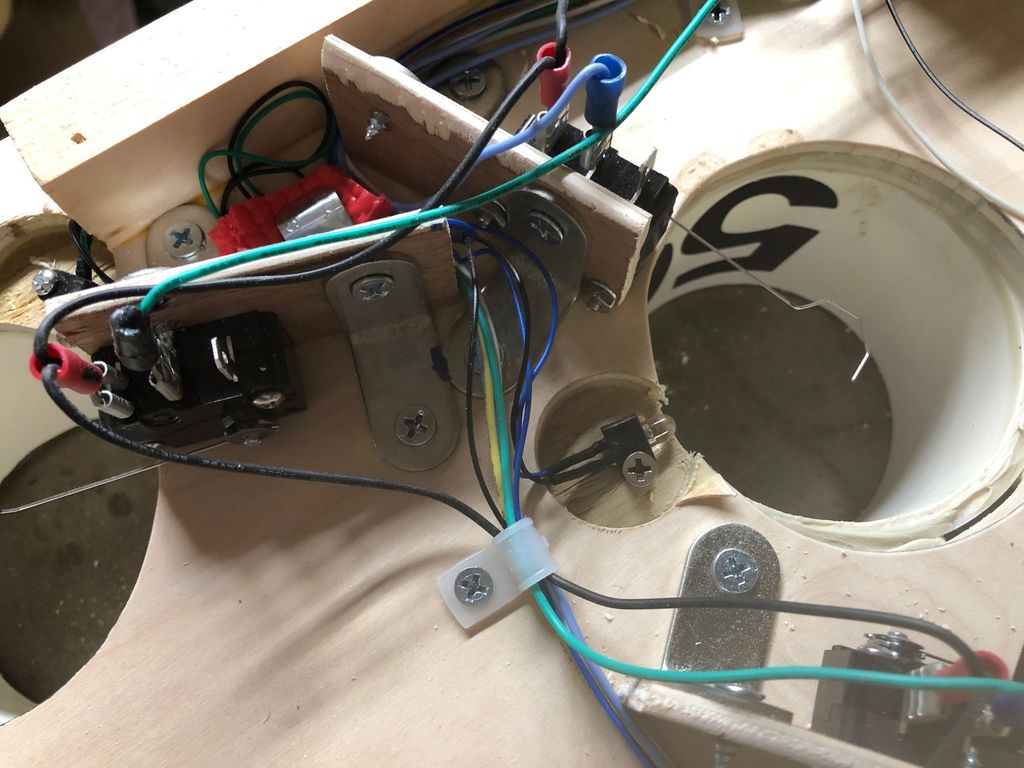
The build is straightforward, following the usual format for motion controller builds. Fitted with a gyroscope and accelerometer, it’s interfaced to the PC using a microcontroller. The toy has a trigger which is hooked up to the fire button in game. Additional buttons were added to the shell for movement and other actions such as reloading and finding cover. As a nice final touch, the large pull handle on the left of the weapon is used to activate the chain saw in-game.

While it’s unlikely to be competitive with a mouse or even gamepad in practice, it’s hard to argue against the fun of wielding a full-size, 10-pound weapon when playing Gears of War 5. [Eric] has also shared a basic controller hacking guide for those eager to get into similar builds themselves. We’ve featured [Eric]’s work before, too – with this epic Minecraft pickaxe build. Video after the break.

Continue reading “Life Size Lancer Becomes Gears Of War Motion Controller”
Skee-Ball Scoring With Coin Slot Switches

Bowling is great and all, but the unpredictability of that little ball jump in Skee-Ball is so much more exciting. You can play it straight, or spend a bunch of time perfecting the 100-point shot. And unlike bowling, there’s nothing to reset, because gravity gives you the balls back.

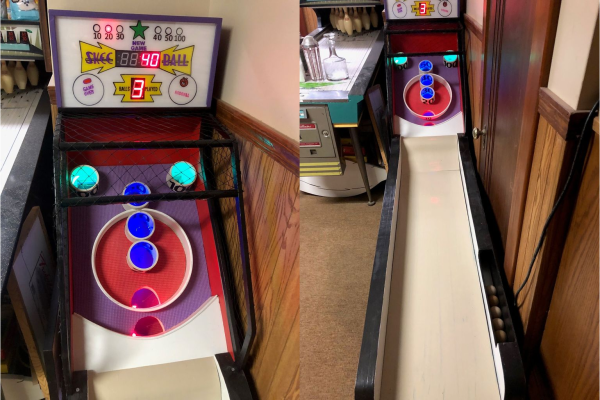
In one of [gcall1979]’s earlier Skee-Ball machines, gravity assisted the scoring mechanism, too: each ball rolls back to the player and lands in a lane labeled with the corresponding score, which is an interesting engineering challenge in its own right. He decided to build automatic scoring into his newest Skee-Ball machine.

At the bottom of each cylinder is an arcade machine coin door switch with a long wire actuator. These had to be mounted so they’re close enough to the hole, but out of the way of the balls.

Each switch is wired up to an Arduino Mega along with four large 7-segments for the score, and a giant 7-segment to show the number of balls played. Whenever the game is reset, a servo drops a door to release the balls, just like a commercial machine.

The arcade switches work pretty well, especially once he bent the wire into hook shape to cover more area. But they do fail once in a while, maybe because the targets are full-size, but the balls are half regulation size. For the next one, [gcall1979] is planning to use IR break-beam targets which ought to work with any size ball. If you prefer bowling, you won’t strike out with break-beam targets there, either.

Finding The Random Seed Of Minecraft’s Title Screen

Minecraft is a game about exploring procedure-generated worlds. Each world is generated from a particular “seed” value, and sharing this seed value allows others to generate the same world in their own game. Recently, the distributed computing project Minecraft@Home set about trying to find the seed value of the world shown in the Minecraft title screen, and have succeeded in their goal.

The amount of work required to complete this task should not be underestimated. 137 users contributed 181 hosts with 231 GPUs to the effort, finding a solution in under 24 hours. The list of contributors to the project is a long one. It appears the method to find the seed involved comparing screenshots from various seed worlds to the original image. This took a lot of reverse engineering in order to calculate the camera FOV and other settings of the original capture, such that the results could be compared accurately. Interestingly, the group found two seeds that can generate the requisite world, suggesting the world generator code has some collisions between seed values.

We’re not sure what’s more astounding, the amount of work that went into the project, or that there’s a distributed computing project tackling advanced Minecraft research. Either way, we’re no strangers to Minecraft hacks around these parts. Video after the break. Continue reading “Finding The Random Seed Of Minecraft’s Title Screen”

Four On The Floor For Your Virtual Race Car

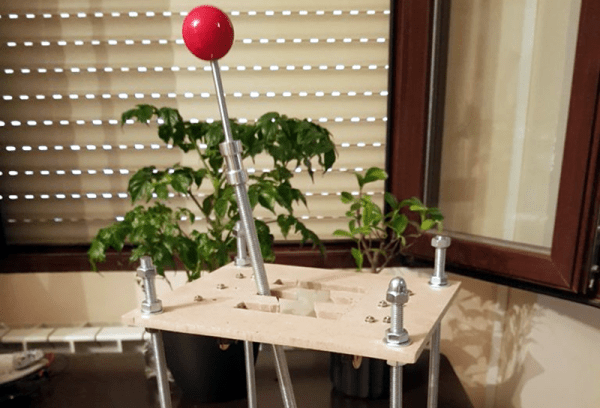
There was a time when building realistic simulations of vehicles was the stuff of NASA and big corporations. Today, many people have sophisticated virtual cockpits or race cars that they use with high-resolution screens or even virtual reality gear. If you think about it, a virtual car isn’t that hard to pull off. All you really need is a steering wheel, a few pedals, and a gear shifter. Sure, you can build fans to simulate the wind and put haptics in your seat, but really the input devices alone get you most of the way there. [Oli] decided he wanted a quick and easy USB gear shifter so he took a trip to the hardware store, picked up an arcade joystick, and tied it all together with an Arduino Leonardo. The finished product that you can see in the video below cost about $30 and took less than six hours to build.

The Leonardo, of course, has the ability to act like a USB human interface device (HID) so it can emulate a mouse or a keyboard or a joystick. That comes in handy for this project, as you would expect. The computer simply has to read the four joystick buttons and then decide which gear matches which buttons. For example up and to the left is first gear, while 4th gear is only the down button depressed. A custom-cut wooden shifter plate gives you the typical H pattern you expect from a stick shift.

Continue reading “Four On The Floor For Your Virtual Race Car”

Super Mario 64 As Experienced By Mario

Microsoft’s Kinect, a motion-sensing peripherial originally for the Xbox 360, is almost exactly a decade old now. And in that decade it has expanded from its limited existence tied to a console to a widely-used tool for effective and detailed motion sensing, without breaking the bank. While it’s seen use well outside of video games, it’s still being used to reimagine some classic games. In this project, Reddit user [SuperLouis64] has used it to control Mario with his own body.

While the build still involves some use of a hand controller, most of Mario’s movements are controlled by making analogous movements on a small trampoline, including the famed triple jump. The kinect is able to sense all of these movements and translate them into the game using software that [SuperLouis64] built as well. The trickiest movement seems to be Mario’s spin movement, which appears to have taken some practice to get right.

We appreciate the build quality on this one, and [SuperLouis64]’s excitement in playing the game with his creation. It truly looks like a blast to play, and he even mentions in the Reddit thread that he’s gotten a lot of productive excercise with his various VR and augumented reality games in the past few months. Of course if this is too much physical activity, you could always switch to using your car as the unique game controller instead.

Continue reading “Super Mario 64 As Experienced By Mario”

Jerry Lawson biography

Jerry Lawson And The Fairchild Channel F; Father Of The Video Game Cartridge

The video game console is now a home entertainment hub that pulls in all forms of entertainment via an internet connection, but probably for most readers it was first experienced as an offline device that hooked up to the TV and for which new game software had to be bought as cartridges or for later models, discs. Stepping back through the history of gaming is an unbroken line to the 1970s, but which manufacturer had the first machine whose games could be purchased separately from the console? The answer is not that which first comes to mind, and the story behind its creation doesn’t contain the names you are familiar with today.

The Fairchild Channel F never managed to beat its rival, the Atari 2600, in the hearts of American youngsters so its creator Jerry Lawson isn’t a well-known figure mentioned in the same breath as Atari’s Nolan Bushnell or Apple’s two Steves, but without this now-forgotten console the history of gaming would have been considerably different.

Continue reading “Jerry Lawson And The Fairchild Channel F; Father Of The Video Game Cartridge”

(Re)Making A ColecoVision

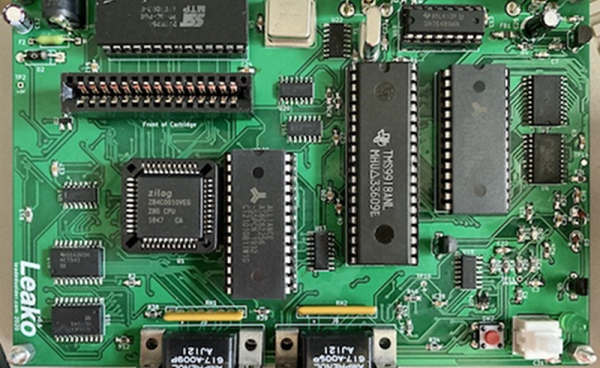
[Leaded Solder] found some ColecoVision game cartridges at a flea market, and like most of us would, thought, “I’ll build a ColecoVision console from scratch to play them!” Well, maybe most of us would think of that, but not actually do it. He did and you can read about the results in great detail since he wrote up two posts, one covering the design and one covering the construction.

The ColecoVision was a game console that famously could be expanded into a nice — for its day — personal computer. It even had a daisy wheel printer in that configuration. However, in either configuration, the game console was the brains of the operation. According to [Leaded Solder] the price of a unit in working order is high even though over 2 million were made because of several design problems that make them less likely to survive the decades. Rather than repair and modify an original unit, it was cheaper and much more educational to build new.

Continue reading “(Re)Making A ColecoVision”