Retrotechtacular: Hacking Wartime Mail

I’m guessing you got quite a few e-mails today. But have you ever had a v-mail? That sounds like some new term for video e-mail, but it actually dates back to World War II. If you are in Europe, the term was Airgraph — not much more descriptive.

If you make a study of war, you’ll find one thing. Over the long term, the winning side is almost always the side that can keep their troops supplied. Many historians think World War II was not won by weapons but won by manufacturing capability. That might not be totally true, but supplies are critical to a combat force. Other factors like tactics, doctrine, training, and sheer will come into play as well.

On the other hand, morale on the front line and the home front is important, too. Few things boost morale as much as a positive letter from home. But there’s a problem.

While today’s warfighter might have access to a variety of options to communicate with those back home, in World War II, communications typically meant written letters. The problem is ships going from the United States to Europe needed to be full of materials and soldiers, not mailbags. With almost two million U.S. soldiers in the European Theater of Operations, handling mail from home was a major concern.

British Mail Hack

The British already figured out the mail problem in the 1930s. Eastman Kodak and Imperial Airways (which would later become British Airways) developed the Airgraph system to save weight on mail-carrying aircraft.  Airgraph allowed people to write soldiers on a special form. The form was microfilmed and sent to the field. On the receiving end, the microfilm was printed and delivered as regular mail.


Continue reading “Retrotechtacular: Hacking Wartime Mail”

BOM Cost Optimization And Tindie Badge Engineering

For the last few months, I’ve been up to my neck in electronic conference badges. This year, I created the single most desirable badge at DEF CON. I also built a few Tindie badges, and right now I’m working on the logistics behind the Hackaday SuperConference badge. Sit tight on that last one — we’re doing something really, really special next month.

Most badge projects are one-off production runs. This is to be expected from a piece of hardware that’s only meant to be distributed at a single event. The Tindie badge is different. It’s now a thing, and we’re building multiple badges for all the cons and conferences Hackaday and Tindie are attending for the rest of the year. This means I have the opportunity to do hardware revisions on the Tindie badge. Right now I’ve built three versions of the Tindie and we’ve distributed about two thousand of these kits at DEF CON, Maker Faire New York, and the Open Hardware Summit.

After about two thousand units, I think we finally have this down. This is how I designed three versions of hardware in as many months and cut the BOM cost of each badge in half. This is bordering on a marginally impressive piece of engineering, and a great lesson on BOM cost optimization.

Continue reading “BOM Cost Optimization And Tindie Badge Engineering”

A 3D Printer Alone Doesn’t Make A Hackspace

There was a time when hackspaces were few and far between — legendary environments that you’d read about online, where amazing projects were made by people who had come together to form communities of creative technology enthusiasts. Of course, they were always in places far afield, California, or Germany, never in provincial England where I call home. Eventually our movement spread its tentacles into the county towns, and several years later with a stint as a hackspace director behind me I sense that it is on the cusp of escaping its underground roots. Every month seems to bring news of yet another organisation wanting to open a makerspace of their own, be they universities, co-working spaces, enterprise centres, libraries, or even banks. It’s evident that our movement has attracted an aura of edginess when it comes to getting things done, and that these entities are anxious to secure a little piece of that for themselves.

So within a few miles of most hackspaces will be several places where you can find a 3D printer, maybe a vinyl cutter, a CAD workstation, and a soldering iron. There will be a fancy hipster coffee machine and some futuristic furniture, and probably some kind of enclosed meeting pod of dubious design. All of which can no doubt be viewed through a glass wall, so that people in suits can watch all that raw #innovation sizzling away.

Viewed from within the movement, it’s easy to see all this activity on the edges of the world of making as a threat. A struggling community organisation survives on its wits alone, it doesn’t have a multi-million pound (or dollar) university or investor behind it. Its tools are hard-won and patched up, and its coffee machine is a battered electric kettle and a jar of supermarket instant coffee. When it comes to gleaming innovation spaces, a group of assorted makers simply can’t compete. Surely the arrival of these spaces will tempt members away, and the hackspace will inevitably wither, and die.

It’s worth taking a step back at this point, and considering what makes a hackspace. Specifically, what makes a good hackspace.

Continue reading “A 3D Printer Alone Doesn’t Make A Hackspace”

Friday Hack Chat: Hardware Games

For this week’s Hack Chat, we’re talking all about hardware games. What’s a hardware game? Anything where we use hardware, electronics, or code for user interaction. This is a vast, vast topic and there are a lot of tips and tricks that go into making a unified experience that’s both valuable and can stand up to the rigors of any crowd.

Our guest for this week’s Hack Chat will be [Phoenix Perry], lecturer, CS PhD researcher, game company owner, artist, programmer, game designer, and activist. For every human-computer computer interaction to teaching computer science, [Phoenix] has had her hand in it. She founded Code Liberation Foundation, which teaches women to program games for free. She’s a lecturer in Physical Computing at Goldsmiths, University of London, she’s given talks at Hackaday conferences, she’s created low-poly trees,

For this Hack Chat, we’re going to be talking about integrating hardware into gaming, or turning the idea for a game into a reality with hardware. We’ll be discussing game design, hardware design for games (need to make it idiot-proof, after all), building communities, and educating others.

As usual with Hack Chats, we’re taking questions from the audience. If you have a question that simply must be answered, here’s a discussion sheet. Fill that out, and we might get around to your question

join-hack-chatOur Hack Chats are live community events on the Hackaday.io Hack Chat group messaging. This Hack Chat will be going down noon, Pacific time on Friday, October 6th. Wondering why the Brits were the first to settle on a single time zone when the US had a more extensive rail network and the longitude so time zones made sense? Here’s a time zone converter! Use that to ponder the mysteries of the universe.

Click that speech bubble to the right, and you’ll be taken directly to the Hack Chat group on Hackaday.io.

You don’t have to wait until Friday; join whenever you want and you can see what the community is talking about.

Refurbishing An Old P3Steel

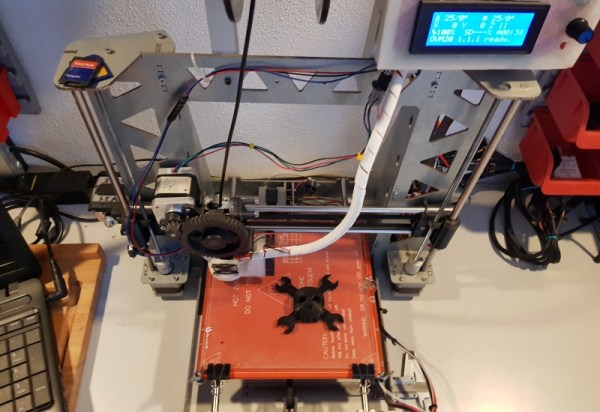
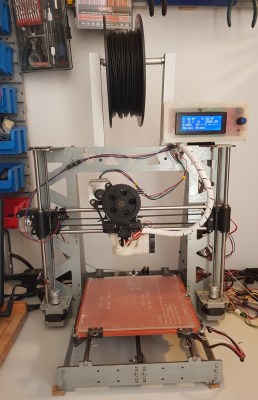
In the aftermath of the London Unconference, after the usual beer drinking networking at the pub, I meet Javier Varela, one of our many readers that were present. It turns out my fellow Iberic friend is involved in some interesting hardware projects, one of them being the OVM20 Lite board. I was looking for an excuse to mess around with my old Prusa and this was the perfect one. The P3Steel 3D printer was just getting dusty on my basement and it printed just fine in the past. Until one day…

Based on Arduino Mega 2560 with the RAMPS 1.4, it was a pretty standard and cheap option to get some years ago (and still is). My additional modifications or upgrades from the standard options was a LCD screen and the DRV8825 stepper drivers.

What happened was that one fine day the prints started to skew. No matter how hard I tried, it skewed. I checked the driver’s potentiometer, I went back to the motor specifications, I swapped drivers around, and I even flashed another firmware. If the print was big enough, it will get messed up. Sometimes even small prints failed. When you are debugging something like this for hours, there comes a point in time that you start to suspect everything. Was it overheating the drivers? If so, why did this never happened before? Maybe the power supply is fluctuating and coming to the end of its life? Some messed up capacitor in the board? Was it RAMPS’ fault or Arduino? A motor starting to fail? A mechanical issue? I had a fine-tuned Marlin firmware that I manually tweaked and slightly changed, which I had no backup off after the flashing. In retrospect, I actually checked for a lot of things that couldn’t really be related to the problem back then but I also learned quite a lot.

Continue reading “Refurbishing An Old P3Steel”

Teaching Electronics With A Breadboard Badge

Over the last year, the production of homebrew electronic badges for conferences has exploded. This is badgelife — the creation of custom hardware, a trial by fire of manufacturing, and a mountain of blinky LEDs rendered in electronic conference badges. It’s the demoscene for hardware, and all the cool kids are getting into it.

At this year’s World Maker Faire in New York, there was a brand new badge given out by the folks at Consumer Reports. This badge goes far beyond simple swag, and if you take a really good look at it, you’ll see magic rendered in breadboards and wire.

The Consumer Reports breadboard badge is simple and apparently designed to introduce kids to the world of electronics like the old Radio Shack, ‘100-in-1 Electronics Projects’ kits. Unlike most of the ‘beginner badges’ we’ve seen, this isn’t a badge where you only solder a few LEDs and a battery holder to a PCB. This is a breadboard badge. This is hacking with 74-series logic. This is an impressive piece of engineering given away by Consumer Reports. No one saw this one coming. I don’t think anyone at Maker Faire realized there’s now a viable way to create breadboard badges.

Continue reading “Teaching Electronics With A Breadboard Badge”

Books You Should Read: Feynman’s Appendix To The Challenger Disaster Report

It isn’t really a book, but Richard Feynman’s Appendix to the Challenger Disaster Report is still definitely something you should read. It’s not particularly long, but it’s educational and relevant not just as an example of critical thinking in action, but as a reminder not to fool oneself; neither individually, nor on an organizational level. Sadly, while much was learned from the events leading to and surrounding the Challenger disaster, over thirty years later many of us can still find a lot of the same things to relate to in our own professional lives. There isn’t a single magic solution, because these problems are subtle and often masquerade as normal.

Feynman and the Challenger Disaster

Richard Feynman (1918-1988) was a Nobel Prize winning physicist and one of the best-known scientists of his time. In 1986 he somewhat reluctantly agreed to join the Rogers Commission, whose task was to investigate the Challenger disaster. The space shuttle Challenger had exploded a little more than a minute after launch, killing everyone on board. The commission’s job was to find out what had gone wrong and how it had happened, and figure out how to keep it from happening again.

Continue reading “Books You Should Read: Feynman’s Appendix To The Challenger Disaster Report”