Get Hands-On At Supercon: Workshop Tickets Now Available

Build something cool and pick up new skills from the workshops at the Hackaday Superconference. Last week we announced all of the talks you’ll find at Supercon, and starting today you can reserve your spot at one of the workshops.

You must have a Superconference ticket in order to purchase a workshop ticket; buy one right now if you haven’t already. You can get mechanical with Haptics and Animatronics, take your product design from schematic to PCB and enclosure, brush up your embedded development on several choices of platform, make cell towers do your bidding, or dump way too many volts into a block of wood.

Space in these workshops is limited so make sure to sign up before all the seats are taken. The base price for workshops is $10 (basically a “skin in the game” price to encourage those who register to show up). Any tickets priced above that base is meant to cover the material expense of the workshop. Here’s what we have planned:

Embedded Programming with Black Magic and the Lights On

Piotr Esden-Tempski

Sunday Afternoon

Embedded systems programming has earned a bad reputation of being difficult to master. Especially in the open-source world, most people associate it with cut and pasted code that is difficult to debug. The usual tools we have to debug embedded systems are a blinking LED and, if we are lucky, printf statements through a serial port. In this self guided workshop we will show you how easy it can be to have full insight into your microcontroller using fully open source tools that are on par with expensive proprietary closed-source solutions.

Fun with High Voltage

Will Caruana

Sunday Morning

This workshop is about making Lichtenberg figures. A Lichtenberg figure is a piece of art though the multiplication of a few thousands of volts to burn wood. We will cover the science behind this art form as well as the safety and lastly we will be getting hands on experience in being able to using high voltage transformers to make these burnings into wood and make coasters you can take home.

Designing Electronic Textures

Noah Feehan

Sunday Afternoon

Participants will learn the physics behind electrovibration, and then get to play/design for it using a new open-source board called WEFT. After the workshop, you’ll know how to deploy electrovibration in your projects, and understand the feeling of different waveforms.

End to End Product Design with Eagle and Fusion 360

Matt Berggren

Saturday Morning

In this session, we’ll take you end to end, from building a new schematic, simulating a circuit using EAGLE’s built-in SPICE simulator, laying out a PCB, generating mfg files and include some tips & tricks for milling boards and making stencils. We’ll also take you thru the link between electronics and mechanics using Fusion360. Alongside EAGLE we’ll build an enclosure and generate the mfg outputs for your mechanical design (CAM, 3D prints, etc). We’ll look at library management across electronics and mechanics and bidirectional synchronization between both of these domains. This is more than an intro, as Matt’s always good for some essential, oft-missed background and tips with EAGLE you might never have known otherwise.

AVR® MCU Effortless Design Workshop: Prototyping with Sensors and BLE

Bob Martin, Senior Staff Engineer

Sunday Morning

This hands-on training session will walk you through how to develop an embedded sensor node prototype with Bluetooth® Low Energy (BLE) connectivity. You will speed through configuration of the AVR microcontroller, sensor interface and communications interface setup by using Atmel Start, a graphical programming interface. This tool will generate libraries with simple APIs so you can spend time working on your solution instead of messing with registers or communication protocols.

Rapid Prototyping and Linux Kernel Development with the PocketBeagle® Platform

Robert Nelson

Saturday Afternoon

The newly introduced PocketBeagle® is an ultra-tiny-yet-complete Linux-enabled, community-supported, open-source USB-key-fob computer. By leveraging the Octavo SIP, the PocketBeagle offers complete BeagleBoard functionality and includes 512MB DDR3 RAM, 1-GHz ARM Cortex-A8 CPU, 2x 200-MHz PRUs, ARM Cortex-M3, 3D accelerator, power/battery management and EEPROM. The board offers lots of GPIOs, on board peripherals and various expansion capabilities via multiple headers and the Mikroelektronika click board interface. During this course you will learn about pin configuration, how to create a Linux distribution, reconfiguring io on the fly and how to leverage expansion modules. Attendees will leave with their very own PocketBeagle and a couple other surprises as well.

Cellular Connectivity for Your Next Hardware Project

Ben Strahan and Chris Gammell

Saturday Afternoon

Your project shouldn’t be constrained by the range of a WiFi signal. This workshop will show you how to connect to cellular towers via a serial link, get connected into the cloud and reliably start transmitting data. This workshop is suitable for people just getting started in the firmware ecosystem up through advanced firmware engineers. Advanced members of the workshop will have the opportunity to hack their conference badge to connect to cell towers. Sign up for this workshop to add another connection method to your hardware development toolbox.

An Introduction to Animatronics with Laser Cut Tentacle Mechanisms

Joshua Vasquez

Saturday Morning

Animatronics are way cool, but the hacker community rarely ventures farther than a few hobby servos and “dem-blinkin’ LEDs.” In this workshop, I’ll get you cozy with tentacle mechanisms that you can build with just a laser cutter and a few hand tools. There are three big takeaways from this workshop. We’ll build up a two-stage controller reusable in other projects, muscle up our vocabulary of off-the-shelf parts for cable mechanisms, and discover a few laser-cut design techniques.

Superconference workshops tend to sell out extremely quickly. Don’t wait to get your ticket.

Hackaday Links Column Banner

Hackaday Links: October 1, 2017

Remember when you first saw a USB port in a standard wall outlet? It was a really great idea at the time, but how’s that 500mA charge holding up now? Fresh from a random press release, here’s a USB 3.0 wall outlet, with USB A and C ports. 5A @ 5V. Future proof for at least several years, I guess.

This is what you call ‘pucker factor’. An Air France A380 traveling from CDG to LAX suffered an uncontained engine failure somewhere over Greenland. Everyone on board is fine, except for the fact they had to spend the night in Goose Bay, Canada. Want the best Twitter/YouTube account of being a passenger? Here you go. Want to know why it landed in Goose Bay? This video is about ETOPS which really doesn’t apply in this instance but it’s a sufficient introduction to diverting airplanes after engine failures.

There are mysterious pylons going up alongside bridges and tunnels in NYC (auto-playing video). No one knows what they are, and the transportation board for New York is hiding behind a cloud of secrecy. We do know there are ‘fiber optics necessary for Homeland Security items’ inside, so place your bets. It’s facial recognition, or at the very least license plate readers. You know, exactly what New York and dozens of other cities have been doing for years.

Did somebody lose a balloon? A Raspberry Pi high-altitude balloon was found on the beach in south-west Denmark.

[Peter] is building an ultralight in his basement. We’ve covered the first part of the build, and we’ve been keeping tabs on him with semi-weekly updates. Now he’s fiberglassed the fuselage and started construction of the wings. Updates of note this week: he’s found a shop with an 8-foot CNC hot wire cutter for the wings. That really cuts down on the build time and it’s actually pretty cheap. One interesting part of this build is a ‘landing gear ejection system’, or a spring thing that allows the landing gear to fall away with the tug of a wire. Why would anyone want a landing gear ejection system? In case he needs to land in a soybean field. A flat bottom means a smoother and more survivable landing. If anyone is still concerned about [Peter]’s safety, this is a put up or shut up situation. Pitch in ten bucks for a parachute if you’re so concerned.

Hoverbike Kalashnikov! What? It’s a guy’s name. No big deal.

Open Hardware Summit is this week in Denver. What will be the highlights of the event? Well, last year, OSHWA announced the creation of an Open Hardware license. This is an all-encompassing license for Open Source Hardware that’s trying to solve some very, very hard problems. Copyright doesn’t work with hardware (except for boat hulls) like it does with software, and this Open Hardware license is the best we’ve got going for us. We’re going to get an update on how well this license is propagating. Also on deck for Summit attendees is a field trip to Sparkfun and Lulzbot. Want to see the world’s second largest 3D printer bot farm? It’ll be awesome.

We’re Using The Word Firmware Wrong

I had an interesting discussion the other day about code written for an embedded system. I was speaking with Voja Antonic about ‘firmware’. The conversation continued forward but I noticed that he was calling it ‘software’. We later discussed it and Voja told me he thought only the parts of the code directly interacting with the microcontroller were firmware; the rest falls under the more generic term of software. It really had me wondering where firmware stops being firmware and is merely software?

The topic has remained on my mind and I finally got around to doing some dictionary searches. I’m surprised that I’ve been using the word differently and I think most of the people I’ve heard use it are doing the same — at least as far as dictionary definitions are concerned. My go to sources are generally Merriam-Webster and Oxford English dictionaries and both indicate that firmware is a type of software that is indelible:

Permanent software programmed into a read-only memory.

computer programs contained permanently in a hardware device (such as a read-only memory)

According to this definition, I have never written a single bit of firmware. Everything I have written has been embedded software. But surely this is a term that must change with the times as technology progress so I kept digging.

Continue reading “We’re Using The Word Firmware Wrong”

Retrotechtacular: An Oceanographic Data Station Buoy For The 1960s

When we watch a TV weather report such as the ones that plaster our screens during hurricane season, it is easy to forget the scale of the achievement they represent in terms of data collection and interpretation. Huge amounts of data from a diverse array of sources feed weather models running on some of our most powerful computers, and though they don’t always forecast with complete accuracy we have become used to their getting it right often enough to be trustworthy.

It is also easy to forget that such advanced technology and the vast array of data behind it are relatively recent developments. In the middle of the twentieth century the bulk of meteorological data came from hand-recorded human observations, and meteorologists were dispatched to far-flung corners of the globe to record them. There were still significant areas of meteorological science that were closed books, and through the 1957 International Geophysical Year there was a concerted worldwide effort to close that gap.

We take for granted that many environmental readings are now taken automatically, and indeed most of us could produce an automated suite of meteorological instruments relatively easily using a microcontroller and a few sensors. In the International Geophysical Year era though this technology was still very much in its infancy, and the film below the break details the development through the early 1960s of one of the first automated remote ocean sensor buoys.

Perhaps our last sentence conjures up a vision of something small enough to hold, from all those National Geographic images of intrepid oilskin-clad scientists launching them from the decks of research vessels. But the technology of the early 1960s required something a little more substantial, so the buoy in question is a (using the units of the day) 100 ton circular platform more in the scale of a medium-sized boat. Above deck it was dominated by an HF (shortwave) discone antenna and its atmospheric instrument package. Below deck (aside from its electronic payload) it had a propane-powered internal combustion engine and generator to periodically charge its batteries. In use it would be anchored to the sea floor, and it was designed to operate even in the roughest of maritime conditions.

The film introduces the project, then looks at the design of a hull suitable for the extreme conditions like a hurricane. We see the first prototype being installed off the Florida coast in late 1964, and follow its progress through Hurricane Betsy in 1965. The mobile monitoring station in a converted passenger bus is shown in the heart of the foul weather, receiving constant telemetry from the buoy through 40 foot waves and 110 mph gusts of wind.

We are then shown the 1967 second prototype intended to be moored in the Pacific, this time equipped with a computerised data logging system. A DEC PDP-8 receives the data mounted in the bus, and are told that this buoy can store 24 hours at a stretch for transmission in one go. Top marks to the film production team for use of the word “data” in the plural.

Finally we’re told how a future network of the buoys for presumably the late 1960s and early 1970s could be served by a chain of receiving stations for near-complete coverage of the major oceans. At the height of the Cold War this aspect of the project would have been extremely important, as up-to-the-minute meteorological readings would have had considerable military value.

The film makes an engaging look at a technology few of us will ever come directly into contact with but the benefits of which we will all feel every time we see a TV weather forecast.

Continue reading “Retrotechtacular: An Oceanographic Data Station Buoy For The 1960s”

Friday Hack Chat: All About LED Design

There are three great enabling technologies of the last twenty years. The first is lithium batteries that hold a lot of juice. Quadcopters wouldn’t exist without them, and the Tesla Model S wouldn’t either. The second is crazy powerful brushless motors. Here, again, quads wouldn’t exist without them, but we’re also getting smaller, torquier, and more powerful motion platforms.

The third great enabling technology in recent memory is LEDs. Remember when the PlayStation 2 came out, and everyone was amazed by the blue LED? That blue LED won a Nobel Prize. Now, we have LED light bulbs, LEDs in any color of the rainbow, powerful UV LEDs, and bazillion candela flashlights. LEDs are awesome.

For this week’s Hack Chat, we’re going to be talking all about LEDs. Everything from strips to rings, discrete to waterproof, COBs, weird colors, and everything in between. If you’re looking to replace your workshop lighting with LEDs, this is the Hack Chat for you. If you’ve ever wondered about the quality of LEDs, and the price-performance ratio, this is for you. This is all about blinky bling.

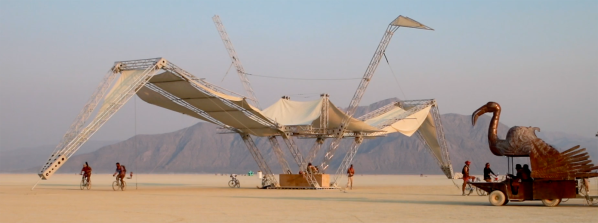
Our guest for this week’s Hack Chat will be [Metalnat], founder of the Burbank MakerSpace, a recent resident of the Supplyframe DesignLab where he designed a VR controller, and worked on Crane, a flapping automaton that glided over the playa at this year’s Burning Man. During this Hack Chat, we’ll be talking about LEDs, including installation methods, types of LEDs, suppliers, and LED manufacturing methods.

This is a Hack Chat, so we’re taking questions from the audience. Here’s a spreadsheet we’ll be using to guide the discussion.

Here’s How To Take Part:

join-hack-chatOur Hack Chats are live community events on the Hackaday.io Hack Chat group messaging. This Hack Chat will be going down noon, Pacific time on Friday, September 29th. Sidereal and solar getting you down? Wondering when noon is this month? Not a problem: here’s a handy countdown timer!

Click that speech bubble to the right, and you’ll be taken directly to the Hack Chat group on Hackaday.io.

You don’t have to wait until Friday; join whenever you want and you can see what the community is talking about.

BeamCNC: Computer-Controlled Construction System Mill

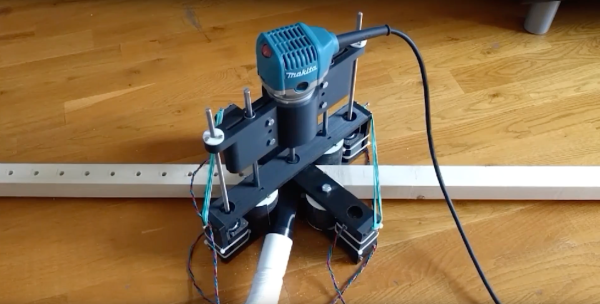
Need to make something quick and dirty out of wooden beams, and want to use elements you know will work together? BeamCNC is a mobile assembly of stepper-controlled rollers and a router that sucks a 2×2 through it and drills the holes in pre-programmed intervals. Currently being developed as part of an Indiegogo campaign currently in preview, its creator [Vladislav Lunachev] has declared it open source hardware. It’s essentially a CNC mill that makes Grid Beam, a classic DIY building set that resembles Meccano, Erector, and other classic sets, only made full-scale for larger projects. While BeamCNC is not affiliated with Grid Beam, it takes the same general idea and automates it.

Continue reading “BeamCNC: Computer-Controlled Construction System Mill”

All The Speakers Plus We’re Heating It Up A Day Early

Things are getting real now. Check the list below for the last round of confirmed speakers to the 2017 Hackaday Superconference. This brings our slate of speakers to 32, but we’re not done yet.

Hackaday is adding an extra day to the Superconference by starting the festivities on Friday. Again this year we have an excellent custom hardware badge in development. It’s hard to pull yourself away during the Supercon for badge hacking so this year you can check in on Friday and let the hacking begin. Since you’ll be in town early, we’re also throwing a party at Supplyframe office (minutes walk from the main venue) for all Supercon speakers and attendees.

But we’re still not done. 32 talks, an epic hardware badge, and an extra day of festivities, what else could there be you ask? Two things: workshops and the Hackaday Prize party. Supercon will play host to eight hardware workshops this year. We’ll announce workshop presenters and topics next week but I can tell you they’re superb this year!

Continue reading “All The Speakers Plus We’re Heating It Up A Day Early”