Retrotechtacular: DC To DC Conversion, Rotary Style

If you want to convert one voltage to another, what do you do? Well, if you are talking DC voltages today, you’ll probably use a DC to DC converter. Really, these converters generate some sort of AC waveform and then use either an inductor or a transformer to boost or buck the voltage as desired. Then they’ll convert it back to DC. If you are talking AC voltages, you could just use a transformer. But think about this: a transformer has two sides. The primary makes an alternating magnetic field. Just like rotating a shaft with magnets on it could. The secondary converts that alternating magnetic field into electricity just like a generator does. In other words, a transformer is just a generator that takes an AC input instead of a rotating mechanical input.

That’s a bit of an oversimplification, but in the old days, a lot of mobile radios (and other devices) took this idea to its logical conclusion. A M-G (Motor Generator) set was little more than a motor connected to a generator. The motor might take, say, 12V DC and the output could be, for example 300V AC that would get rectified for the plate voltage in a tube radio.

Continue reading “Retrotechtacular: DC To DC Conversion, Rotary Style”

Hackaday Links: July 2, 2017

A few months ago, we had a Hack Chat with Chip Gracey, the guy behind Parallax, the Basic Stamp, the Propeller, and the upcoming Propeller II. Now we’ve finally got around to editing that transcript. There’s a lot of awesome stuff in here, from learning a Hardware Design Language to the actual costs of fabbing silicon.

Rigol, the manufacturers of every hackerspace’s favorite oscilloscope, announced a new chipset. The current lineup of Rigol scopes top out at around 1GHz. In a prototype scope based on this chipset, Rigol demonstrated 4GHz bandwidth and 20GS/s with one Billion point memory depth. What this means: Rigol will be making very powerful scopes in the near future.

Hackaday had a meetup this week in New York City. The June workshop at Fat Cat Fab Lab featured speakers involved with twitter bots, 8-bit art, one of the guys behind Beautiful Soup, and a talk on a completely self-sustainable record label. Want to attend one of these meetups? Check out the calendar.

Repairs of retrocomputers are always interesting, but usually the same. Wipe off some dust, possibly replace a cap or two, retrobrite the case, and you’re done. This is not the usual retrocomputer repair. [Drygol] found a C64 that was apparently stored in a swamp for several years. The power switch fell off when he touched it. Somehow, miraculously, the circuit worked and [Drygol] rewarded the board with a new enclosure, dyed keycaps, an SD2IEC mod, and a kernel switch mod.

Guess what’s back? A pen computer with a color sensor on one end, and an ink mixer in the other. The Scribble Pen is the Internet’s infamous crowdfunded color-sensing pen, and the scammer behind it is looking for another funding round. Has anything changed since we tore this thing apart three years ago? No, it’s still a scam. I’ve been keeping tabs on the guy behind it, he’s still not in prison, and there are still idiots on this planet.

The ‘A’ stands for ‘Arts’.

The Benchy is everyone’s favorite tugboat and 3D printer benchmarking tool. They usually float, sideways. However, [MakeShift] somehow figured out how to add weight to the keel and turn the cutest little tugboat into a real, remote controlled boat. You could probably model a proper hull for the bottom of this boat, and it would be one of the few 3D prints where the actual design would be subject to US Copyright.

Is the fidget spinner fad dying? Square, the startup built around turning old AUX to cassette adapters into POS terminals seems to think so. They’ve been graphing their sales figures for fidget spinners, and there has been a marked decline since school let out for the summer. Will the trend pick back up in September? Who cares.

Will It Sell?

Many of us develop things for one of two purposes: to hack something cool, or to sell something cool. When hacking something cool, your target market is yourself, and you already know you’ve made the sale. If your goal is to sell the thing you are making, then a lot more thought and effort is required. You could develop the coolest product in the world, but if your target market is too small, your price is too high, your lead time is too long, or any of a dozen other factors is not quite right, you’ll be spending a lot of time and effort on what will amount to a huge disappointment. The Hackaday Prize Best Product has many great examples which let us study some of these success factors, so let’s take a look. Continue reading “Will It Sell?”

Best Product Entry: Pocket Thermal Camera

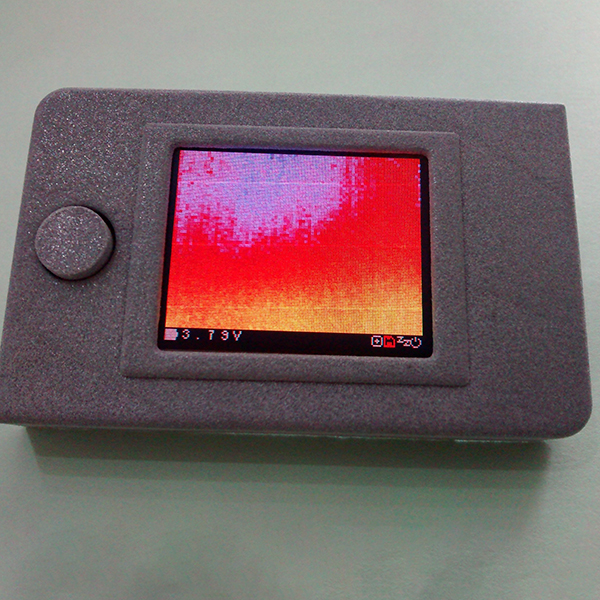
One of the entries in the Hackaday Prize Best Product competition is [x-labz]’s pocket thermal imager. It’s more than a prototype, it’s a design conceived to get out into the world and be used by many. Best Product entries are open until July 24th, and with a $30,000 cash prize on the line let’s take a look at some of the things that elevate a project to product status.

Thanks to recent advances in the state of thermal image sensors, a tool that gives you Predator vision is almost a necessity on the modern workbench. The pocket thermal imager will find drafts in your house during winter, will tell you how to cook a steak, figure out what part is shorting out in your latest electronics project, and will tell you how terrible the heated bed is on your 3D printer.

[x-labz]’s thermal camera is based around the FLIR Lepton image sensor, an 80×60 pixel thermal imaging sensor that’s good enough for most uses. This camera is soldered onto a PCB sandwich containing an Atmel SAMD21 microcontroller, full-color OLED display, SD card, and a battery management system.

What we’ve mentioned so far isn’t out of the ordinary for any other entry in the Hackaday Prize. Building something for the Best Product competition is different, though: a lot of thought has to go into the manufacturability and the fit and finish of this device. So far, everything’s looking great for [x-labz]’s camera. There’s a 3D printed case that looks like it could be easily translated into an injection-moldable shell and at least some of the parts of the user interface are unbelievably satisfying. We’re looking forward to seeing the full Bill of Materials and a business plan (a new requirement this year). That’s an area where many hardware designers lack experience; being able to study the examples from Best Product entries will be a welcomed resource.

There’s a world of difference between building a project and building a product, and the entire goal of the Best Product portion of the Hackaday Prize is to reward those people who go the extra mile as aspiring entrepreneurs and show us how that’s done. $50k in cash prizes are set aside for Best Product; $30,000 for the winner as we mentioned before, but there is also $1000 for each of the twenty entries that make it to the finals in this category in addition to some much deserved notoriety from Hackaday’s community of hardware aficionados and early adopters.

Friday Hack Chat: Climate Change

This Friday, we’re talking climate change. Is it possible to remove carbon from the atmosphere before most cities are underwater? What role can hackers play in alleviating climate change? It’s all going down this Friday on the Hack Chat on Hackaday.io

We’ve invited [Tito Jankowski] and [Matthew Eshed] to talk about climate change this Friday over on hackaday.io. [Tito] and [Matthew] are the founders of Impossible Labs, and they’re looking for ways to find, test, and build technology that will remove carbon from Earth’s atmosphere. Their goal is to return the earth’s atmosphere to 300 parts per million of carbon dioxide by 2050. Will they succeed? If someone doesn’t, you can kiss every coastal city goodbye.

Their first job is getting everyone to care. [Jankowski] thinks it can be done through better access to information and snazzy graphics — if people knew what was going on, maybe they’d give a darn. So whether you’d like to talk graphics and data or the engineering of carbon sequestration devices, this is a Hack Chat of global importance. Join us!

Here’s How To Take Part:

join-hack-chatOur Hack Chats are live community events on the Hackaday.io Hack Chat group messaging. This Hack Chat will take place at noon Pacific time on Friday, June 30th. Confused about where and when ‘noon’ is? Here’s a time and date converter!

Log into Hackaday.io, visit that page, and look for the ‘Join this Project’ Button. Once you’re part of the project, the button will change to ‘Team Messaging’, which takes you directly to the Hack Chat.

You don’t have to wait until Friday; join whenever you want and you can see what the community is talking about.

Wooden Laptop Enclosure: New Life For Old Thinkpad

Technology is designed to serve us and make our lives better. When a device gets outdated, it is either disposed of or is buried in a pile of junk never to be seen again. However, some individuals tend to develop a certain respect for their mechanical servants and make an effort to preserve them long after they have become redundant.

My relationship with my first laptop is a shining example of how to hold onto beloved hardware way too long. I converted that laptop into a desktop with a number of serious modifications which helped me learn about woodworking along the way. Maybe it’s more pragmatic to just buy new equipment. But you spend so much time each day using your devices. It is incredibly satisfying to have a personal connection that comes from pouring your own craftsmanship into them.

Why the Effort?

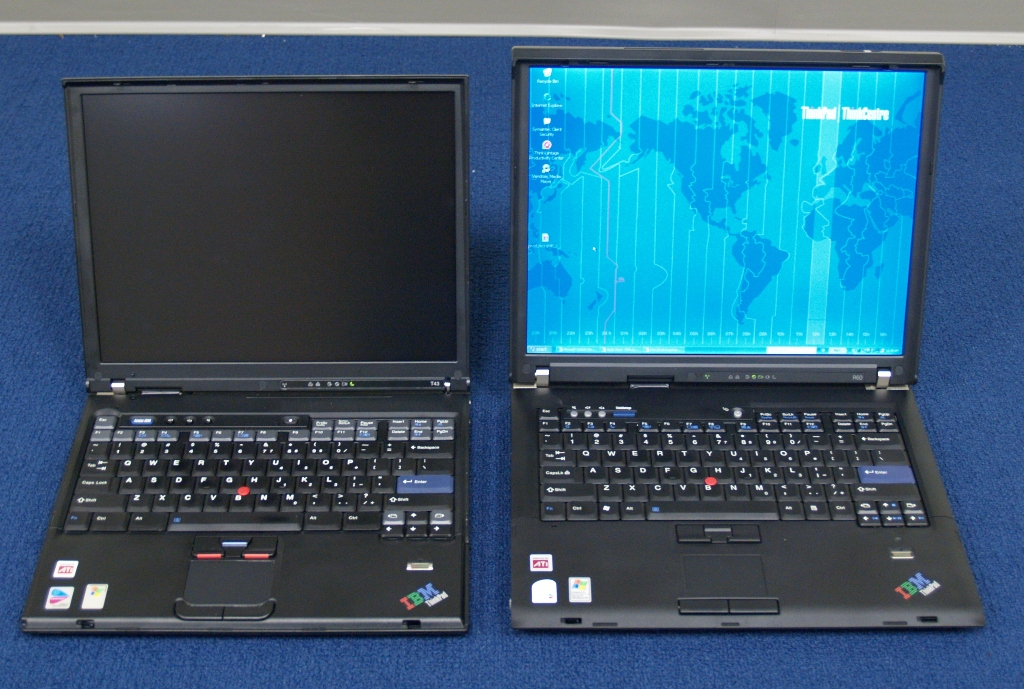
IBM Thinkpad R60 via Notebook Review

The laptop in question is an IBM R60 which I lugged around during the first three years after I graduated. It was my companion during some tough times and naturally, I developed a certain attachment to it. With time its peripherals failed including the keyboard which housed the power switch and it was decided that the cost of repair would outweigh its usefulness.

Then came the faithful day when I was inspired to make something with the scrap wood that had accumulated in my workshop. This would be my second woodworking project ever and I did not have the professional heavy machinery advertised in most YouTube videos. Yet I had two targets in mind with this project.

  1. Make the R60 useful again.
  2. Learn about woodworking for creating enclosures for future projects.

Armed with mostly hand tools, a drill and a grinder that was fitted with a saw blade, I started with the IBM R60 to all-in-one PC mod. Following is a log of things I did and those I regret not doing a.k.a. lessons learned. Read on.

Continue reading “Wooden Laptop Enclosure: New Life For Old Thinkpad”

A Crash Course In Thingiverse Customizer

OpenSCAD is a great way to create objects for 3D printing (or other purposes), especially if you are already used to programming. For things like front panels, it is great because you can easily make modifications and — if you wrote your code correctly–everything will just adjust itself to new positions.

However, what if you have a general-purpose piece of code, and you want people to have the ability to customize it? For example, consider this code:


$fn=100;
difference()
{
  cube([25,25,5]);
  translate([4,4,-1]) cylinder(h=7,r=2);
  translate([25-4,4,-1]) cylinder(h=7,r=2);
  translate([4,25-4,-1]) cylinder(h=7,r=2);
  translate([25-4,25-4,-1]) cylinder(h=7,r=2);
}

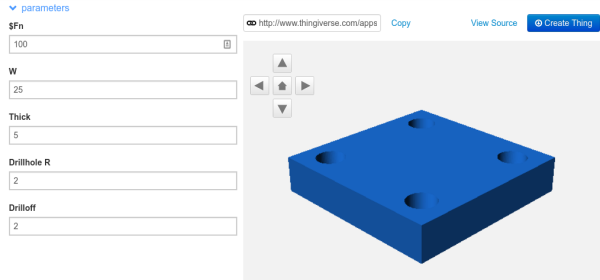
That creates the plate with four drill holes you see on the right.

Continue reading “A Crash Course In Thingiverse Customizer”