Hackaday Retro Edition: Androids And Amigas

Tiny ARM boards are everywhere, and if the Raspberry Pi is any indication, they’re mostly used for emulating old consoles and computers. With only a $30 single board computer, it’s easy to emulate an SNES, Apple II, C64, or any of the other piece of classic 80s or 90s hardware.

Understandably, there will eventually be a few projects and products that hope to capitalize on this retro trend. Few of them will go through the rigamarole of actually licensing the relevant IP. The Armiga is one of these projects. It’s an emulated Amiga 500 with 1MB of RAM packaged in what looks like a 3.5″ external floppy drive.

Inside this tiny little box is a dual core ARM for Amiga emulation. For the most part, this is just a basic Android system, but the real selling point of this system is the Armiga Project software. This is a full emulator and game browser that also includes a legal (!) copy of Kickstart 1.3. The ‘upscale’ version of the Armiga also includes a floppy disk controller and drive, should you ever want to dump all those old floppies sitting around in your attic.

This isn’t the first time we’ve heard about the Armiga. It was a crowdfunding campaign a year ago that was unsuccessful for reasons we can’t comprehend. The creators of the Armiga have forged on, and now these tiny little boxes of guru meditation have started shipping. The Beta units have sold out and there’s a waiting list for more.

Hacklet 55 – Home Automation Projects

Home automation – the idea of a smart home that monitors and controls the inside environment, takes commands from occupants, and generally makes living easier. Hackers, makers, and engineers have been building their own vision of the smart home for decades. Thanks to cell phones and the revolution of the “internet of things”, home automation is now in the public eye. The hackers haven’t stopped though. They’re still building dreams, one circuit and one line of code at a time. This week’s Hacklet is dedicated to some of the best home automation projects on Hackaday.io!

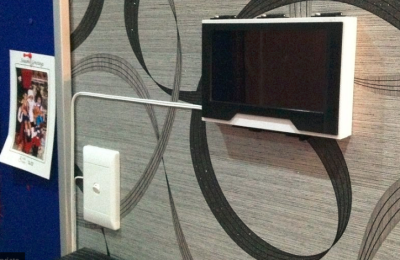
jarvisWe start at the top – [IamTeknik’s] Project Jarvis has been in the top five skulled and viewed projects on Hackaday.io for as long as we’ve been keeping records. Just like the fictional Tony Stark design which inspired its name, Jarvis is based on artificial intelligence. [IamTeknik] has created a system using the BeagleBone Black running his own custom software. He’s also creating Jarvis from the ground up – even the relay modules have been designed and built by [IamTeknik]. So far Jarvis has a great 3D printed door lock unit, and a really nice wall mounted tablet. We’re watching to see what modules [IamTeknik] adds next!


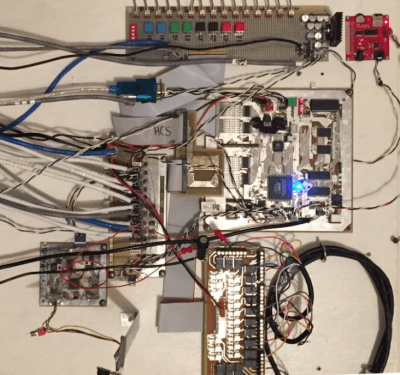
hcs[Morrisonpiano] is no home automation noob. He’s been running his own system for two decades. HCS_IV Home Automation System is a project to update his HCS_C home automation system. For the uninitiated, the original HCS was created by [Steve Ciarcia] of Byte and Circuit Cellar fame. There have been several generations of the hardware and software since then, with plenty hackers adding their own custom features. [Morrisonpiano] is updating his system with an NXP Arm Cortex M4 CPU, three big Altera Cyclone FPGAs, and plenty of flash storage. Why use a FPGA on a home automation system? I/O of course! HCS uses a ton of I/O. There are 16 RS485 ports and 10 RS232 serial ports. Going with an FPGA makes things flexible as well. Want to add CAN bus? Just drop in some CAN HDL code and you’re golden!


[Sswitchteven] is giving the smart home more senses with Squirco Smart Home System – Sensor Network. Rather than just have a temperature sensor at the thermostat, or a motion detector in the front foyer, [Steven] wants a network of unobtrusive sensors to blanket the home. He’s doing this by replacing the common light switch with a smart module that has sensors for temperature, humidity, and human presence. [Steven] has spent quite a bit of time researching and experimenting microwave tomography as a means to detect humans. Going with microwaves means no obvious PIR windows.


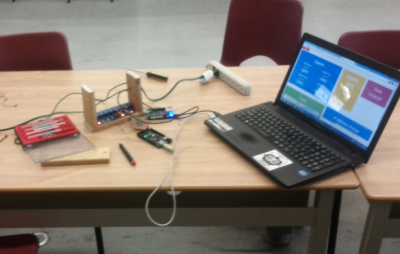
bbb-haFinally, we have [Ansaf Ahmad] with BeagleBone Black Home Automation. The idea for this project came from a calculus class on optimization. [Ansaf] is putting mathematical theorems to use in the real world by monitoring usage patterns and current demands of a device. With that data, he can optimize the usage to make things greener. So far, [Ansaf] has been experimenting with a lamp. The system has a web front end which uses PHP. The GPIO pins on the board are controlled using Python and Flask. As an early project, BeagleBone Home Automation is doing great – it’s already earned [Ansaf] high grades in his computer engineering class!

If you want more smart home goodness, check out our updated home automation projects list! Did I miss your project? Don’t be shy, just drop me a message on Hackaday.io. That’s it for this week’s Hacklet, As always, see you next week. Same hack time, same hack channel, bringing you the best of Hackaday.io!

CAPTION CERN CONTEST – Saying Goodbye To An Old Friend

The tangled web woven by Week 22 of the Caption CERN Contest has come to a close. It’s been another bumper week with 112 comments. Thank you to everyone who submitted a caption! We realize it may have been hard for some of the network engineers out there to type through their tears, but thank you for persevering! While we don’t know exactly what these two CERN scientists were wiring up, [rwells97] did figure out that the scope in the image is most likely a Tektronix 545/A, which was a popular scope back in the late 1950s and early 1960s. The weight on a beast like that was around 70 lbs!

The Funnies:

  • “Dude, this one’s full of wires too! Every single one of these is full of wires! Why would anyone need so many wires? What in the name of God were they DOING down here?” – [The Green Gentleman]
  • “Getting to blinky” required a whole lot more work then the engineers realized…” – [Kieran Paulger]
  • “I think I lost an electron back here, Bob. I’m positive.” – [Christine Hampton]

This week’s winner is [alan] with “Daft Punk was actually two of CERN’s best acoustics researchers prior to forming the band. Here they are after hours working on the track that would later be named ‘Da Funk'”. [Alan] is a Computer Science PhD candidate with focus on computational biology, specifically population genomics. Hopefully he has some hardware in the mix somewhere, because we’re sending him a Stickvise from The Hackaday Store!

Week 23

cern-23-smSomething a bit different this week. CERN is probably best known for the various particle accelerators they’ve had over the years. One of the first units was synchrocyclotron SC-1, which operated from 1957 to 1974. According to the album page on CERN’s servers, SC-1’s last day of operation was celebrated with a funeral procession. Scientists, and staff walked the grounds with flowers, top hats, and even a shrouded coffin. We can all related to decommissioning a well-worn piece of equipment. Be it a computer, a machine tool, or even a synchrocyclotron, there are always the mixed feelings of thanks that it did a good job, and relief that it will no longer need to be maintained.

Even though we have a pretty good idea of what’s going on in this image, we’re going to caption it anyway! Give us your best captions of what you think is really going on here! This week’s prize is a LightBlue Bean from The Hackaday Store. Add your humorous caption as a comment to this project log. Make sure you’re commenting on the contest log, not on the this post. As always, if you actually have information about the image or the people in it, let CERN know on the original image discussion page.

Retrotechtacular: The Omega Navigational System

In 1971, the United States Navy launched the Omega navigational system for submarines and surface ships. The system used radio frequencies and phase difference calculations to determine global position. A network of eight (VLF) transmitter sites spread around the globe made up the system, which required the cooperation of six other nations.

Omega’s fix accuracy was somewhere between one and two nautical miles. Her eight transmitter stations were positioned around the Earth such that any single point on the planet could receive a usable signal from at least five stations. All of the transmitters were synchronized to a Cesium clock and emitted signals on a time-shared schedule.

LOP-thumbA ship’s receiving equipment performed navigation by comparing the phase difference between detected signals. This calculation was based around “lanes” that served to divvy up the distance between stations into equal divisions. A grid of these lanes formed by eight stations’ worth of overlapping signals provides intersecting lines of position (LOP) that give the sailor his fix.

In order for the lane numbers to have meaning, the sailor has to dial in his starting lane number in port based on the maps. He would then select the pair of stations nearest him, which were designated with the letters A to H. He would consult the skywave correction tables and make small adjustments for atmospheric conditions and other variances. Finally, he would set his lane number manually and set sail.

Continue reading “Retrotechtacular: The Omega Navigational System”

Hackaday Links Column Banner

Hackaday Links: July 5, 2015

It’s the fifth of July. What should that mean? Videos on YouTube of quadcopters flying into fireworks displays. Surprisingly, there are none. If you find one, put it up in the comments.

The original PlayStation was a Nintendo/Sony collaboration. This week, some random dude found a prototype in his attic. People were offering him tens of thousands of dollars on the reddit thread, while smarter people said he should lend it to MAME and homebrewer/reverse engineer groups. This was called out as a fake by [Vadu Amka], one of the Internet’s highly skilled console modders. This statement was sort of semi retracted. There’s a lot of bromide staining on that Nintendo PlayStation, though, and if it’s a fake, the faker deserves thousands of dollars. Now just dump the ROMs and reverse engineer the thing.

Remember BattleBots? It’s back. These are my impressions of the first two episodes: Flamethrowers are relatively common now, ‘parasitic bots’ – small, auxilliary bots fighting alongside the ‘main’ bot are now allowed. KOs only count for the ‘main’ bot. Give it a few more seasons and every bot will be a wedge. One of the hosts is an UFC fighter, which is weird, but not as weird as actually knowing some of the people competing.

Ceci n’est pas un Arduino, which means it’s from the SRL camp. No, wait. It’s a crowdfunding campaign for AS200 Industries in Providence, RI.

Wanna look incredibly sketchy? Weld (or braze, or solder) your keys to a screwdriver.

The UK’s National Museum of Computing  is looking for some people to help maintain 80 BBC Micros. The museum has a ‘classroom’ of BBC micro computers still in operation. Caps dry out, switching power supplies fail, and over the years these computers start to die. If you have the skills and want to volunteer, give it a shot.

USA-made Arduinos are now shipping. That’s the Massimo Arduino, by the way.

Win $1000 for pressing a buttonWe’re gauranteed to give away a thousand dollar gift card for the Hackaday store next Wednesday to someone who has participated in the latest round of community voting for the Hackaday Prize.

Caption CERN Contest – Cut The Black Wire

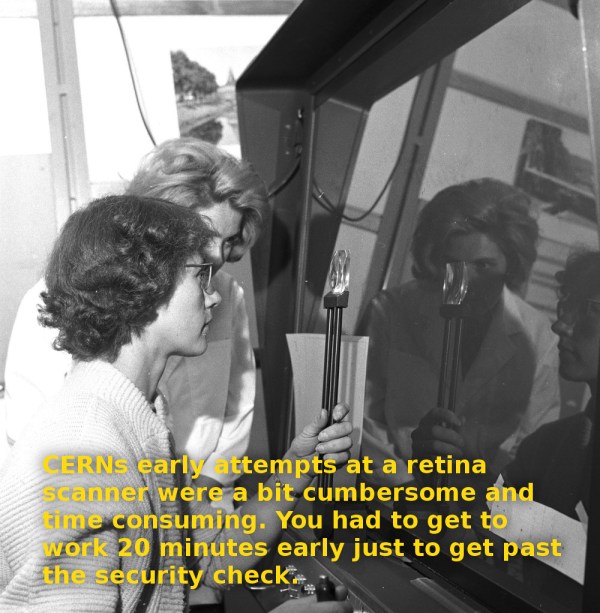
Week 21 of the Caption CERN Contest is now history. It’s been a great week of captions, so as always a huge thank you goes out to everyone who entered. We still have no idea what these two CERN scientists were working on. Lenses, switches, and a giant glass screen which could have anything behind it. It’s a tough one. But what we lack in facts, you all made up for in humor.

The Funnies:

  • “I spy with my quantum eye, something with a 75% probability of being spin up!”- [bbarrett90]
  • “Preping the Voight-Kampff set up, they have learnt from their unfortunately predecessors that a mirrored bullet proof glass between them and the upset replicant subject might be a good idea.” -[K.C. Lee]
  • “Mary and Steve swore that they were going to be the ones to win this year’s where’s Waldo competition, unfortunately they lost to the guys in the next lab with an SEM.” – [TrollinTeemo]

This week’s winner is [Lou] with “CERNs early attempts at a retina scanner were a bit cumbersome and time consuming. You had to get to work 20 minutes early just to get past the security check.” Lou’s bio is “Test engineer with Mechanical background who likes to tear things apart”. We bet he’s going to enjoy using his new Teensy 3.1 from The Hackaday Store to build something new with all the parts he has left over from teardowns!

Week 22

cern-22-smHoly cable gore, Batman! This image may make a network engineer or IT person weep, but it was business as usual back in the early days of CERN. 14 racks of equipment, with coaxial cables running everywhere. Let’s hope all those patches are connected to the correct ports! What were these two CERN scientists working on? It’s up to you to tell us as CERN has lost the records!

While you’re working on your captions, check out the old oscilloscope the standing scientist is using. Scope carts used to be necessary. Today all but the most powerful oscilloscopes weigh in at under 10 pounds.

This week’s prize is a Stickvise from The Hackaday Store. Add your humorous caption as a comment to this project log. Make sure you’re commenting on the contest log, not on the contest itself. As always, if you actually have information about the image or the people in it, let CERN know on the original image discussion page.

Good Luck!

Hacklet 54 – Virtual Reality Projects

Virtual Reality is finally coming of age. Hackers, Makers and Engineers have dreamed of creating immersive interfaces for years. From the first flight simulators to today’s cellphone powered head mounted displays, VR has always been an exciting field. Many of the advances today are being created by hackers who were inspired by systems like Virtuality from the early 1990’s. Now 25 years on, we’re seeing amazing advances – not only in commercial systems, but in open source VR projects. This week’s Hacklet is all about the best VR projects on Hackaday.io!

vr1We start with [j0nno] and D.I.Y Virtual Reality. [J0nno] has become interested in VR, and decided to build his own head mounted display. His goal is to create a setup with full head tracking and an open source software stack. He’s hoping to do this within a budget of just $200 AUD. [J0nno] started with the Ritech3d-V2 VR Goggles, which are a plastic implementation of Google’s project cardboard. For display he’s using a 5.6 inch 1280 x 800 TFT LCD. Tracking is optical, using IR LEDs and a PS3 Eye camera. [J0nno’s] background is in software, so he’s doing great setting up OpenVR and Perception. The hardware side is a bit new to him. This isn’t stopping [J0nno] though! In true hacker spirit, he’s learning all about resistors and driving LEDs as he works on D.I.Y Virtual Reality.
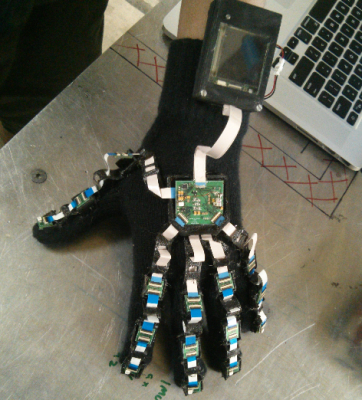
vr2Next up is [Josh Lindsay] with Digitabulum: The last motion-capture glove. Digitabulum is a motion capture glove designed to be able to emulate most other motion capture systems. It is also designed to be relatively low-cost. At $400 per hand, it is less expensive than most other offerings, though we’d still love to see something even cheaper. [Josh] is going with inertial sensors, and a lot of them. Specifically he’s using no less than 17 LSM9DS1 Inertial Measurement Unit (IMU) sensors from ST Microelectronics. IMU sensors like this combine multiple rate gyros, accelerometers, and magnetometers into a single unit. Essentially every segment of every finger has its own sensor suite. As you might imagine, that is quite a bit of data to crunch. An Altera Max II CPLD and an ST Arm processor help boil down the data to something which a VR engine can process. [Josh] has been working on this project for over a year now, and he’s making great progress. The prototype glove looks terrific!
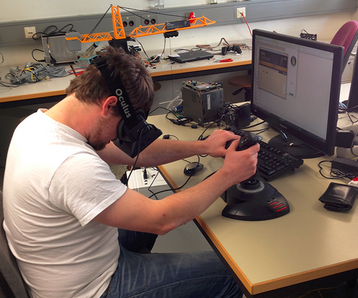
vr3[Thomas] brings augmented reality to the table with Oculus Rift featured Crane control. What started as a hobby experiment became [Thomas’] major project at university. He’s connected an Oculus Rift to a toy crane. A stereo camera on the crane sends a video image to the operator. The camera is mounted on a pan/tilt mechanism driven by the Rift’s head tracking unit. Simple joystick controls allow [Thomas] to move the boom and lower the line. On-screen displays show the current status of the crane. The use of the Rift makes this an immersive demonstration. One could easily see how moving this system into the real world would make crane operations safer for crane operators.
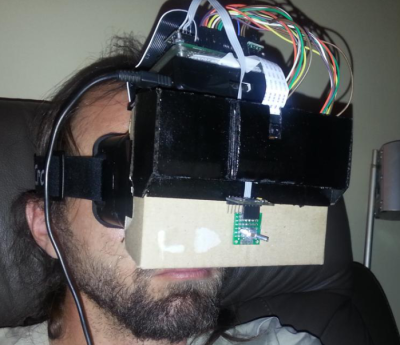
vr4Finally we have [Arcadia Labs] with DIY Augmented Reality Device. This project, which is the [Arcadia Labs] entry in the 2015 Hackaday Prize, uses two 320 x 240 screens to create an augmented reality head mounted display. While the resolution can’t match that of the Oculus Rift or HTC Vive, [Arcadia Labs] is ok with that. They’re going for a lower cost open source alternative for augmented reality. Tracking is achieved with an IMU, while a PS3 Eye camera provides the video. A Raspberry Pi controls the show. [Arcadia Labs] was able to get 50 frames per second on the displays just using the Pi’s SPI interface, however the USB PS3 Eye camera limits things to around 10 FPS. This project is under heavy development right now, so follow along with us to see where [Arcadia Labs] ends up!

If you want VR goodness, check out our new virtual reality projects list! Did I miss your project? Don’t be shy, just drop me a message on Hackaday.io. If you’re on the left coast of the USA, check out SOCAL Virtual Reality Conference and Expo. Hackaday is a sponsor. The event happens on July 12 at the University of California Irvine.

That’s it for this week’s Hacklet, As always, see you next week. Same hack time, same hack channel, bringing you the best of Hackaday.io!