People With Dementia Can DRESS Smarter

People with dementia have trouble with some of the things we take for granted, including dressing themselves. It can be a remarkably difficult task involving skills like balance, pattern recognition inside of other patterns, ordering, gross motor skill, and dexterity to name a few. Just because something is common, doesn’t mean it is easy. The good folks at NYU Rory Meyers College of Nursing, Arizona State University, and MGH Institute of Health Professions talked with a caregiver focus group to find a way for patients to regain their privacy and replace frustration with independence.

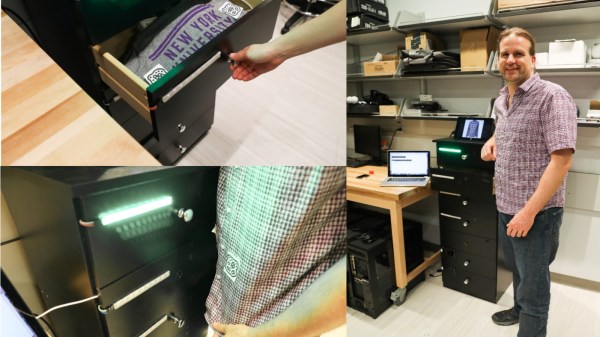
Although this is in the context of medical assistance, this represents one of the ways we can offload cognition or judgment to computers. The system works by detecting movement when someone approaches the dresser with five drawers. Vocal directions and green lights on the top drawer light up when it is time to open the drawer and don the clothing inside. Once the system detects the article is being worn appropriately, the next drawer’s light comes one. A camera seeks a matrix code on each piece of clothing, and if it times out, a caregiver is notified. There is no need for an internet connection, nor should one be given.

Currently, the system has a good track record with identifying the clothing, but it is not proficient at detecting when it is worn correctly, which could lead to frustrating false alarms. Matrix codes seemed like a logical choice since they could adhere to any article of clothing and get washed repeatedly but there has to be a more reliable way. Perhaps IR reflective threads could be sewn into clothing with varying stitch lengths, so the inside and outside patterns are inverted to detect when clothing is inside-out. Perhaps a combination of IR reflective and absorbing material could make large codes without being visible to the human eye. How would you make a machine-washable, machine-readable visual code?

Helping people with dementia is not easy but we are not afraid to start, like this music player. If matrix codes and barcodes get you moving, check out this hacked scrap-store barcode scanner.

Thank you, [Qes] for the tip.
Intra-Oral Device Detects Opioid Overdose

As you may have heard, the U.S. is in the grips of an opioid epidemic. Overdose deaths from heroin, oxycontin, and fentanyl have quadrupled since 1999. The key to detecting opioid overdose before it’s too late is in monitoring respiration. Opioids in particular cause depressed respiration, which is slow and ineffective breathing that’s inadequate for the gas exchange that keeps us alive. Depressed respiration becomes fatal unless the patient is given nalaxone, an antidote that works by blocking opioid receptors in the brain.

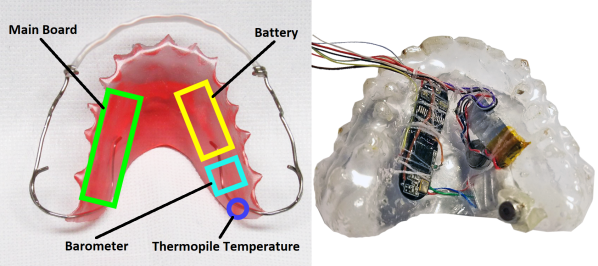
[Curt White] is developing an intra-oral device to prevent opioid overdose via early detection. It tracks a patient’s inhale/exhale rate and sends the data over Bluetooth to an open-source website.  The tiny device uses an air pressure sensor, a humidity sensor, and a thermopile thermometer to accurately track a person’s full respiration waveform whether their mouth is open or closed. The brain is one of [Curt]’s hacked $35 activity trackers that we told you about a few days ago.

All of the hardware including the battery is embedded in a custom retainer made from thermoplastic. [Curt] used Tyvek and surgical tape to isolate the air pressure sensor. Both are waterproof and breathable, which means that air can get to the sensor, but not saliva. Hold your breath and click past the break to watch [Curt] demonstrate this amazing tool on himself.

Continue reading “Intra-Oral Device Detects Opioid Overdose”

Is That A Tweet On Your Belt Buckle Or Are You Just Happy To See Me?

What a time to be alive! The range of things you never knew you needed but absolutely must have expands at a breakneck pace, such that it’s now possible to pick up a belt buckle with an embedded LED matrix to scroll messages. We have no idea what the use case for something like this is, but some people will buy anything.

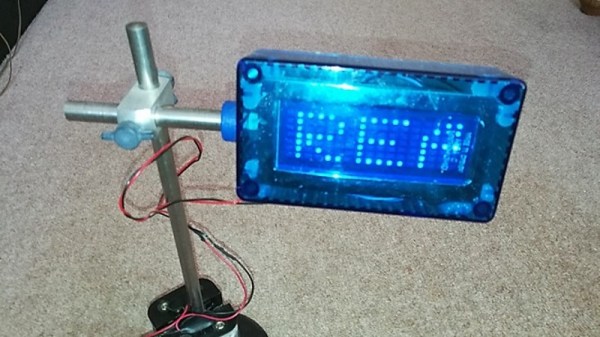
One such person was a friend of [Brian Moreau], who doubled down after being gifted the glowing bauble by turning it into a WiFi enabled Tweet-scrolling belt buckle. It appears to be a just for fun project, and to be honest one would need a heck of a belt for the buckle after his mods. He added an ESP8266 to take care of monitoring his Twitter account and driving the display on the belt buckle, a non-trivial task given that the thing is programmed with only two buttons that scroll through characters to compose a message. The microcontroller might have fit inside the original buckle or only added a little to its bulk, but [Brian] decided to replace the two coin cells powering it with an external 6-volt battery pack. That required a buck converter to power the ESP, so the whole thing ended up being thrown in a case and acting more like a neat display than a flashy fashion statement.

We’d bet some tradeoffs could be made to reduce the bulk and get that buckle back where it belongs, though. Once it does, maybe it’ll be part of a complete LED-laden ensemble, from head to toe.

Smartwatch Fights Anxiety With Action

In our fast-paced modern world, it’s no wonder that so many suffer from anxiety and panic attacks. There are several time-worn techniques for dealing with the symptoms of these attacks. But as anyone who’s ever suffered such an attack can tell you, it can be difficult to sense one coming on until it’s too late. By then, rational thinking has been supplanted by intrusive thoughts. For this year’s Hackaday Prize, [Austin Marandos] is doing his part by using technology to help us check ourselves before we wreck ourselves with worry.

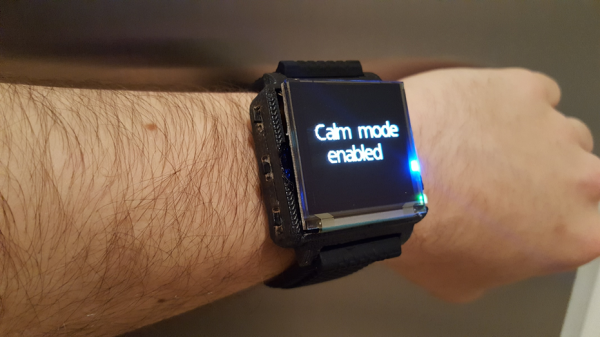
Similar smartwatches exist to detect oncoming attacks, but they don’t do anything to combat them. Minder is like having a friend strapped to your wrist that’s never absorbed in their own problems. It wants to help no matter what it takes, which is why it features multiple techniques for getting back to a state of calm.

Minder’s brain is the bite-size Qduino Mini, which is great for a crowded wearable because of its built-in charging circuit. It uses heart rate and temperature sensors to determine the onset of a panic attack, and a vibration motor to alert the user. The motor also plays a part in the relaxation techniques to keep the user focused and in control. Use the upcoming break to relax and check out the video.

If your anxiety stems from feelings of inadequacy, it might be Imposter Syndrome.

Continue reading “Smartwatch Fights Anxiety With Action”

Morse Code Blinking Jewelry

With the size of electronic parts and batteries these days, very small items are obviously becoming more and more viable. [Yann Guidon] has made some awesome pieces of LED jewelry using a minimal number of surface mount parts and a small lithium-ion battery. To make the jewelry stand out a bit, other than just blinking on and off, these LEDs blink a short message in Morse code.

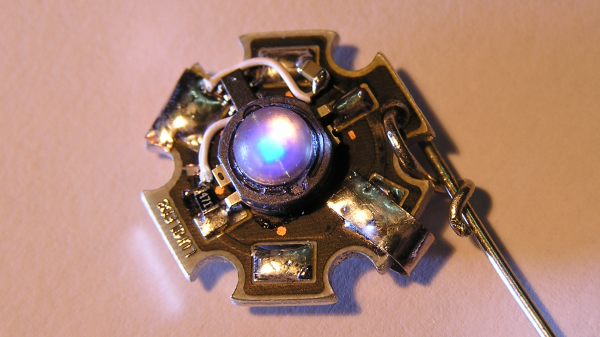
This is an update and open sourcing of some work that [Yann] did a few years ago, and the iterations have resulted in a smaller design. But the main part of the latest version is the addition of the Morse code blinking using a small microcontroller. The microcontroller [Yann] used is the SMD version of the PIC10F200, a small, 8 pin PIC microcontroller. This, a resistor and a metal clip are soldered to pads on a Luxeon Star LED.  The LEDs are undervolted so they’re not too bright, so the heat sink isn’t really needed, but it’s a good size for the components. Because the LEDs don’t generation much heat, the back of the aluminum frame that the LED is on is carved out a bit so that the small lithium-ion battery can go there.

The final component is the code itself, and [Yann] has released it as an assembly file. An associated text file contains the text of the message that you want the earrings to blink. The text file can contain up to 190 bytes. A shell script converts the text to a file that can be included in the asm file. After that script is run, assemble the code and flash it to the PIC and you’re done!

We’ve seen a couple of other LED jewelry projects done, including this LED engagement ring, and these tiny light-up earrings. You can see video of [Yann]’s project in the video below:
Continue reading “Morse Code Blinking Jewelry”

Printed Circuits In The Palm Of Your Hand

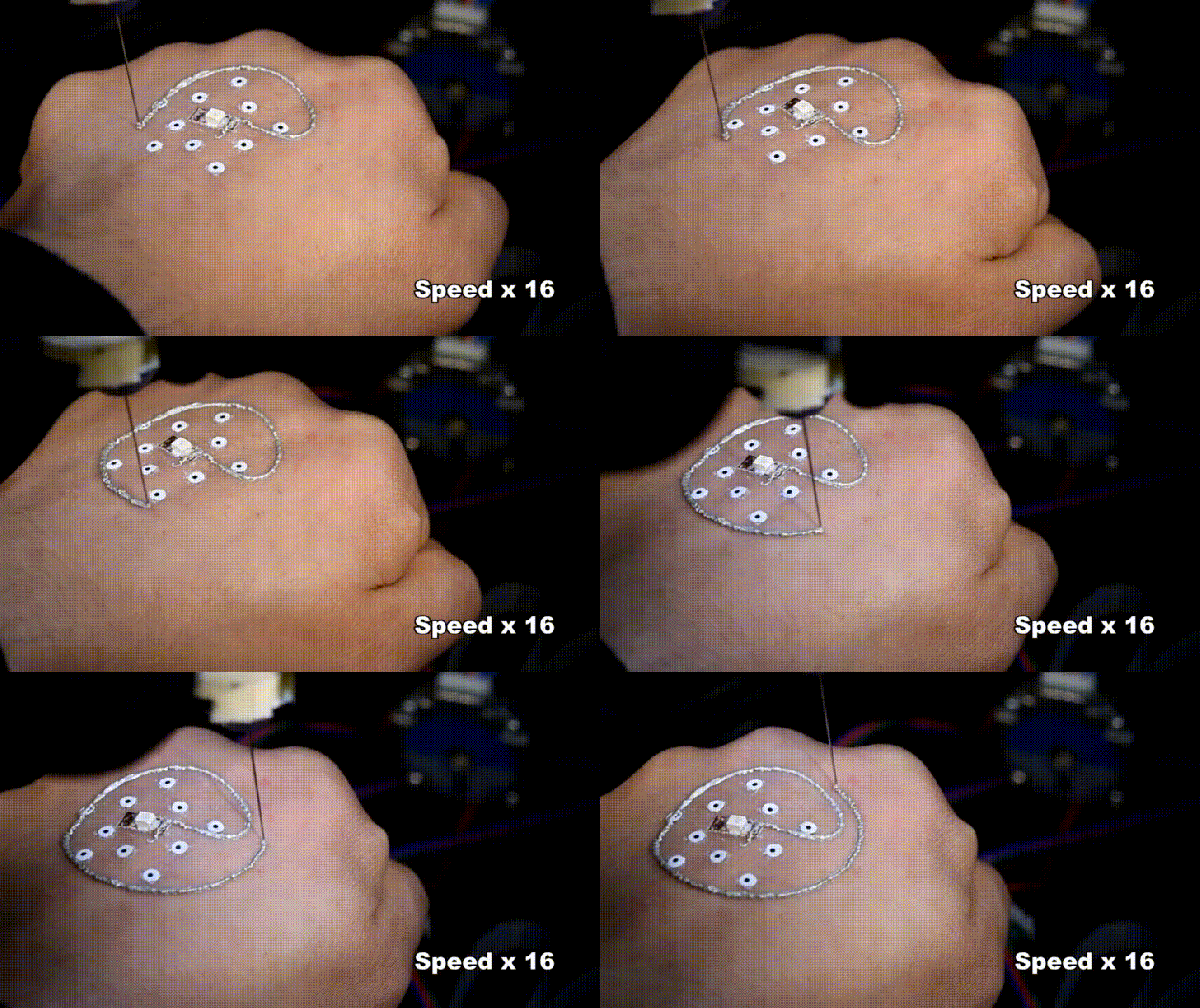
If you’ve ever wanted to more fully integrate yourself with technology, you might have to thank a team of researchers — led by [Michael McAlpine] — at the University of Minnesota in the near future. They’ve developed a technique that allows circuits to be printed directly onto your skin, with the team arguing — once the low-cost printer is modified for compact portability — it would be ideal for ‘on-the-fly’ circuit needs.

“But the hand isn’t exactly a stable print bed,” you say. We hear you, and the team is actually one step ahead — the printer can compensate for subtle movements during the printing process by tracking markers placed on the hand. The ‘filament’ is made from silver flakes — akin to conductive ink — which prints and cures at room temperatures, and can be either peeled or washed off. We should hope so, as it’s meant to be layered on human skin.

Speaking of which, it can also print cells!

It’s only been tested on a mouse so far, but the same technology that allows the printer to accurately track the hand means that it could use bio-ink to directly add cells to a wound or some other epidermal affliction to help speed the healing process.

For the circuits, though, you’ll still need the other circuit components and a compact means to power them — to say nothing about the fact that if the circuit is water-soluble, then a little perspiration would cause the ink to run. We’re excited to see where this tech goes!

[Thanks for the tip, Qes!]

Continue reading “Printed Circuits In The Palm Of Your Hand”

Hacked Fitness Trackers Aim To Improve Mental And Physical Health

We all know that the mind can affect the body in dramatic ways, but we tend to associate this with things like the placebo effect or psychosomatic illnesses. But subtle clues to the mind-body relationship can be gleaned from the way the body moves, and these hacked fitness monitors can be used to tease data from the background noise of everyday movements to help treat mental health issues.

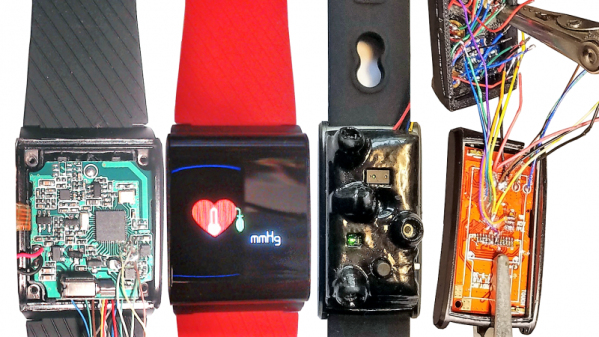
Over the last few years, [Curt White] of the Child Mind Institute has been able to leverage an incredibly cheap but feature-packed platform, the X9 Pro Sports Bracelet, a fitness band that looks more or less like a watch. Stuffed with an ARM Cortex processor, OLED screen, accelerometer, pulse sensor, and a ton of other stuff, the $35 wearable is a hacker’s dream. And hack it he did. One version of the bracelet is called Tingle, which is used to detect and avert body-focused repetitive behaviors (BFRBs), compulsive disorders that can result in self-harm through pulling at hair or pinching. The Tingle is trained to recognize the motions associated with these behaviors and respond with haptic feedback through the vibration motor. Another hacked X9 was attached to a dental retainer and equipped with sensors to monitor respirations intraorally, in an attempt to detect overdoses. It’s fascinating stuff, and the things [Curt] has done with these cheap fitness bands is mighty impressive.

This project is yet another entry in the 2018 Hackaday Prize, which is currently in the Robot Modules phase. Got an idea for something to make robots easier to build? Start a project page on Hackaday.io and get entered. Maybe your module will even feature a hacked fitness tracker.

Continue reading “Hacked Fitness Trackers Aim To Improve Mental And Physical Health”