New Sparkfun Designs


Sparkfun has recently released a bevy of new boards and other devices, with some very intriguing new builds among them.

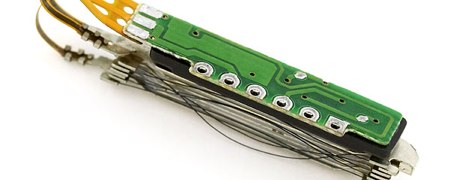
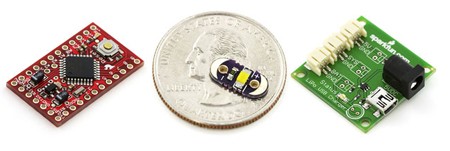
The first board that caught our attention is the Wee. It is a compact Arduino compatible controller that features a small size, low voltage, and many other minimalist attributes. It is built around an ATMega 168V and uses all SMD parts.

For even tinier fun, check out the LilyPad LED. It is a LED designed to be incorporated into clothing, featuring large holes for threading, a thin and extremely small PCB and a very bright 250mcd light. It is also washable, meaning that one or many can permanently be incorporated into clothing without fear of losing them. You can see these in the turn signal jacket we covered earlier.

The last one we’ll discuss is the LiPoly Charger, a USB lithium ion battery charger. Based on the Max 1555 IC, the LiPoly can use USB bus power or a 2.1mm center positive wallwart power(it uses the more high-powered wall-wart if both are connected). It can’t charge NiMH batteries, but it is still compact, efficient, and very useful.

Live Full Motion Video On A Peggy

[Windell] was stoked enough to send us [Jay]’s sweet hack on [Windell]’s Evil Mad Scientist Laboratories Peggy 2.0 kit. [Jay] added serial input and hacked quartz composer on his mac to light up all 625 LEDs with live motion video. If you were jealous of the Metalab’s giant LED display, now you can have your own – smaller and cheaper.

EMSL has recently supplemented this awesome device with their Arduino Library for Peggy 2.0. It is a program library that contains various animations and demonstrations of how to draw on a Peggy. Download and enjoy them as they are or tweak them to test out some of Peggy 2.0’s capabilities.

Wii Nunchuck Used For Mocap On 3D Studio Max


If you’ve been looking for a cheap way to do motion capture on 3D Studio Max, [melka] has devised an ingenious way to do mocap using a Wii nunchuck. As shown in his Vimeo video, the nunchuck is connected to an Arduino that feeds MIDI data to a computer running the MIDI app Ableton Live. Ableton Live feeds that data to 3D Studio Max via MIDI Yoke.

The video below the break shows that the motion of the nunchuck can be seen in real time in the 3D Studio Max Window. We’re really hoping [melka] will post a writeup of this project soon, as we are hungry for more details.

Continue reading “Wii Nunchuck Used For Mocap On 3D Studio Max”

Really Bare Bones Board Arduino Clone


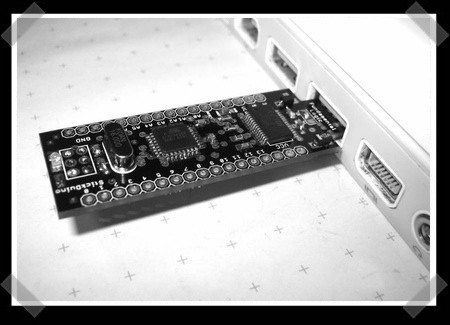
Modern Device’s Really Bare Bones Board is an Arduino clone designed to have an incredibly small footprint. It’s barely wider than the requisite AVR and is laid out so you can reduce the size even further. Don’t need the power connector? Just snip it off. Don’t need the voltage regulator? That can be removed just as easily. The kit is only $12 and all through-hole components. [youevolve] posted a build guide that shows exactly how easy it is to assemble.

Related: Freeduino SB 2.1 review

Ardupilot: Arduino Based UAV Autopilot


A short while back, [Chris Anderson] released an Arduino based autopilot. It rings in fairly cheap and being open source, you can tweak away. To add more functionality, he’s releasing a dual core version. Thanks to the second processor, it no longer requires an external hardware co-pilot. It uses an on-board GPS and features an ATtiny based fail safe. It’s still under development, but he’s made the design files available.

Arduino PhotoLab


Droplet photography (link translated from French) often produces simple and beautiful images, but timing the exposure can be tricky. Snapping the photo too early or too late can cause you to miss the action, which only lasts a fraction of a second. EquinoxeFR (the people behind the Asus WL500GP audio hack) came up with a solution to this problem using a circuit with an ATmega168 running an Arduino environment. The circuit controls a syringe that contains a liquid and is triggered remotely to release a drop into a darkened chamber. A camera with the shutter open is attached to the chamber, and before the droplet hits, it crosses an IR sensor that triggers the flash to go off a few milliseconds later, capturing the unique crown shape of the impact. No schematic is available as yet, but comments at the bottom of the post suggest one will be coming soon.

GPS Logging Arduino Shield


ladyada continues to produce more and more interesting Arduino shields. This new GPS logger plugs into a standard Arduino board and has support for four different GPS receiver modules. On the backside of the board is an SD card slot where it stores the coordinates in a text file. The total runtime can vary from five hours to twenty depending on how you choose to power the device and how you use the device. How often you read the device and whether you maintain the GPS lock will affect the power consumption. Like all of ladyada’s projects, you’ll find a great construction guide and example code on her site.