A Car That Runs On Homemade Chemical Reactions

The race for chemical engineering is quite literally on. Every year, the American Institute of Chemical Engineers (AlChE) brings together hundreds of university students to face-off to design the fastest car using techniques they’ve learned from chemical engineering courses.

The Chem-E-Car competition races cars which are only powered by chemical reactions. The goal is to come up with an elegant solution – you can’t simply jettison matter out the back as the method of locomotion. In particular, the rules don’t allow the use of liquid or obnoxious odor discharge, commercial batteries, brakes, or electrical/mechanical timing devices. However, this doesn’t mean that electronics are absent from these designs. Many teams must gather data in order to design a control system to improve the performance of their car.

Students have to build a power system, stopping mechanism, circuitry, and mechanical assembly for the body of the car, all to fit in a size constraint not much bigger than a shoebox. The competition primarily judges the accuracy of the chemical reaction for stopping the car more so than speed or power. Given that the load the car must carry is typically unknown until the day of the competition, this is a significant challenge, allowing teams to find a way to design a flexible reaction that can accommodate a range of loads and distances.

For example, this 2015 entry from the Rice University team (PDF) uses a fuel cell for locomotion and an iodine clock reaction as a timer for braking. The fuel cell powers an Arduino which monitors a light-dependent resistor. In between the LED and that LDR, the clock reaction turns opaque at a predictable time and triggers the motors to stop turning.

While many schools choose not to disclose their designs in order to gain a competitive edge, we applaud the teams who have shared the story of their builds. Kudos to the Rice team mentioned above, to the 2014 Rutger’s team whose white paper outlines the construction of aluminum air batteries worthy of Walter White, to the car from the Universitas Negeri Semarang, Indonesia powered by a thermoelectric generator (PDF), the UC Berkeley team for outlining numerous approaches to developing their power system, and the two Ohio State team’s entries seen winning the regional competition in the video below.

If you were on a team that compete the the Chem-E-Car, we want to hear about it!

Continue reading “A Car That Runs On Homemade Chemical Reactions”

The Story Of The Quickening: Mercurial Metal

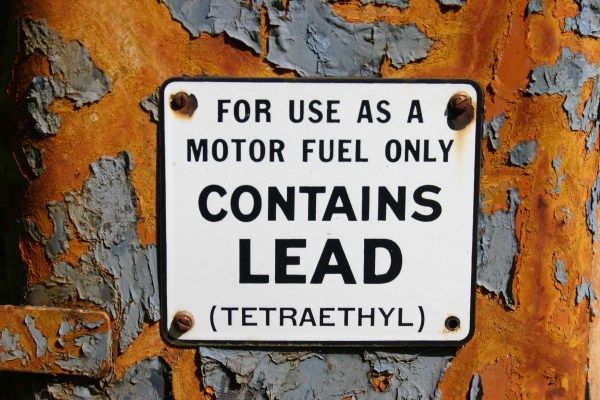
Of all known metals, mercury is probably one of the most famous, if only for its lustrous, liquid form at room temperature. Over the centuries, it has been commonly used in a wide variety of applications, including industrial chemical processes, in cosmetics, for telescope mirrors, thermometers, fluorescent lamps, dental fillings, bearings, batteries, switches and most recently in atomic clocks.

Though hardly free from the controversy often surrounding a toxic heavy metal, it’s hard to argue the myriad ways in which mercury has played a positive role in humanity’s technological progress and scientific discoveries. This article will focus both on its historical, current, and possible future uses, as well as the darker side of this fascinating metal.

Continue reading “The Story Of The Quickening: Mercurial Metal”

Using Glow-in-the-Dark Fish Gut Bacteria To Make Art

In New Orleans, a Loyola University professor has been creating original art out of glow-in-the-dark fish gut bacteria, enough to fill 1000 Petri dishes. Her first major foray into art was biomorphic abstractions, inspired by Impressionist painters, with her current work reflecting much of the abstraction of the earlier style.

The bacteria comes from the Pacific Rock Fish and glows a vibrant electric-blue. It is typically kept in a freezer and has a texture and color similar to water when it’s being used. The luminescence only lasts for 24 hours, presenting timing challenges when preparing artwork for a photoshoot, as artist [Hunter Cole] often does. With a Q-tip, [Cole] paints roses, lilies, and insects onto the Petri dishes and arranges them for surreal photography shoots. In addition to painting shapes in agar, she uses a light painting technique by filling clear water bottles with the bacteria for long-exposure shots.

[Cole] is planning on presenting her work at an art exhibit in New Orleans, along with showcasing a performance piece featuring models clad in chandelier-like costumes glowing with bioluminescent bacteria in petri dishes.

A Self-Healing, Stretchable Electronic Skin

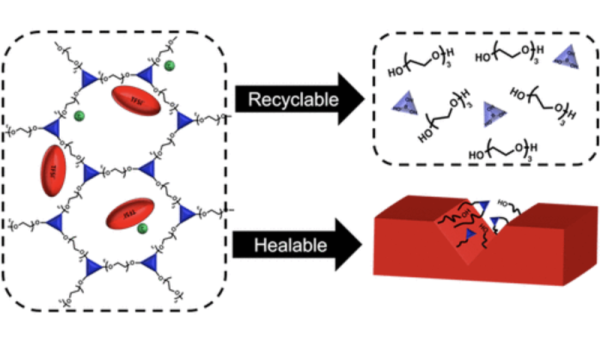
In a report published by Science Advances, a research team from the United States and Korea revealed a strain-sensitive, stretchable, and autonomous self-healing semiconductor film. In other words, they’ve created an electronic skin that’s capable of self-regulation. Time to cue the ending track from Ex Machina? Not quite.

Apart from the inevitable long timeline it will take to see the material in production, there are still challenges to improve sensing for active semiconductors. The methods used by the team – notably using a dynamically cross-linked blend of polymer semiconductor and self-healing elastomer – have created a film with a gauge factor of 5.75×10^5 at full strain. At room temperature, even with fracture strains, the material demonstrated self healing.

The technique mimics the self healing properties of human skin, accelerating the development of biomedical devices and soft robots. While active-matrix transistor array-based sensors can provide signals that reduce crosstalk between individual pixels in electronic skin, embedding these rigid sensors and transistors into stretchable systems causes mechanical mismatch between rigid and soft components. A strain-sensing transistor simplifies the process of fabrication, while also improving mechanical conformability and the lifetime of the electronic skin.

The synthetic skin was also shown to operate within a medically safe voltage and to be waterproof, which will prevent malfunctions when placed in contact with ionic human sweat.

[Thanks Qes for the tip!]

A Single-Digit-Micrometer Thickness Wood Speaker

Researchers have created an audio speaker using ultra-thin wood film. The new material demonstrates high tensile strength and increased Young’s modulus, as well as acoustic properties contributing to higher resonance frequency and greater displacement amplitude compared to a commercial polypropylene diaphragm in an audio speaker.

Typically, acoustic membranes have to remain very thin (on the micron scale) and robust in order to allow for a highly sensitive frequency response and vibrational amplitude. Materials made from plastic, metal, ceramic, and carbon have been used by engineers and physicists in an attempt to enhance the quality of sound. While plastic thin films are most commonly manufactured, they have a pretty bad impact on the environment. Meanwhile, metal, ceramic, and carbon-based materials are more expensive and less attractive to manufacturers as a result.

Cellulose-based materials have been making an entrance in acoustics research with their environmentally friendly nature and natural wooden structure. Materials like bagasse, wood fibers, chitin, cotton, bacterial cellulose, and lignocellulose are all contenders for effective alternatives to parts currently produced from plastics.

The process for building the ultra-thin film involved removing lignin and hemicellulose from balsa wood, resulting in a highly porous material. The result is hot pressed for a thickness reduction of 97%. The cellulose nano-fibers remain oriented but more densely packed compared to natural wood. In addition, the fibers required higher energy to be pulled apart while remaining flexible and foldable.

At one point in time, plastics seemed to be the hottest new material, but perhaps wood is making a comeback?

[Thanks Qes for the tip!]

The Strain Of Flu Shot Logistics

Did you get a flu shot this year? How about last year? In a world of next-day delivery and instant downloads, making the yearly pilgrimage to the doctor or the minute clinic feels like an outdated concept. Even if you get your shots free at the office, it’s still a pain to have to get vaccinated every year.

Unfortunately, there’s really no other way to deal with the annual threat of influenza. There’s no single vaccine for the flu because there are multiple strains that are always mutating. Unlike other viruses with one-and-done vaccinations, influenza is a moving target. Developing, producing, and distributing millions of vaccines every year is a massive operation that never stops, or even slows down a little bit. It’s basically Santa Claus territory — if Santa Claus delivered us all from mass epidemics.

The numbers are staggering. For the 2018-19 season, as in last year, there were 169.1 million doses distributed in the United States, up from 155.3 million doses the year before. How do they do it? We’re gonna roll up our sleeves and take a stab at it.

Continue reading “The Strain Of Flu Shot Logistics”

pierced puffed exposed leads lithium ion battery

Lessons In Li-Ion Safety

If you came here from an internet search because your battery just blew up and you don’t know how to put out the fire, then use a regular fire extinguisher if it’s plugged in to an outlet, or a fire extinguisher or water if it is not plugged in. Get out if there is a lot of smoke. For everyone else, keep reading.

I recently developed a product that used three 18650 cells. This battery pack had its own overvoltage, undervoltage, and overcurrent protection circuitry. On top of that my design incorporated a PTC fuse, and on top of that I had a current sensing circuit monitored by the microcontroller that controlled the board. When it comes to Li-Ion batteries, you don’t want to mess around. They pack a lot of energy, and if something goes wrong, they can experience thermal runaway, which is another word for blowing up and spreading fire and toxic gasses all over. So how do you take care of them, and what do you do when things go poorly?

Continue reading “Lessons In Li-Ion Safety”