[Ben Krasnow] Discusses The Heat Treatment Of Steel

steel

For home metallurgy, there are two sources of information for the heat treatment and tempering of steel. The first source is academic publications that include theoretical information, while the second includes the home-spun wisdom of blacksmiths who learn through trial and error. [Ben Krasnow] put up a great video that tries to bridge that gap with some great background information with empirical observations to back up his claims.

For investigating the hardness of steel, a few definitions are in order. The first is stiffness, or the ability of a material to ‘spring back’ after being flexed. The second is strength, specifically yield strength, which is the amount of strain a material can withstand before being permanently deformed.

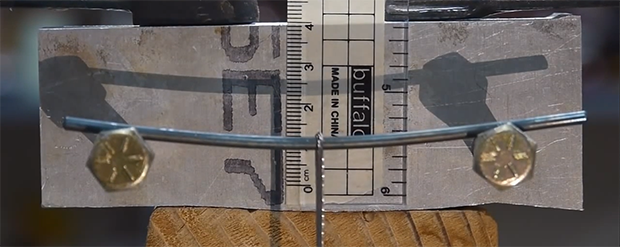
[Ben] did all these experiments with a 1/8″ W1 steel drill rod. As it came from McMaster, this rod could handle a bit of force before becoming permanently bent, and in terms of stiffness was much better than a piece of coat hanger wire [Ben] had lying around. After taking a piece of this drill rod, heating it up to a cherry red and quenching it in water, [Ben] successfully heat treated this steel to a full hardness. After putting it on his testing jig, this full hardness steel didn’t deform at all, it simply broke.

Full hardness steel is basically useless as a structural material, so [Ben] tried his hand at tempering pieces of his drill rod. By putting a few pieces in a kiln at the requisite temperature, [Ben] was able to temper his drill rods to be stronger than the stock material, but not as terribly brittle as a full hard rod.

Continue reading “[Ben Krasnow] Discusses The Heat Treatment Of Steel”

DIY Soda Can Battery

sodaCanBattery

It may not be particularly useful to create some makeshift batteries out of soda and soda cans, but it’s a good introduction to electrodes and electrolytes as well as a welcomed break from lemons and potatoes. The gang at [Go-Repairs] lopped off the can’s lid and temporarily set the soda aside, then took steel wool to the interior of the can to remove the protective plastic coating. The process can be accelerated by grabbing your drill and cramming the steel wool onto the end of a spade bit, although pressing too hard might rip through the can.

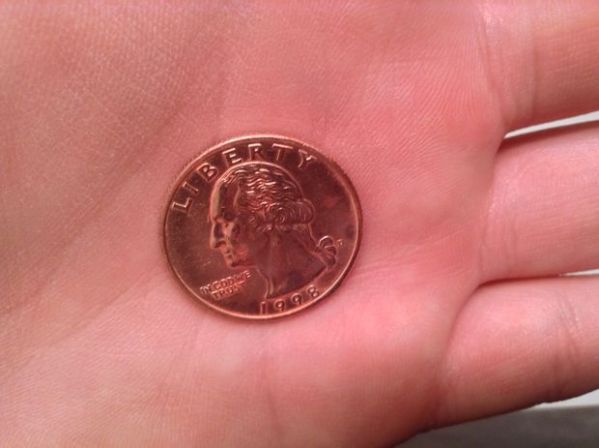
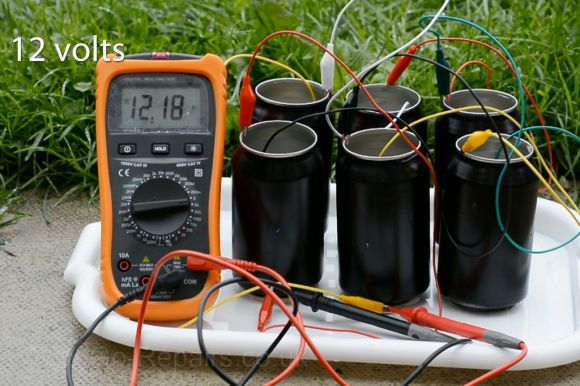
With the soda poured back in, you can eek out some voltage by clipping one lead to the can and another to a copper coin that’s dunked into the soda. Stringing along additional cans in series can scale up the juice, but you’ll need a whole six pack before you can get an LED working—and only just. The instructions suggest swapping out the soda for a different electrolyte: drain cleaner, which can pump out an impressive 12 volts from a six pack series. You’ll want to be careful, however, as it’s likely to eat through the can and is one lid away from being dangerous.

Stick around for a quick video after the break, and if you prefer the Instructables format, the [Go-Repairs] folks have kindly reproduced the instructions there.

Continue reading “DIY Soda Can Battery”

OpenFuge: An Open-source Centrifuge

openFuge

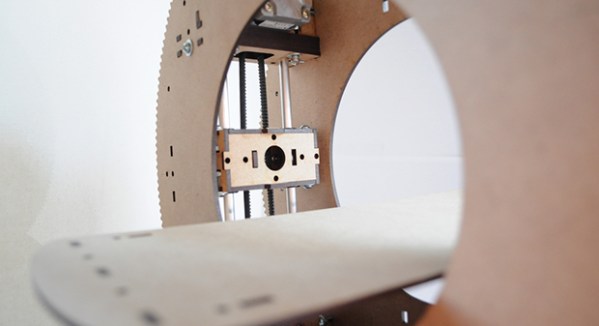
Biohackers, fire up your laser cutters. [CopabX] has developed OpenFuge: a (relatively) low-cost, open-source centrifuge from powerful hobby electronic components. If you thought the VCR centrifuge wasn’t impressive, trolls be damned— OpenFuge can crank out 9000 RPM and claims it’s capable of an impressive 6000 G’s. [CopabX] also worked in adjustable speed and power, setting time durations, and an LCD to display live RPM and countdown stats.

And it’s portable. Four 18650 lithium cells plug into the back, making this centrifuge a truly unique little build. The muscle comes from a DC outrunner brushless motor similar to the ones that can blast you around on a skateboard but with one key difference; an emphasis on RPMs over torque. We’re not sure exactly which motor is pictured, but one suggestion on the bill of materials boasts a 6000 KV rating, and despite inevitable losses, that’s blazing fast at nearly 15V.

You’ll want to see the demonstration video after the break, but also make time to swing by Thingiverse for schematics and recommended parts.

Continue reading “OpenFuge: An Open-source Centrifuge”

VCR Centrifuge

VCR’s practically scream “tear me open!” with all those shiny, moving parts and a minimal risk that you’re going to damage a piece of equipment that someone actually cares about. Once you’ve broken in, why not hack it into a centrifuge like [Kymyst]? Separating water from the denser stuff doesn’t require lab-grade equipment. As [Kymyst] explains: you can get a force of 10 G just spinning something around your head. By harvesting some belt drives from a few VCR’s, however, he built this safer, arm-preserving motor-driven device.

[Kymst] dissected the video head rotor and cassette motor drive down to a bare minimum of parts which were reassembled in a stack. A bored-out old CD was attached beneath the rotor while a large plastic bowl was bolted onto the CD. The bowl–here a microwave cooking cover–acts as a protective barrier against the tubes spinning inside. The tube carriers consist of plastic irrigation tubing fitted with a homemade trunnion, which [Kymyst] fashioned from some self-tapping screws and a piece of PVC. At 250 rpm, this centrifuge reaches around 6 G and best of all, gives a VCR something to do again. Take a look at his guide and make your own, particularly if your hackerspace has a bio lab.

DIY Ultrasonic Acoustic Levitation

[Mike] saw a few videos of ultrasonic acoustic levitation rigs put together by student researchers. Figuring it couldn’t be that hard to replicate, he set out and built his own using surplus parts and whatever was sitting around his parts drawer.

The build began with a huge ultrasonic transducer from an old ultrasonic cleaning tank [Mike] picked up on eBay for $20 £20. He didn’t pick up the standard driver board, as those don’t have a very clean output – something desperately needed if you’re setting up a standing wave. He did manage to put a simple supply together with a 555 timer, a MOSFET and a 12 V transformer connected backwards, though.

The test rig is pretty simple – just the transducer sitting on a table with an aluminum plate sitting above it on threaded rods. By adjusting the distance between the transducer to the aluminum plate, [Mike] managed to set up some standing waves he was able to suspend small Styrofoam balls in. It’s not quite precise enough to levitate small chunks of sodium and water, but it makes for an excellent science fair-type project.

Continue reading “DIY Ultrasonic Acoustic Levitation”

A Touch Screen Geiger Counter Without A Geiger Tube

geiger

We’re assuming [Toumal] was desperately bored one day, because in the depths of the Internet he found some really cool components to build a solid state Geiger counter.

The Arduino and touchscreen are rather standard fare [Toumal] picked up on eBay for about $30. What really sets this project apart from all the other geiger counter builds we’ve seen is the solid state geiger counter [Toumal] used. This device uses a specially-made photodiode made by First Sensor to detect gamma emissions from 5 to 1000 keV.

[Toumal] put all the software for his Arduino touch screen radiation detector up on github. To be honest, we’re really impressed with the rad sensor [Toumal] used for this project, so if you ever decide to pick one of those up, he’s got your back with an Arduino library for it.

Potassium Chlorate From Household Products

To the upper right we have very pure potassium chlorate, so much so that it bursts into flames when mixed with sugar and catalyzed with some sulfuric acid. [Mr. Home Scientist] produced the KClO3 using household chemicals and some rudimentary equipment sourced on eBay.

The experiment started off with concentrated bleach containing 8.25% sodium hypochlorite. He needed sodium chlorate so a hot plate was used to boil the bleach until crystals started to form. A more efficient way to achieve this reaction would be using electrolysis (check out the HHO generator we saw recently for a homemade rig). The next step is to add potassium chloride, which is sourced from the grocery store as a sodium-free salt alternative. After mixing with the filtered remains of the bleach reaction the two are combined. There is no precipitate from this — an indication that not everything is as it should be. But an overnight stay in the refrigerator results in the potassium chlorate crystals seen above.

Fiery testing (seen below) lets him know the experiment worked. From here the product can be used for things like making solid rocket engines.

Continue reading “Potassium Chlorate From Household Products”