ATtiny Gets A Tiny Software UART

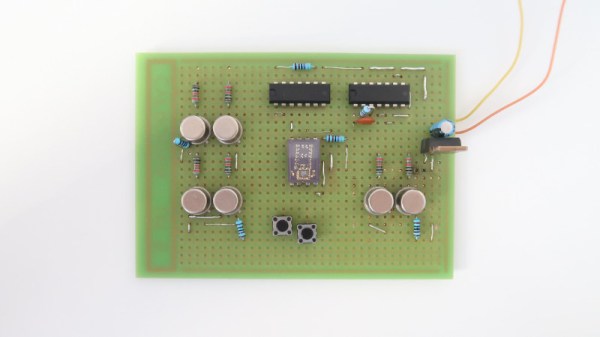
Modern microcontroller platforms spoil us with their performance and expansive spec sheets. These days it’s not uncommon to be developing for a cheap micro that has a clock rate well in excess of 100MHz, with all manner of peripherals baked in. DACs, WiFi, you name it – it’s in there, with a bunch of libraries to boot. It wasn’t always this way, and sometimes you would even find yourself lacking hardware serial support. In these cases, the bitbanged software UART is your friend, and [MarcelMG] decided to document just how it’s done.

The amateur programmer’s first recourse may be to use delays to properly time the output data stream. This has the drawback of wasting processor cycles and doesn’t let the microcontroller do much else useful. Instead, [Marcel] discusses the proper way to do things, through the use of interrupt service routines and hardware timers.

[Marcel]’s implementation is for the ATtiny24A, though it should be easily portable to other AVR8 processors. Taking up just 2 bytes of RAM and 276 bytes of program space, it’s compact – which is key on resource-limited 8-bit devices. The code is available on Github if you fancy trying it out yourself.

It’s a technique that is more than familiar to the old hands, but useful to those new to the art. It can be particularly useful if you need to get data out of a legacy platform with limited options. As times change, it’s important to pass on the techniques of yesteryear to the new generation. Of course, if things are really tight, you can even do a half-duplex UART on a single pin.


Old Meets New In 3D Printed Telegraph

We often think of 3D printing as a way to create specific components in our builds, everything from some hard-to-find little sprocket to a custom enclosure. More and more of the projects that grace the pages of Hackaday utilize at least a few 3D printed parts, even if the overall build itself is not something we’d necessarily consider a “printed” project. It’s the natural progression of a technology which at one time was expensive and complex becoming increasingly available to the maker and hacker.

But occasionally we see 3D printing used not to create new devices, but recreate old ones. A perfect example is the almost entirely 3D printed telegraph system created by [Matt]. Projects like this help bring antiquated technology back to a modern audience, and can be an excellent educational tool. Showing someone a diagram of how the telegraph worked is one thing, but being able to run off a copy on your 3D printer and putting a working model in their hands is quite another.

[Matt] acknowledges that he’s hardly the first person to 3D print a telegraph key, but says that he’d never seen the complete system done before. The key is perhaps the component most people are familiar with from film and old images, but alone it’s really nothing more than a momentary switch. To actually put it to use, you need a telegraph sounder on the receiving end to “play” the messages.

The sounder is a somewhat more complex device than the key, and uses an electromagnet to pull down a lever and produce an audible clicking noise. In the most basic case, the coil is directly connected to the key, but in a modern twist [Matt] has added a MOSFET into the circuit so the electromagnet is triggered locally within the sounder. This prevents sparks from eroding the contacts in the key, and alleviates problems associated with current loss over long wire runs.

We’ve previously seen 3D printing used to revive vintage games which are no longer available such as “The Amazing Dr. Nim”, and how modern techniques such as additive manufacturing can help put World War II aircraft back in the air. While there was never much question that 3D printing would be a big part of our future, it would seem to be taking a fairly active role in preserving our past as well.

Driving A Controllerless LCD With The Humble Arduino Uno

These days, you could be forgiven for thinking driving an LCD from a microcontroller is easy. Cheap displays have proliferated, ready to go on breakout boards with controllers already baked in. Load up the right libraries and you’re up and running in a matter of minutes. However, turn your attention to trying to drive a random LCD you’ve yanked out of a piece of old equipment, and suddenly things get harder. [Ivan Kostoski] was in just such a position and decided to get down to work.

[Ivan]’s LCD was a 320×240 STN device salvaged from an old tape library. The display featured no onboard controller, and the original driver wasn’t easily repurposed. Instead, [Ivan] decided to drive it directly from an Arduino Uno.

This is easier said than done. There are stringent timing requirements that push the limits of the 8-bit platform, let alone the need for a negative voltage to drive the screen and further hardware to drive the backlight. These are all tackled in turn, with [Ivan] sharing his tips to get the most flexibility out of the display. Graphics and text modes are discussed, along with optimizations that could be possible through the varied use of available RAM and flash.

The code is available on Github. If you need inspiration for your own controllerless LCD driver. [Ben Heck] has done similar work too, using FPGA grunt to get the job done.

Component Video For The Commodore 64

Of all the retro systems, the Commodore 64 had the best video system. The VIC-II chip in the C64 was the best example of why Commodore was the best, but in terms of video output, the C64 was still a consumer device: the only output was S-video, or composite video, or something like it. The professional stuff uses YPbPr, an RGB video signal that separates the red, green, and blue colors. On a modern LCD, the difference between composite and YPbPr is noticeable, and if you’re going to run your C64 on the big screen, it would be very helpful to use a professional video standard.

In an effort to bring the C64 into the future, [c0pperdragon] created an FPGA-based modification for the VIC-II chip. The end result is getting YPbPr signals directly from the computer, and outputting it to a TV in glorious 480p.

Inside the Commodore 64, the VIC-II creates the chrominance signal in a way that is impossible to convert it back to any form of RGB. The solution to get RGB out of this information is to listen in to 22 pins of the VIC-II to determine what signals it intends to generate. This is done with a smallish Altera FPGA connected to the VIC-II through a ribbon cable. On the FPGA, the luminescence and all the color information is generated, then converted into true YPbPr. For the complete mod, the RF modulator is removed, and the original A/V jack is still functional. This is effectively a very in-depth mod that rids the C64 of the TV connector and channel selector (that no one uses anymore) and replaces it with a professional-grade video output.

When it comes to C64 mods, we thought we’ve seen it all. We’ve seen C64s resurrected from the dead, and we’ve seen drop-in replacements for the SID that still don’t have working filters oh my god. This is on another level. This is using FPGAs to drag the C64 into the modern era, and if you don’t care about the rusting RF box, it’s a reversible mod.

This Cardboard Box Can Tell You What It Sees

It wasn’t that long ago that talking to computers was the preserve of movies and science fiction. Slowly, voice recognition improved, and these days it’s getting to be pretty usable. The technology has moved beyond basic keywords, and can now parse sentences in natural language. [Liz Meyers] has been working with the technology, creating WhatIsThat – an AI that can tell you what it’s looking at.

Adding a camera to Google’s AIY Voice Kit makes for a versatile object identification system.

The device is built around Google’s AIY Voice Kit, which consists of a Raspberry Pi with some additional hardware and software to enable it to process voice queries. [Liz] combined this with a Raspberry Pi camera and the Google Cloud Vision API. This allows WhatIsThat to respond to users asking questions by taking a photo, and then identifying what it sees in the frame.

It may seem like a frivolous project to those with working vision, but there is serious potential for this technology in the accessibility space. The device can not only describe things like animals or other objects, it can also read text aloud and even identify logos. The ability of the software to go beyond is impressive – a video demonstration shows the AI correctly identifying a Boston Terrier, and attributing a quote to Albert Einstein.

Artificial intelligence has made a huge difference to the viability of voice recognition – because it’s one thing to understand the words, and another to understand what they mean when strung together. Video after the break.

[Thanks to Baldpower for the tip!]

Continue reading “This Cardboard Box Can Tell You What It Sees”

Car Alarm Hacks 3 Million Vehicles

Pen testing isn’t about evaluating inks. It is short for penetration testing — someone ensuring a system’s security by trying to break in or otherwise attack it. A company called Pen Test Partners made the news last week by announcing that high-end car alarm systems made by several vendors have a critical security flaw that could make the vehicles less secure. They claim about three million vehicles are affected.

The video below shows how alarms from Viper/Clifford and Pandora have a simple way to hijack the application. Once they have access, they can find the car in real time, control the door locks, and start or stop the car engine. They speculate a hacker could set off the alarm from a nearby chase car. You’d probably pull over if your alarm started going off. They can then lock you in your car, approach, and then force you out of the car.

Continue reading “Car Alarm Hacks 3 Million Vehicles”

A Garbage Bag Skirt Is Fit For A Hovercraft

The hovercraft is an entertaining but much maligned form of transport. While they have military applications and at times have even run as ferries across the English Channel, fundamental issues with steering and braking have prevented us all driving them to work on a regular basis. They do make great toys however, and [HowToMechatronics] has built an excellent example.

The build is primarily a 3D printed affair, with the hull, ducting, and even the propellers being made in this way. The craft is sized to be readily printable on a 30cm square build platform, making it accessible to most printer owners. Drive is via brushless motors, and control is achieved using their previously-featured self-built NRF24L01 radio control transmitter.

What stands out among most other hovercraft builds we see here is the functioning skirt. It’s constructed from a garbage bag, and held on to the hull with a 3D printed clamping ring. Most quick builds omit a skirt and make up for it with light weight and high power, so its nice to see one implemented here. We’d love to see how well the craft works on the water, though it holds up well on the concrete.

Finished in a camouflage paint scheme, the craft looks the part, and handles well too. We’d consider a small correction to the center of gravity, but it’s nothing a little ballast wouldn’t fix. Video after the break. Continue reading “A Garbage Bag Skirt Is Fit For A Hovercraft”