See The Radioactive World With This Peltier Cloud Chamber

Remember when a homemade cloud chamber was a science fair staple? We haven’t participated for decades, but it seemed like every year someone would put a hunk of dry ice in a fish tank, add a little alcohol, and with the lighting just right – which it never was in the gymnasium – you might be lucky enough to see a few contrails in the supersaturated vapor as the occasional stray bit of background radiation whizzed through the apparatus.

Done right, the classic cloud chamber is a great demonstration, but stocking enough dry ice to keep the fun going is a bit of a drag. That’s where this Peltier-cooled cloud chamber comes into its own. [mosivers] spares no expense at making a more permanent, turn-key cloud chamber, which is perched atop a laser-cut acrylic case. Inside that is an ATX power supply which runs a Peltier thermoelectric cooling module. Coupled with a CPU cooler, the TEC is able to drive the chamber temperature down to a chilly -42°C, with a strip of white LEDs providing the required side-lighting. The video below gives a tour of the machine and shows a few traces from a chunk of pitchblende; it’s all pretty tame until [mosivers] turns on his special modification – a high-voltage grid powered by a scrapped electronic fly swatter. That really kicks up the action, and even lets thoriated TIG welding electrodes be used as a decent source of alpha particles.

It’s been a while since we’ve seen a Peltier cloud chamber build around here, which is too bad because they’re great tools for engaging young minds as well as for discovery. And if you use one right, it just might make you as famous as your mother.

Continue reading “See The Radioactive World With This Peltier Cloud Chamber”

A Turntable For Model Railroads

Way back when, before diesel-electric locomotives were a thing, trains weren’t really able to go backwards too well. Also it’s sometimes necessary to turn carriages around in a small space. For that, the railway turntable was invented. If you want to implement one on a model layout, this project from DIY & Digital Railworld is for you.

The project is at an early stage – thus far, laying out how to set up an Arduino Uno using a potentiometer to control the speed of a stepper motor, which rotates the turntable. The turntable itself is a 3D printed part sourced from Thingiverse, designed to suit the specific stepper motor used.

This has the easy part sorted – rotating a piece of track through 360 degrees to orient a train properly. However, there’s significant work ahead. Power needs to be hooked up to the rails, and a system for accurately aligning the turntable with outgoing tracks needs to be devised. This is particularly relevant for N-gauge setups, where tolerances are everything.

We’d love to know how you’d tackle the various issues to build a working model turntable in the comments. We’ve seen some serious model railroad builds before around these parts. Video after the break.

Continue reading “A Turntable For Model Railroads”

Adventures In Automating A Candle Factory

Have you ever considered the manufacture of candles? Not necessarily manufacturing them yourself, but how they are manufactured in a small-scale industrial setting? It’s something that has been of great concern to Michael Schuldt as he grappled with the task of automating a simple manual candle production process.

It’s not just an interesting subject, but the topic of manufacturing automation is something we can all learn from. This was the subject of his Adventures in Manufacturing Automation talk at the recent Hackaday Superconference which you’ll find below the break. Let’s dive in and see what this is all about!

Continue reading “Adventures In Automating A Candle Factory”

Morse Code Keyboard 1939 Style!

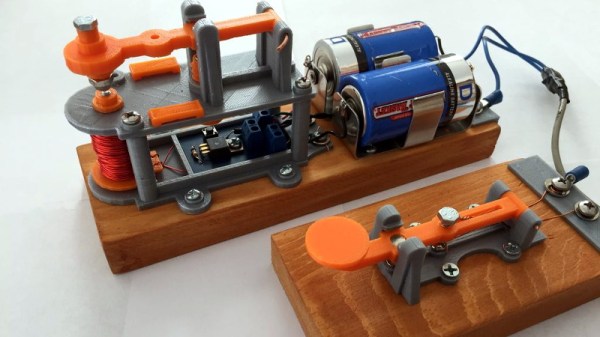
If you want to learn Morse code and you don’t have a teacher, you’d probably just head over to a website or download a phone app. Before that, you probably bought a cassette tape or a phonograph record. But how did you learn Morse if you didn’t have any of that and didn’t know anyone who could send you practice? Sure, you could listen to the radio, but in 1939 that might be difficult, especially to find people sending slow enough for you to copy.

Wireless World for August 3rd, 1939, has the answer in an article by [A. R. Knipe] on page 109. While you probably wouldn’t use it today, it is a great example of how ingenious you can be when you don’t have an Arduino and all the other accoutrements we take for granted today.

Continue reading “Morse Code Keyboard 1939 Style!”

Delta Robot Is Sorting Golf Balls And Taking Names

It’s a common situation faced by every hard-working American – you get home after a long day at the calcium mines, and find yourself stuck with a pile of colored golf balls that simply aren’t going to sort themselves. Finally, you can put away your sorting funnels and ball-handling gloves – [Anthony] has the solution.

That’s right – it’s a delta robot, tasked with the job of sorting golf balls by color. A Pixy2 object tracking camera is used to survey the table, with the delta arms twitching around to allow the camera to get an unobstructed view. Once the position of the balls is known, a bubble sort is run and the balls rearranged into their correct color order.

[Anthony] readily admits the bubble sort is very inefficient at this task; it was an intentional choice so it could be later compared with other sorting methods. [Anthony] also goes into detail, sharing the development process of the suction gripper as well as discussing damping methods to reduce noise.

Delta machines are always fun to watch, and are a good choice for sorting machines. We’ve seen some really tiny ones, too. Video after the break.

Continue reading “Delta Robot Is Sorting Golf Balls And Taking Names”

Preserving Floppy Disks Via Logic Analyser

The floppy disk is a technology that is known only to the youth of today as the inspiration for the Save icon. There’s a lot of retro computing history tied up in these fragile platters, thus preservation is key. But how to go about it? [CHZ-Soft] has found an easy way, using a logic analyzer and a healthy dose of Python.

Floppy drives have particularly low-level interfaces, offering up little more than a few signals to indicate the position of the head on the disk, and pulses to indicate changes in magnetic flux. The data is encoded in the pattern of flux changes. This has important implications as far as preservation goes – it’s best to record the flux changes themselves, and create an image of the exact magnetic state of the disk, and then process that later, rather than trying to decode the disk at the time of reading and backing up just the data itself. This gives the best likelihood of decoding the disk and preserving an accurate image of floppy formats as they existed in the real world. It’s also largely platform agnostic – you can record the flux changes, then figure out the format later.

[CHZ-Soft] takes this approach, explaining how to use a Saleae logic analyser and a serial port to control a floppy drive and read out the flux changes on the disk. It’s all controlled automatically through a Python script, which automates the process and stores the results in the Supercard Pro file format, which is supported by a variety of software. This method takes about 14MB to store the magnetic image of a 720KB disk, and can even reveal a fingerprint of the drive used to write the disk, based on factors such as jitter and timing.

It’s an impressive hack that shows that preservation-grade backups of floppy disks can be achieved without spending big money or using specialist hardware. We’ve seen other projects in this space before, too.

Vintage Programmer Gets Modern Chip Adapter

While trying to revive a Donkey Kong Jr arcade board, [Jelmer Bruijn] found himself in the market for an EPROM programmer and became the proud owner of a 1990’s era Dataman S4. Despite its age, it’s a fairly nice tool which allows you to read and write a laundry list of different EPROM types, all without being tied to a computer. The only catch is that a few types of chips need an adapter to work in the Dataman S4, some of which are unsurprisingly no longer available.

After some above and beyond support from the current crew at Dataman set him on the right track, [Jelmer] decided to try his hand at reverse engineering how the old adapters worked so he could build his own. His ultimate goal was to read 40 pin EPROMs on the 32 pin Dataman S4, but in the end he says the information he gathered should be applicable for building other adapters if you ever find yourself in need of such things.

As you might expect, there’s a bit more to the project than a simple pin adapter. [Jelmer] assumed some kind of shift register or latching arrangement would be required to make up for the shortage of pins on the Dataman S4’s ZIF socket. It was just a matter of figuring out how it all went together.

Luckily, [Jelmer] found that the programmer would happily attempt to perform operations on a 16 bit EPROM even though no adapter was physically present. This gave him a chance to probe around with a logic analyzer to figure out what it was trying to accomplish. The trick turned out to be splitting the 16 bit bus into two 8 bit buses which are requested sequentially.

With careful observation, close studying of 16 bit chip datasheets, and much brow furrowing, he was eventually able to come up a design that used five 74xx573 latches and put a schematic together in Eagle. There were a few kinks to iron out when the boards finally arrived, but ultimately the design worked on the first try. [Jelmer] says the same technique should work for 42 pin EPROMs, but as Dataman still actually sell adapters for those he decided not to supply schematics for it.

[Jelmer] tells us that he was inspired to send this success story our way after reading how our very own [Elliot Williams] took the long away around to erase a couple UV EPROMs recently While this isn’t the first time we’ve seen somebody have to hack support for 16 bit EPROMs into their programmer, it’s good to see that the manufacturer at least had the customer’s back in this case.