The Estes line of flying model rockets have inspired an untold number of children and adults alike, thanks in part to their simplicity. From the design and construction of the rockets themselves to the reliability and safety of the modular solid-propellant motors, the company managed to turn actual rocket science into a family activity. If you could glue fins onto a cardboard tube and stick a plastic nosecone on the end, you were nearly ready for launch.
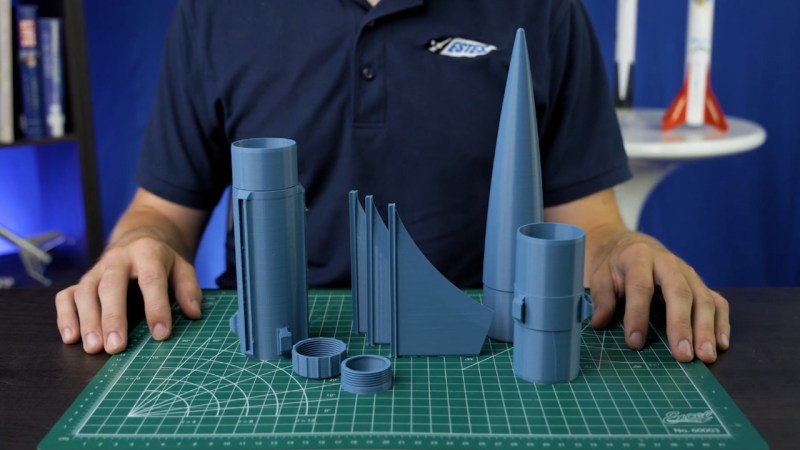
But what if you’re looking for something a bit more challenging? That’s where the new Estes Scorpio 3D comes in. Unlike the classic Estes kit, which included the fins, nosecone, and other miscellaneous bits of the rocket, the Scorpio kit requires you to 3D print your own parts. Do it right, and the company says you can send your creation to heights of 1,000 feet (305 m).
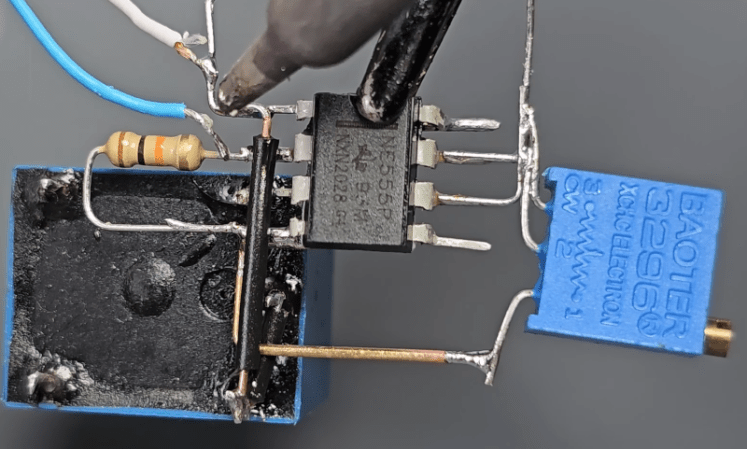
We often marvel at the many things a 555 can do. But [Zafer Yildiz] shows us that it can even take the place of a PCB. You’ll see what we mean in the video below. The timer relay circuit is built “dead bug” style with the 555 leads bent out to provide wiring terminals.
Honestly, these kinds of circuits are fun, but we would be reticent to use this type of construction for anything that had to survive in the real world. Solder joints aren’t known for being mechanically stable, so this is good for experiments, but maybe not something you want to do all the time.
To connect the miniature world of integrated circuits like a CPU with the outside world, a number of physical connections have to be made. Although this may seem straightforward, these I/O pads form a major risk to the chip’s functioning and integrity, in the form of electrostatic discharge (ESD), a type of short-circuit called a latch-up and metastability through factors like noise. Shielding the delicate ASIC from the cruel outside world is the task of the I/O circuitry, with [Ken Shirriff] recently taking an in-depth look at this circuity in Intel’s 386 CPU.
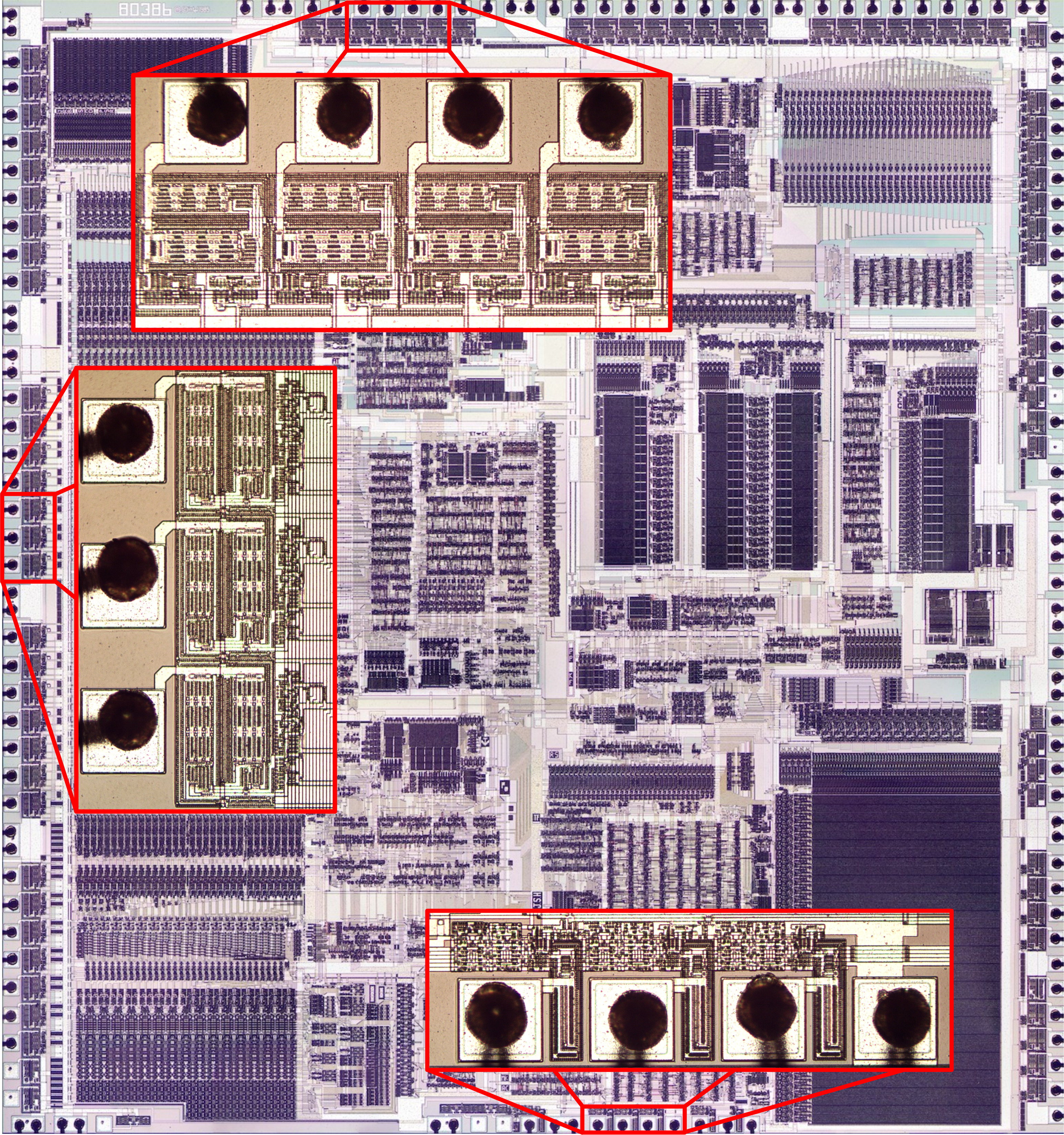
The 386 die, zooming in on some of the bond pad circuits. (Credit: Ken Shirriff)
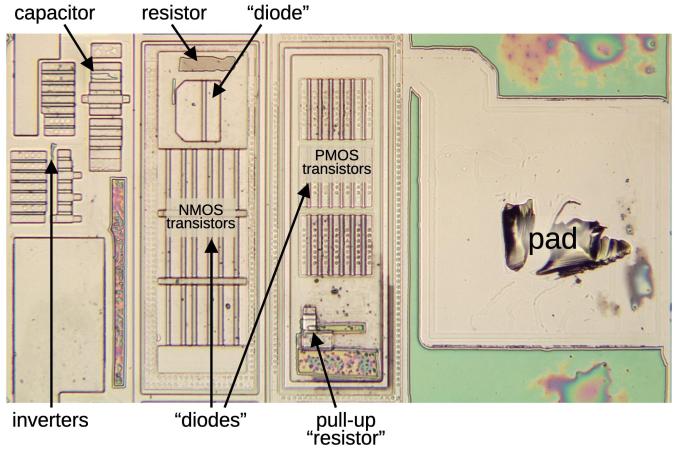
The 386 has a total of 141 of these I/O pads, each connected to a pin on the packaging with a delicate golden bond wire. ESD is on the top of the list of potential risks, as a surge of high voltage can literally blow a hole in the circuitry. The protective circuit for this can be seen in the above die shot, with its clamping diodes, current-limiting resistor and a third diode.
Latch-up is the second major issue, caused by the inadvertent creation of parasitic structures underneath the P- and NMOS transistors. These parasitic transistors are normally inactive, but if activated they can cause latch-up which best case causes a momentary failure, but worst case melts a part of the chip due to high currents.
To prevent I/O pads from triggering latch-up, the 386 implements ‘guard rings’ that should block unwanted current flow. Finally there is metastability, which as the name suggests isn’t necessarily harmful, but can seriously mess with the operation of the chip which expects clean binary signals. On the 386 two flip-flops per I/O pad are used to mostly resolve this.
Although the 386’s 1985-era circuitry was very chonky by today’s standards, it was still no match for these external influences, making it clear just how important these protective measures are for today’s ASICs with much smaller feature sizes.
With the assistance of an extra pair of hands, but without any power tools in sight, this old master marks up a piece of wood and then cuts a collapsible chair out of it. He uses various types of saw, chisels, a manual drill, and various other hand tools. His workspace is a humble plank with a large clamp attached. At the end he does use a powered hot air gun to heat the finish he uses to coat the final product.
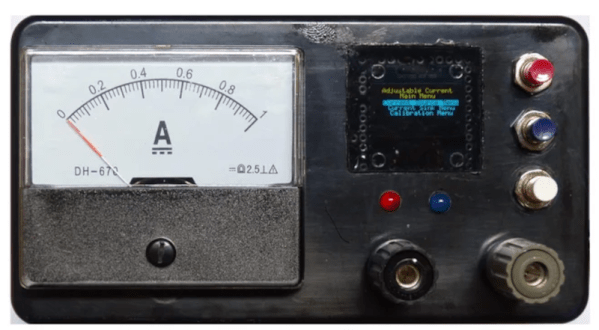
At first glance, [RobBest]’s constant current source looks old school. The box is somewhat old-fashioned, featuring switches and binding posts. Most importantly, there’s a large analog meter dominating the front panel. Then you notice the OLED display, and you know something’s up.
The device can source or sink a constant current. In addition, it features a timer that calculates milliamp-hours and automatically turns off when not in use. The brain is a PIC 16F1765, which controls the screen, the buttons, and a few relays. While that might seem an odd choice for the processor, it is actually smart. The device has both a DAC and an ADC, plus an internal op amp. The analog output and a single pass transistor control the current flow, while the two relays flip it between a source and a sink.
Without that op amp, the DAC can’t produce much current. However, by passing it through the onboard amplifier, the output can drive about 100 mA, which is sufficient for this project.
This is a classic circuit, but the addition of a CPU and a display gives it capabilities that would have been very difficult to build back in the day. Want to dive into the theory behind constant current sources? Or just the practical use of a voltage regulator to make one?
When you think of neon, you might think of neon signs or the tenth element, a noble gas. But there was a time when neon bulbs like the venerable NE-2 were the 555 of their day, with a seemingly endless number of clever circuits. What made this little device so versatile? And why do we see so few of them today?
Neon’s brilliant glow was noted when William Ramsay and Morris Travers discovered it in 1898. It would be 1910 before a practical lighting device using neon appeared. It was 1915 when the developer, Georges Claude, of Air Liquide fame, received a patent on the unique electrodes suitable for lighting and, thus, had a monopoly on the technology he sold through his company Claude Neon Lights.
However, Daniel Moore in 1917 developed a different kind of neon bulb while working for General Electric. These bulbs used coronal discharge to produce a red glow or, with argon, a blue glow. This was different enough to earn another patent, and neon bulbs found use primarily as indicator lamps before the advent of the LED. However, it would also find many other uses.
Entries keep ticking in for the One Hertz Challenge, some more practical than others. [Pierre-Loup M.]’s One Hertz Sculpture has no pretensions of being anything but pretty, but we can absolutely respect the artistic impulse behind it.
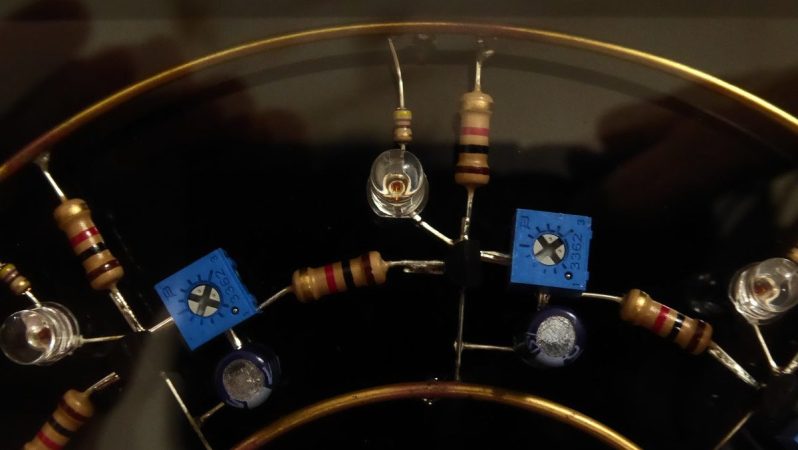
The sculpture is a free-form circuit inside of a picture frame. There are 9 LEDs in a ring with a few other components to produce a reverse-chase effect (one going dark at a time) taking about 1 second to circle the sculpture. As far as free-form circuit art goes, it’s handsomely done, but as this is Hackaday it’s probably the electronics, rather that the aesthetics that are of interest.
The circuit is an example of a ring oscillator: a cascading chain of NOT gates, endlessly feeding into and inverting one
Without timing it, it looks like 1 Hz, even if we know it’s not.
another. The NOT gates are implemented in resistor-transistor logic with 2N3904 NPN transistors, nine in total. Of course the inverter delay of this sort of handmade logic gate is far too fast for an aesthetically pleasing (or visible) chase, so some extra circuitry is needed to slow down the oscillations to something less than the 5 MHz it would naturally do. This is affected by pairing every transistor with an RC oscillator. Ideally the RC oscillator would have a 0.111..s period (1/9th of a second), but a few things got in the way of that. The RC oscillator isn’t oscillating in a vacuum, and interactions with the rest of the circuit have it running just a little bit fast. That’s really of no matter; a simple oscillator circuit like this wasn’t going to be a shoe in for the accuracy-based Time Lords category of this contest. As a sculpture and not a clock, you’re not going to notice it isn’t running at exactly 1Hz. (Though a ring-oscillator based clock would be a sight indeed.)