Oscillator Negativity Is A Good Thing

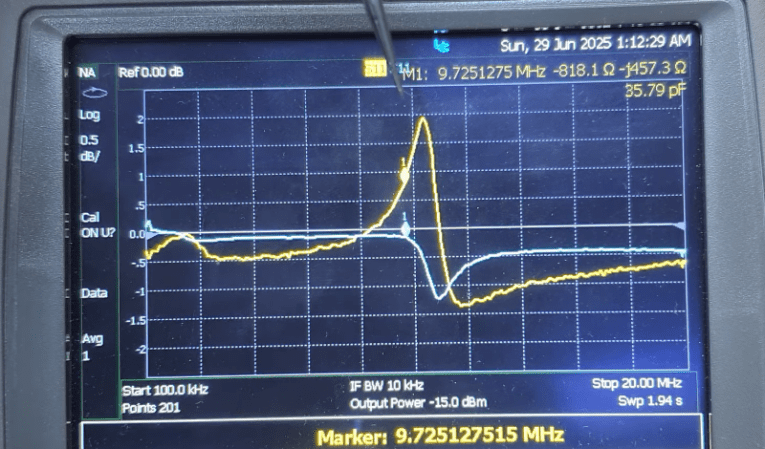
Many people who get analog electronics still struggle a bit to design oscillators. Even common simulators often need a trick to simulate some oscillating circuits. The Barkhausen criteria state that for stable oscillation, the loop gain must be one, and the phase shift around the feedback loop must be a multiple of 360 degrees. [All Electronics Channel] provides a thorough exploration of oscillators and, specifically, negative resistance, which is punctuated by practical measurements using a VNA. Check it out in the video below.

The video does have a little math and even mentions differential equations, but don’t worry. He points out that the universe solves the equation for you.

In an LC circuit, you can consider the losses in the circuit as a resistor. That makes sense. No component is perfect. But if you could provide a negative resistance, it would cancel out the parasitic resistance. With no loss, the inductor and capacitor will go back and forth, electrically, much like a pendulum.

So, how do you get a negative resistance? You’ll need an active device. He presents some example oscillator architectures and explains how they generate negative resistances.

Crystals are a great thing to look at with a VNA. That used to be a high-dollar piece of test gear, but not anymore.

Continue reading “Oscillator Negativity Is A Good Thing”

Reliving VHS Memories With NFC And ESPHome

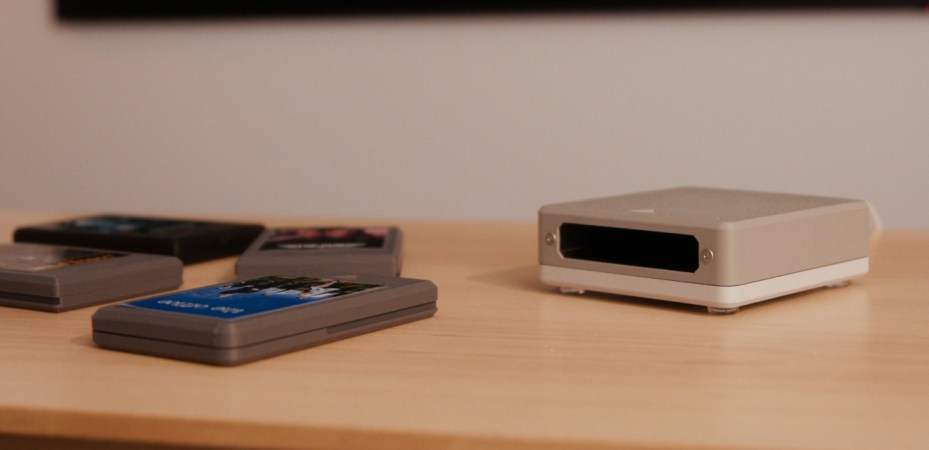
Like many of us of a certain vintage, [Dillan Stock] at The Stock Pot is nostalgic for VHS tapes. It’s not so much the fuzzy picture or the tracking issues we miss, but the physical experience the physical medium brought to movie night. To recreate that magic, [Dillan] made a Modern VHS with NFC and ESPHome.

NFC tags are contained in handsomely designed 3D printed cartridges. You can tell [Dillan] put quite a bit of thought into the industrial design of these: there’s something delightfully Atari-like about them, but they have the correct aspect ratio to hold a miniaturized movie poster as a label. They’re designed to print in two pieces (no plastic wasted on supports) and snap together without glue. The printed reader is equally well thought out, with print-in-place springs for that all important analog clunk.

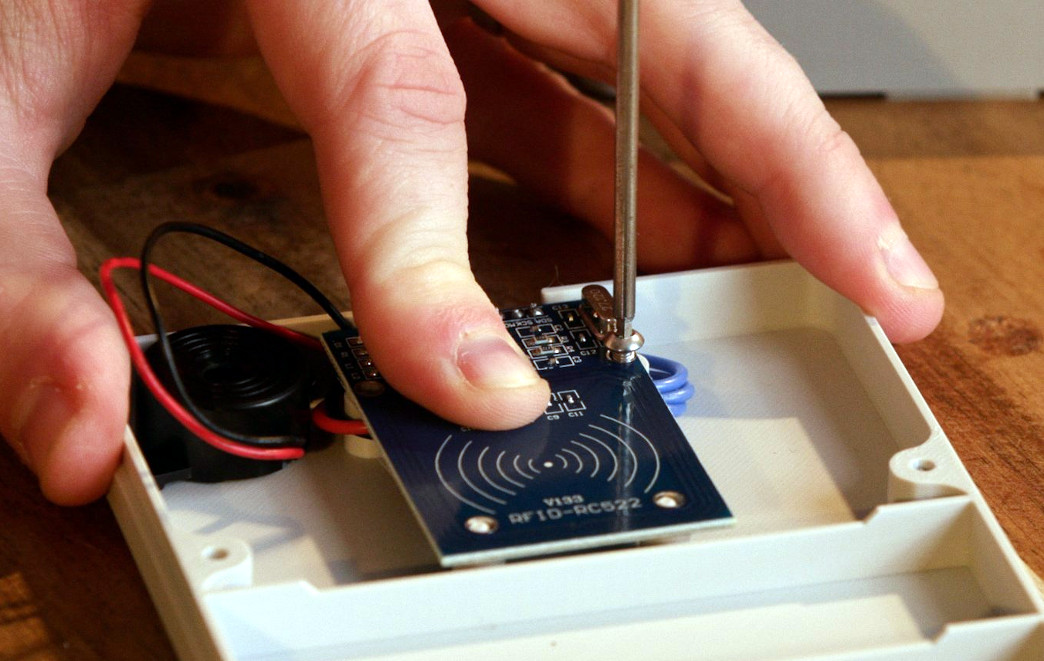
Electronically, the reader is almost as simple as the cartridge: it holds the NFC reader board and an ESP32. This is very similar to NFC-based audio players we’ve featured before, but it differs in the programming. Here, the ESP32 does nothing related directly to playing media: it is simply programmed to forward the NFC tag id to ESPHome. Based on that tag ID, ESPHome can turn on the TV, cue the appropriate media from a Plex server (or elsewhere), or do… well, literally anything. It’s ESPHome; if you wanted to make this and have a cartridge to start your coffee maker, you could.

If this tickles your nostalgia bone, [Dillan] has links to all the code, 3D files and even the label templates on his site. If you’re not sold yet, check out the video below and you might just change your mind. We’ve seen hacks from The Stock Pot before, everything from a rebuilt lamp to an elegant downspout and a universal remote.

Continue reading “Reliving VHS Memories With NFC And ESPHome”

Subpixel Rendering For Impossibly Small Terminal Text

When it comes to text, how small is too small? The experts say a six point font is the minimum for readability, but as [James Bowman] shows us, you can get away with half of that. 

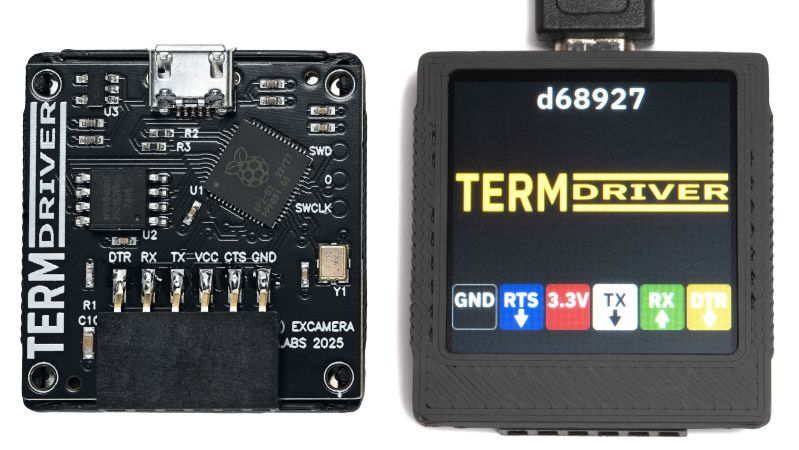
The goal is to produce a 40-character display on a 24 mm x 24 mm LCD that has a resolution of 240 x 240 to show a serial terminal (or other data) on the “TermDriver2” USB-to-Serial adapter. With 24 lines, that’s a line per millimeter: very small text. Three points, to be precise, half what the experts say you need. Diving this up into 40 columns gives a character cell of six by nine pixels. Is it enough?

Continue reading “Subpixel Rendering For Impossibly Small Terminal Text”

Mechanical 7-Segment Display Combines Servos And LEGO

If you need a seven-segment display for a project, you could just grab some LED units off the shelf. Or you could build something big and electromechanical out of Lego. That’s precisely what [upir] did, with attractive results.

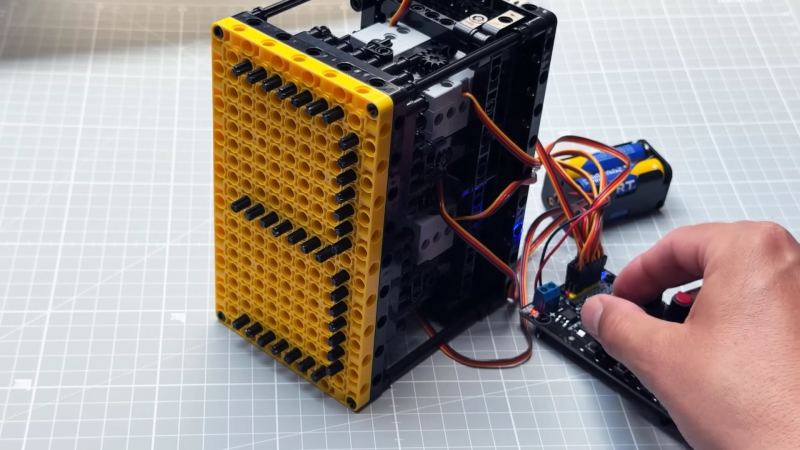
The build relies on Lego Technic parts, with numbers displayed by pushing small black axles through a large yellow faceplate. This creates a clear and easy to read display thanks to the high contrast. Each segment is made up of seven axles that move as a single unit, driven by a gear rack to extend and retract as needed. By extending and retracting the various segments in turn, it’s possible to display all the usual figures you’d expect of a seven-segment design.

It’s worth noting, though, that not everything in this build is Lego. The motors that drive the segments back and forth are third-party components. They’re Geekservo motors, which basically act as Lego-mountable servos you can drive with the electronics of your choice. They’re paired with an eight-channel servo driver board which controls each segment individually. Ideally, though, we’d see this display paired with a microcontroller for more flexibility. [upir] leaves that as an exercise for the viewer for now, with future plans to drive it with an Arduino Uno.

Design files are on Github for the curious. We’ve featured some similar work before, too, because you really can build anything out of Lego. Video after the break.

Continue reading “Mechanical 7-Segment Display Combines Servos And LEGO”

Keep Track Of The Compost With LoRaWAN

Composting doesn’t seem difficult: pile up organic matter, let it rot. In practice, however, it’s a bit more complicated– if you want that sweet, sweet soil amendment in a reasonable amount of time, and to make sure any food-born pathogens and weed seeds don’t come through, you need a “hot” compost pile. How to tell if the pile is hot? Well, you could go out there and stick your arm in like a schmuck, or you could use [Dirk-WIllem van Gulik]’s “LORAWAN Compostheap solarpowered temperaturesensor” (sic).

The project is exactly what it sounds like, once you add some spaces: a solar-powered temperature sensor that uses LoRaWAN to track temperatures inside (and outside, for comparison) the compost heap year round. Electronically it is pretty simple: a Helltech CubeCell AB01 LoraWAN module is wired up with three DS18B20 temperature sensors, a LiPo battery and a solar panel. (The AB01 has the required circuitry to charge the battery via solar power.) Continue reading “Keep Track Of The Compost With LoRaWAN”

Tektronix TDS8000 banner

Repairing An Old Tektronix TDS8000 Scope

Over on his YouTube channel our hacker [CircuitValley] repairs an old TDS8000 scope.

The TDS8000 was manufactured by Tektronix circa 2001 and was also marketed as the CSA8000 Communications Signal Analyzer as well as the TDS8000 Digital Sampling Oscilloscope. Tektronix is no longer manufacturing and selling these scopes but the documentation is still available from their website, including the User Manual (268 page PDF), the Service Manual (198 page PDF), and some basic specs (in HTML).

You can do a lot of things with a TDS8000 scope but particularly its use case was Time-Domain Reflectometry (TDR). A TDR scope is the time-domain equivalent of a Vector Network Analyzer (VNA) which operates in the frequency-domain.

Continue reading “Repairing An Old Tektronix TDS8000 Scope”

Tamagotchi Torture Chamber Is Equal Parts Nostalgia And Sadism

Coming in hot from Cornell University, students [Amanda Huang], [Caroline Hohner], and [Rhea Goswami] bring a project that is guaranteed to tickle the funny bone of anyone in the under-40 set, and sadists of all ages: The Tamagochi Torture Chamber.

Tamagotchi Torture Chamber displaying Tombstone
He’s dead, Jim.

In case you somehow missed it, Bandai’s Tamagochi is a genre-defining digital pet that was the fad toy at the turn of the millennium, and has had periodic revivals since. Like the original digital pet, there are three pushbuttons to allow you to feed, play with, and clean your digital pet. These affect the basic stats of happiness, health, food and weight in ways that will be familiar to anyone who played with the original Tamagochi. Just as with the original, mistreatment or neglect causes the Tamagochi to “die” and display a tombstone on the TFT display.

Where the “Torture Chamber” part comes in is the presence of an accelerometer and soft physics simulation– the soft physics gets an entire core of the Pi Pico at the heart of this build dedicated to it, while the other core handles all inputs, display and game logic. What this enables is the ability to bounce the digital pet off the walls of its digital home with an adorable squish (and drop in health stat) by tilting the unit. You can check that out in the demo video blow.

Is it overkill for a kids toy to have a full soft body simulation, rather than just a squish-bounce animation? Probably, but for an ECE project, it lets the students show off their chops… and possibly work out some frustrations.

We won’t judge. We will point you to other Tamagotchi-inspired projects, though: like this adorable fitness buddy, or this depressingly realistic human version.

If you’ve got an innovative way to torture video game characters, or a project less likely to get you on Skynet’s hitlist, don’t forget to send in a tip!

Continue reading “Tamagotchi Torture Chamber Is Equal Parts Nostalgia And Sadism”