Retrocomputing On A Chip

New electrical components enable us to reconstruct old wiring more efficiently. Especially, the accessible and cheap FPGA kits which offer the possibility to put together wiring of many old computers as an “on-a-chip” solution.

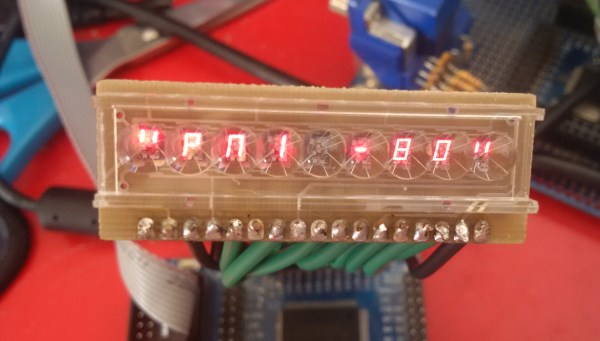
When I managed to get a hold of an old bubble LED display and a pretty mechanical matrix keyboard, I decided to build a replica of an old single board computer. Logical options seemed to be to build either KIM-1 or Heathkit ET-3400. Replicas of KIM-1 already exist, even for Arduino, so my task would be reduced to connect the keyboard and display. But then I told myself that I would use the fact that my bubble display has 9 positions as an excuse to build the legendary Czechoslovak Single Board Computer PMI-80 which used the same display. My replica is an FPGA, or rather an FPGA emulator of this very computer.
Continue reading “Retrocomputing On A Chip”

Nuts About Volts

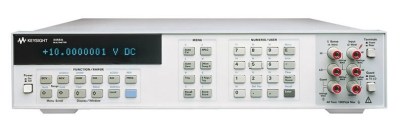
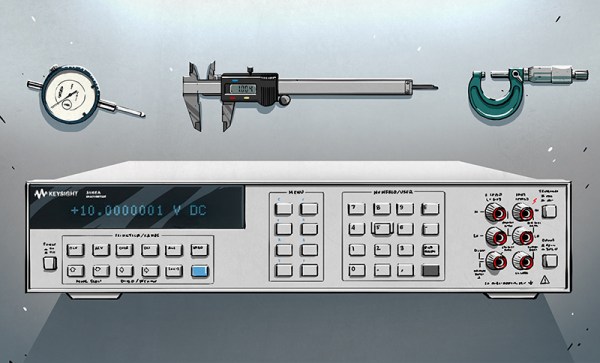
Among multimeters one instrument stands far and above the rest. An object desired for its accuracy, resolution and shear engineering beauty. I speak of course of the HP 3458A. That’s right, not Keysight, not even Agilent (though of course it goes by those brands too). The 3458A was released in 1989, when HP was still… well… HP. An elegant meter from a more civilized age. As the HP Journal documents, the 3458A was a significant engineering feat and has remained in production (and largely unchallenged) for the last 26 years.

keyBut what, you might ask, makes the 3458A such a significant and desirable instrument? It’s all in the digits. The 3458A is one of the few 8.5 digit multimeters available. It is therefore sensitive to microvolt deflections on 10 volt measurements. It is this ability to distinguished tiny changes on large signals that sets high precision multimeters apart. Imagine weighing an elephant and being able to count the number of flies that land on its back by the change in weight. The 3458A accomplishes a similar feat.

Continue reading “Nuts About Volts”

Sit ‘n Spin For Big Kids

Humans seem to have a strange love affair with testing their limits, especially when it comes to spinning. Perhaps they ride the Gravitron while dreaming they’re in NASA’s 20 g test centrifuge. When carnival rides aren’t enough though, a few intrepid hackers bust out the welders and take matters into their own hands. This is a hack that goes by many names, though  “The Redneck Spin Chair” will bring up plenty of hits on YouTube.

The design is dead simple. Take a rear differential and axle assembly out of an old car or truck. Rotate it 90 degrees, so the diff is now pointing up. Weld a chair on. Finally, weld on a couple of tow bars. Pulling the whole mess will cause the wheels to spin, which transmits power through the differential and rotates the chair. The ride doesn’t have be pulled very fast, as automotive differentials generally have reduction between 3:1 and 5:1. We’re running things in reverse, so that reduction becomes a multiplier. The result, which can be seen in the video below is a very dizzy rider.

The earliest incarnation of this ride we could find was created at Eagle Mountain in Burtrum, Minnesota. We’re betting this particular hack has been around for decades longer though. The closest in our recent memory is North Street Labs’ Centrifury. Do you know of an earlier incarnation? Let us know in the comments!

Continue reading “Sit ‘n Spin For Big Kids”

Streaming Video On An Apple IIc

Some of the projects we feature solve a problem. Others just demonstrate that they can be done. We’re guessing that it’s the latter that motivated [Joshua Bell] to write a VNC client for an Apple IIc. To fully appreciate how insane this is, have a look at the video below the break.

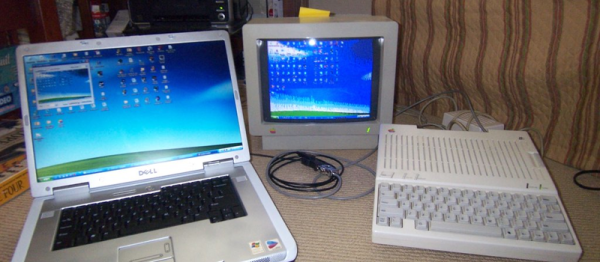
There’s more than one thing amazing about this hack. Somehow, [Joshua]’s VNC program runs entirely in the memory of an Apple IIc, as he demonstrates at the beginning of the video by downloading all of the code into the Apple over a serial cable. After the initial bootstrap, he runs the code and you see (in full four-color splendour!) a low-res Windows XP appear on the IIc.

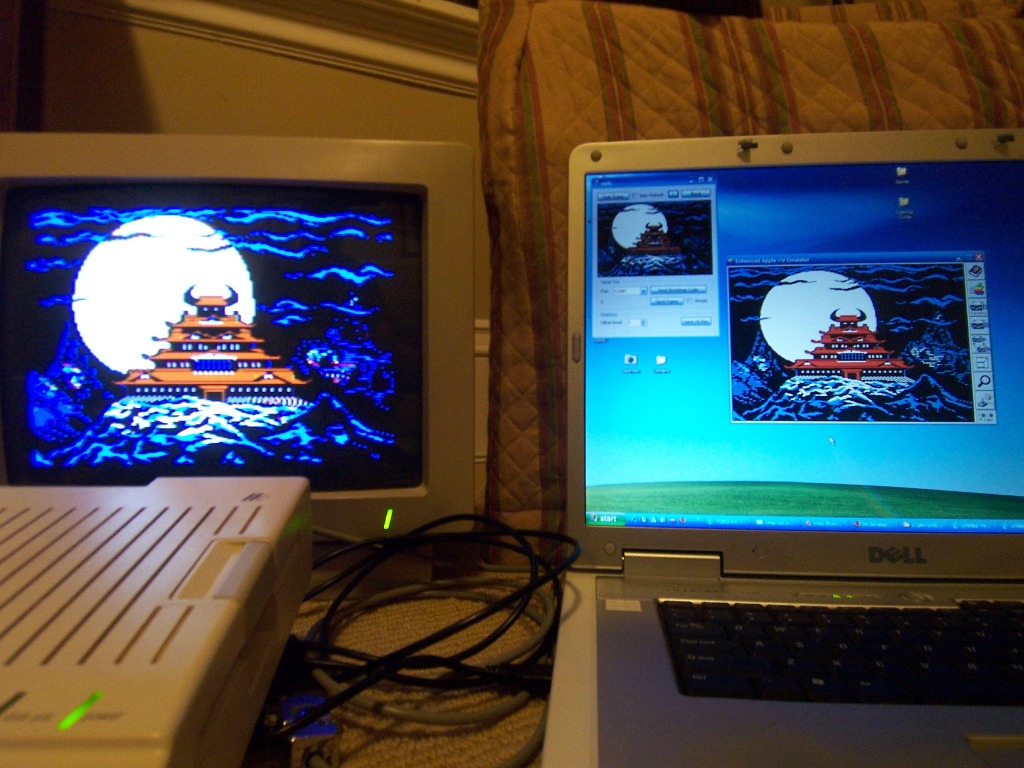
2440964467_decb0daf10_oWhat’s more incredible, but is unfortunately not demonstrated in the video, is that he appears to have not just mirrored the PC’s screen on the Apple, but has actually managed to get a one-frame-per-second bi-directional VNC working at 115,200 baud. In this snapshot from his flickr gallery, he appears to be playing Karateka on the IIc and watching it on his laptop.

If you’ve got a IIc kicking around, and you want to show it yet more new tricks, don’t neglect this browser written for the Apple IIc. Or if you’ve only got an Apple IIc+ and you’re totally ticked off that the beep is different from that of the IIc, you can always go on an epic reverse-engineering quest to “repair” it.

Continue reading “Streaming Video On An Apple IIc”

Motorcycle Headlight Modulator Is A Bright Idea

Motorcyclists are paranoid about being hit by cars, and with reason. You’re a lot safer when you’re encased in a metal shell, with airbags and seatbelts. The mass difference between a car and a motorcycle doesn’t work out well for the biker, either. Unfortunately for bikers, motorcycles are also slimmer and generally less visible than cars.

A few decades ago, motorcycle manufacturers switched over to daytime running headlights to make bikes more visible. In the meantime, however, cars have done the same, leading many bikers to fear that their visibility advantage is losing it’s impact. The solution? Blink the headlights gently during the daytime, and run them normally at night.

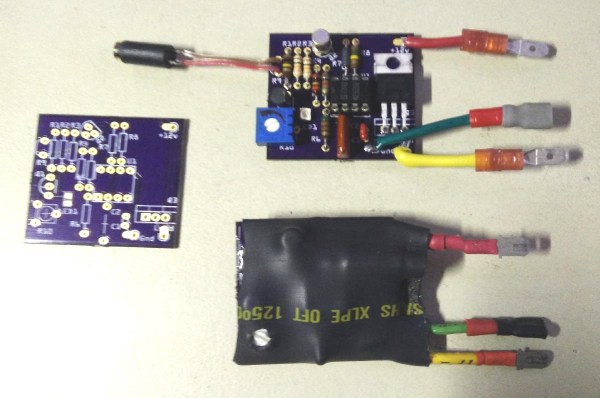
[William Dudley] was unsatisfied with commercial versions, so he built a custom headlight modulator for his motorcycle.

head_mod_cds_7_schem And believe it or not, he did it with a 555 timer IC and a light-dependent resistor (plus some transistors and a whole slew of miscellaneous parts). But [William]’s design is a good one, and he walks you through all of the choices he made in building the light-sensing circuit that disables the 555.

Whether you need a motorcycle headlight modulator or are interested to learn how this problem would be solved in the pre-Arduino days, go check out [William]’s post. And while you’re on the nostalgic electronics trip, check out this nixie tube speedometer.

The Junk Bins Of Akihabara

Akihabara, Tokyo has transformed over the years. In its present form Akihabara emerged from the ruins of a devastated Tokyo after World War 2 when the entire district was burnt to the ground. The area was rebuilt in the shadow of the Akiba Jinja (dedicated to the god of fire prevention), and a new breed of street vendors began to appear. Huddling under the protection of railway bridges, and dealing mostly in Black market radio parts, these vendors set a new tone to what would become Japan’s “Electric Town”. And as Japanese manufacturing prowess grew so too did Akihabara.

maid
Maids touting for business

Now of course Akihabara is also home to Otaku culture, and is perhaps best known in this regard for its maid cafes. Streets are littered with maids touting their cafes, somewhat incongruously among computer outlets and precision tooling stores.

My interests however lie squarely in Akihabara’s glorious junk bins. Of all places I think I’m happiest  digging through this mass of discarded technology from Japan’s manufacturing past.

A tour through the junks bins is like an archaeological dig. And in this article I will present some recent finds, and ponder on their relevance to Japanese manufacturing.

Continue reading “The Junk Bins Of Akihabara”

3 Billion Devices And A Sega Genesis Run Java

A few years ago, [Mike]’s friend gave him an old Sega Genesis with the very cool and somewhat rare SegaCD drive attached. The SegaCD gave him an idea – while it’s not easy to burn a cartridge and play homebrew games on a real Genesis console, everyone has a CD burner somewhere. [Mike] began writing his demo and then realized adding Java would be easy on the 68000. The result is Java on three billion devices and a Sega Genesis.

This project is built around Java Grinder a Java byte code compiler that will compile classes, factories, and all the horrible Java design.design.pattern.pattern.patterns() into assembly language. Already, there are a lot of platforms supported by Java Grinder, including the Commodore 64, the TI99, and thanks to some work from [Joe Davisson], the Apple IIgs

With a byte code compiler, an assembler, and an API for the Sega-specific hardware, [Mike] set about building his demo. Since this was a Sega, it needed the ‘SEGA’ sound at the start. [Mike] ended up recording his voice saying ‘JAVA!’ This plays through the Z80 on the Genesis.

The complete demo – viewable in its emulated format below – has everything you would expect from a proper demo. Starfields, dancing sprites, and even a Mandelbrot pattern make it into the three-minute long demo.

Continue reading “3 Billion Devices And A Sega Genesis Run Java”