Convert A Cheap Tube Preamp Into A Headphone Amp With Jenny

Big-name tube amplifiers often don’t come cheap. Being the preserve of dedicated audiophiles, those delicate hi-fis put their glass components on show to tell you just how pricey they really ought to be. If you just want to dip your toe in the tube world, though, there’s a cheaper and more accessible way to get started. [Jenny List] shows us the way with her neat headphone amp build.

The build starts with an off-the-shelf preamp kit based around two common 6J1 tubes. These Chinese pentode valves come cheap and you can usually get yours hands on this kit for $10 or so. You can use the kit as-is if you just want a pre-amp, but it’s not suitable for headphone use out of the box due to its high-impedance output. That’s where [Jenny] steps in.

You can turn these kits into a pleasing headphone amp with the addition of a few choice components. As per the schematic on GitHub, a cheap transformer and a handful of passives will get it in the “good enough” range to work. The transformer isn’t perfect, and bass response is a compromise, but it’s a place to start your tinkering journey. Future work from [Jenny] will demonstrate using a MOSFET follower to achieve much the same result.

We’ve seen a great number of headphone amplifiers over the years, including one particularly attractive resin-encased example.

Continue reading “Convert A Cheap Tube Preamp Into A Headphone Amp With Jenny”

3D Print An Instant Camera

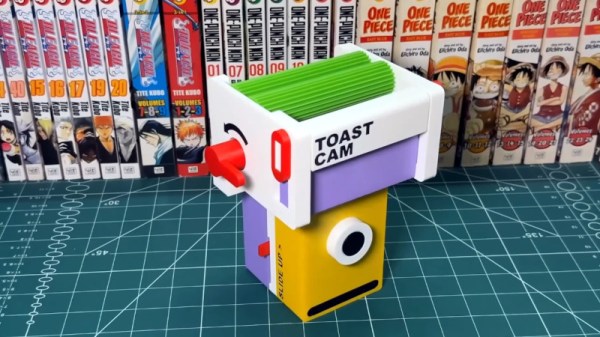
Instant photography occupies a niche in film photography that has endured despite its relatively high cost and the ease of newer digital technologies. There are two main manufacturers, Polaroid and Fujifilm, as well as a few smaller boutique camera makers. Into this comes [Toast], with an entirely 3D printed instant camera, not a Polaroid as he calls it, but one for Fuji Instax Mini film.

Currently available instant film comes in cartridges in which each picture is a layered design with a sachet of developing chemicals at the end. Once the film part has been exposed it is developed by passing through a set of rollers which squeeze the chemicals evenly over the film, allowing it to develop. The camera in the video below the break is simple enough, a pinhole box camera design, but the huge challenge and the interesting part of the video comes in the developer attachment which has those rollers. It’s considerably more challenging than it might at first appear, and he goes through many iterations before getting it right with some steel rollers.

The 3D print files are available but only at a price, and despite that we think there’s enough in the video below for anyone who wants to experiment for themselves. For the rest of us it’s an insight into a technology we all know about, but maybe have never looked closely at.

Instax has appeared here before, usually as an instant back for older cameras, but sometimes for far tastier projects.

Continue reading “3D Print An Instant Camera”

Cyanotype Prints On A Resin 3D Printer

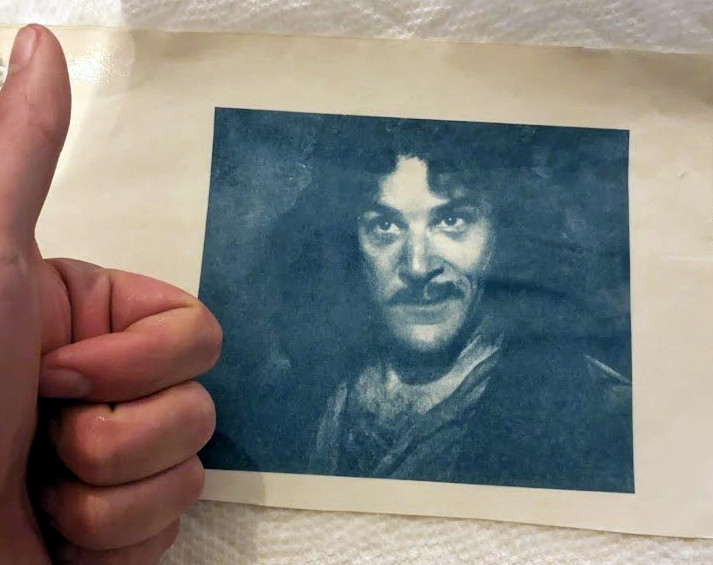
Not that it’s the kind of thing that pops into your head often, but if you ever do think of a cyanotype print, it probably doesn’t conjure up thoughts of modern technology. For good reason — the monochromatic technique was introduced in the 1840s, and was always something of a niche technology compared to more traditional photographic methods.

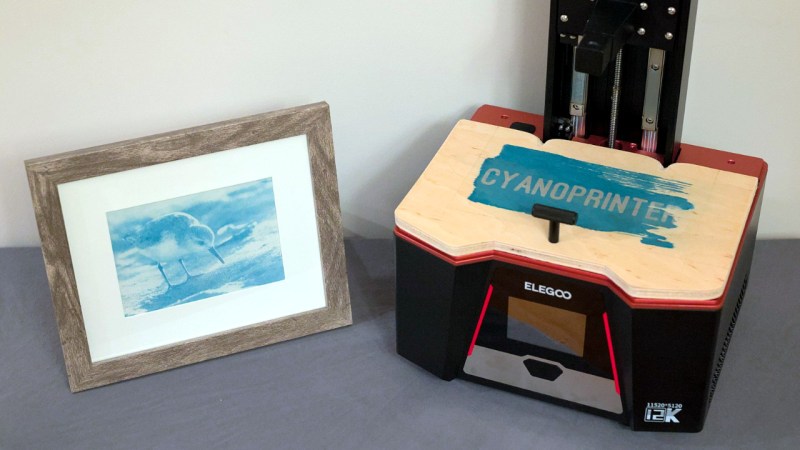
The original method is simple enough: put an object or negative between the sun and a UV-sensitive medium, and the exposed areas will turn blue and produce a print. This modernized concept created by [Gabe] works the same way, except both the sun and the negative have been replaced by a lightly modified resin 3D printer.

A good chunk of the effort here is in the software, as [Gabe] had to write some code that would take an image and turn it into something the printer would understand. His proof of concept was a clever bit of Python code that produced an OpenSCAD script, which ultimately converted each grayscale picture to a rectangular “pixel” of variable height. The resulting STL files could be run through the slicer to produce the necessary files to load into the printer. This was eventually replaced with a new Python script capable of converting images to native printer files through UVtools.

On the hardware side, all [Gabe] had to do was remove the vat that would usually hold the resin, and replace that with a wooden lid to both hold the UV-sensitized paper in place and protect the user’s eyes. [Gabe] says there’s still some room for improvement, but you wouldn’t know it by looking at some of the gorgeous prints he’s produced already.

No word yet on whether or not future versions of the project will support direct-to-potato imaging.

3D Printed Air Raid Siren Sounds Just Like The Real Thing

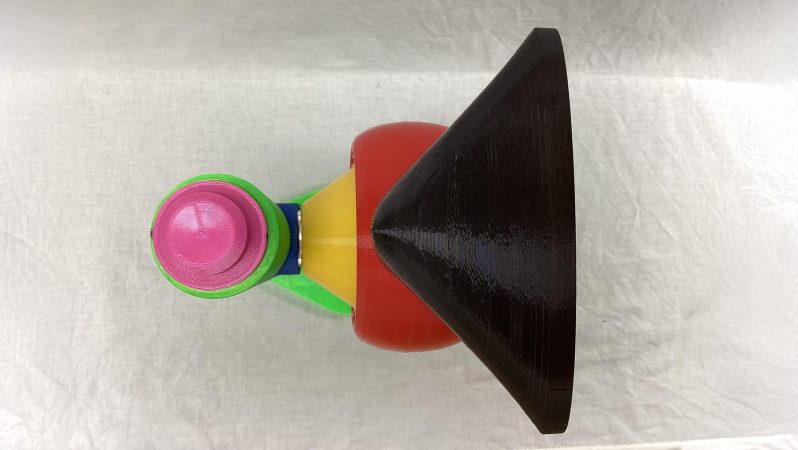
Air raid sirens have an important job to do, and have been a critical piece of public safety infrastructure in times of geopolitical turmoil. They sound quite unlike anything else, by virtue of their mechanical method of generating an extremely loud sound output. They’re actually remarkably simple to build yourself, as [MarkMakies] demonstrates.

[Mark’s] build relies almost entirely on 3D printed components and ex-RC gear. The sound itself is generated by a rotor which spins inside a stator. Each is designed with special slots, such that as the rotor turns at speed, it creates spikes of air pressure that generate a loud wail. The rotor and stator are fitted inside a housing with a horn for output, which helps direct and amplify the sound further.

To spin the rotor, [Mark] used a powerful brushless motor controlled by a common hobby speed controller. The actual speed is determined by a potentiometer, which generates pulses to command the speed controller via a simple 555 circuit. By ramping the speed of the motor up and down, it’s possible to vary the pitch of the siren as is often done with real air raid sirens. This action could be entirely automated if so desired.

If you do decide to build such a siren, just be wary about how you use it. There’s no need to go around agitating the townsfolk absent an actual air raid. It’s worth noting that sirens of this type aren’t just used for air raids, either. They’re often used for tornado warnings, too, such as in Dallas, for example. But why not for music?

Continue reading “3D Printed Air Raid Siren Sounds Just Like The Real Thing”

A 3D Printed Camera You Can Now Download, Shutter And All

A couple of years ago we were excited to read news of an entirely 3D printed camera, right down to the shutter. We wrote it up back then but sadly the required STL files were not yet available. Now after time away with his family, its creator [Mark Hiltz] is back. The medium-format Pioneer Camera can now be downloaded for printing in its entirety under a Creative Commons licence.

Looking at the design, it appears to be a relatively straightforward build. The shutter is extremely simple, as far as we can see, relying on magnets to ensure that the open part of its rotation is at an unstable repulsing point between stable magnetic poles. The images aren’t perfect because he’s using a very simple lens, but this is part of the charm of a camera like this one. We hope that people will take it and produce refinements to the design making for a cheap and good entry to medium format photography.

While you’re printing your own Pioneer, take a look at our original coverage.

Google FindMy Tools Run On An ESP32

As of about a day ago, Google’s reasonably new Find My network just got more useful. [Leon Böttger] released his re-implementation of the Android tracker network: GoogleFindMyTools. Most interestingly for us, there is example code to turn an ESP32 into a trackable object. Let the games begin!

Everything is in its first stages here, and not everything has been implemented yet, but you are able to query devices for their keys, and use this to decrypt their latest location beacons, which is the main use case.

The ESP32 code appears not to support MAC address randomization just yet, so it’s possibly more trackable than it should be, but if you’re just experimenting with the system, this shouldn’t be too much of a problem. The README also notes that you might need to re-register after three days of use. We haven’t gotten to play with it just yet. Have you?

If you’re worried about the privacy implications of yet another ubiquitous tracking system out there, you’re not alone. Indeed, [Leon] was one of the people working on the Air Guard project, which let iPhone users detect trackers of all sorts around them. Anyone know if there’s something like that for Android?

Thanks [Lars] for the hot tip!


Jeff Dunham next to a Philco Predicta TV

Jeff Dunham Finds A NOS 1958 Philco Predicta

When you see a ventriloquist like [Jeff Dunham], you probably expect to see him with a puppet. This time – spoilers ahead – you won’t. Besides his fame on stage, [Dunham] is also a collector of vintage tech and a die-hard television enthusiast. In the video below, [Dunham] has gotten his hands on a rarity: an unboxed 1958 Philco Predicta TV. The original tape was still on the box. We get to follow along on his adventure to restore this sleek, retro-futuristic relic!

[Dunham]’s fascination with the Predicta stems from its historical significance and bold design. At a time when television was making its way into American homes, the Predicta dared to be different with its swivel-mounted picture tube and early printed circuit boards. Despite its brave aesthetics, the Predicta’s ambition led to notorious reliability issues. Yet, finding one in pristine condition, sealed and untouched for over six decades, is like unearthing a technological time capsule.

What makes this story unique is [Dunham]’s connection to both broadcasting and his craft. As a ventriloquist inspired by Edgar Bergen — whose radio shows captivated America — [Dunham] delights in restoring a TV from the same brand that first brought his idol’s voice to airwaves. His love for storytelling seamlessly translates into this restoration adventure.

After unboxing, [Dunham’s] team faces several challenges: navigating fragile components, securing the original shipping brace, and cautiously ramping up voltage to breathe life into the Predicta. The suspense peaks in the satisfying crackle of static, and the flicker of a 65-year-old screen finally awakened from slumber.

Have you ever come across an opportunity like this? Tell us about your favorite new old stock find in the comments. Buying these can be a risk, since components have a shelf life. We appreciate when these old TVs play period-appropriate shows. Who wants to watch Game of Thrones on a Predicta?

Continue reading “Jeff Dunham Finds A NOS 1958 Philco Predicta”