Arctic Adventures With A Data General Nova II — The Equipment

As I walked into the huge high bay that was to be my part-time office for the next couple of years, I was greeted by all manner of abandoned equipment haphazardly scattered around the room. As I later learned, this place was a graveyard for old research projects, cast aside to be later gutted for parts or forgotten entirely. This was my first day on the job as a co-op student at the Georgia Tech Engineering Experiment Station (EES, since renamed to GTRI). The engineer who gave me the orientation tour that day pointed to a dusty electronic rack in one corner of the room. Steve said my job would be to bring that old minicomputer back to life. Once running, I would operate it as directed by the radar researchers and scientists in our group. Thus began a journey that resulted in an Arctic adventure two years later.

The Equipment

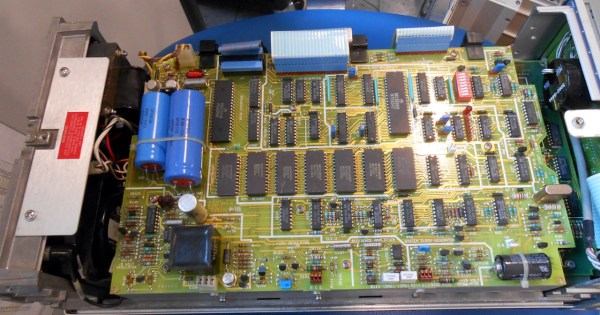
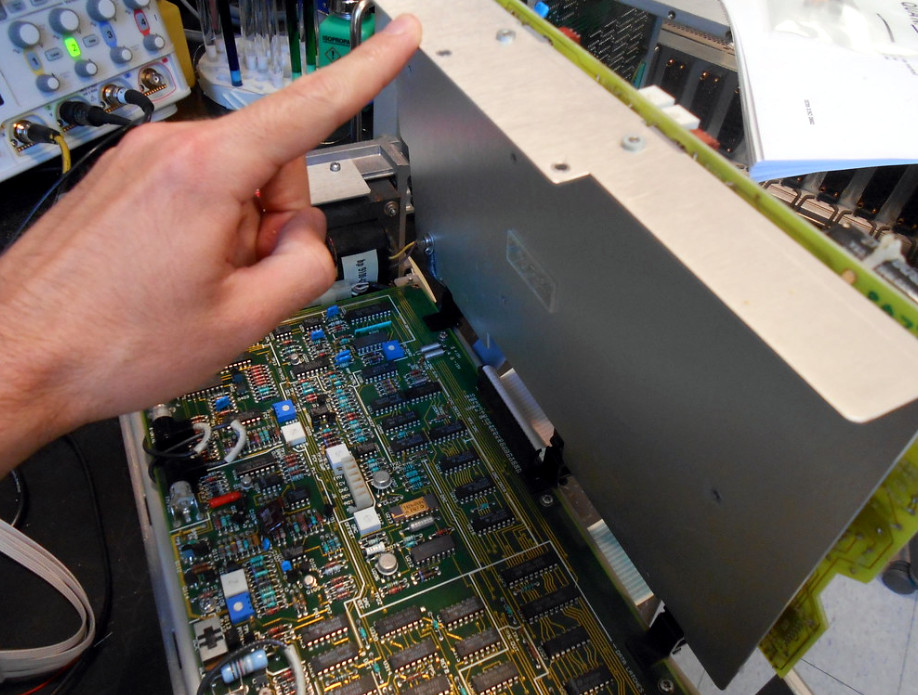
The computer in question was a Data General (DG) mini computer. DG was founded by former Digital Equipment Corporation (DEC) employees in the 1960s. They introduced the 16-bit Nova computer in 1969 to compete with DEC’s PDP-8. I was gawking at a fully-equipped Nova 2 system which had been introduced in 1975. This machine and its accessories occupied two full racks, with an adjacent printer and a table with a terminal and pen plotter. There was little to no documentation. Just to turn it on, I had to pester engineers until I found one who could teach me the necessary front-panel switch incantation to boot it up. Continue reading “Arctic Adventures With A Data General Nova II — The Equipment”

Lorenz Attractor Analog Computer With Octave Simulation

[Janis Alnis] wanted to build an analog computer circuit and bought some multiplier chips. The first attempt used apparently fake chips that were prone to overheating. He was able to get it to work and also walked through some Octave (a system similar to Matlab) simulations for the circuit. You can follow along in the video below.

Getting the little multiplier chips into the breadboard was a bit of a challenge. Of course, there are a variety of ways to solve that problem. The circuit in question is from the always interesting [Glen’s Stuff] website.

From that site:

The Lorenz system, originally discovered by American mathematician and meteorologist, Edward Norton Lorenz, is a system that exhibits continuous-time chaos and is described by three coupled, ordinary differential equations.

So, the circuit is an analog solution to the system of differential equations. Not bad for a handful of chips and some discrete components on a breadboard. We’ve seen a similar circuit on Hackaday.io.

Check out our recent competition winners if you want to see op amps do their thing. Analog computers were a thing. They aren’t always that complicated, either.

Continue reading “Lorenz Attractor Analog Computer With Octave Simulation”

Random Number Generation By Brain

If you want to start an argument in certain circles, claim to have a random number generation algorithm. Turns out that producing real random numbers is hard, which is why people often turn to strange methods and still, sometimes, don’t get it right. [Hillel Wayne] wanted to get a “good enough” method that could be done without a computer and found the answer in an old Usenet post from random number guru [George Marsaglia].

The algorithm is simple. Pick a two-digit number — ahem — at random. OK, so you still have to pick a starting number. To get the next number, take the top digit, add six, and then multiply by the bottom digit. So in C:  n1=(n/10+6)*(n%10). Then use the last digit as your random number from 0 to 9. Why does it work? To answer that, the post shows some Raku code to investigate the behavior.

In particular, where does the magic number 6 come into play? The computer program notes that not any number works well there. For example, if you used 4 instead of 6 and then started with 13, all your random digits would be 3. Not really all that random! However, 6 is just a handy number. If you don’t mind a little extra math, there are better choices, like 50.

If you think humans are good at picking random numbers, ask someone to pick a number between 1 and 4 and press them to do it quickly. Nearly always (nearly) they will pick 2. However, don’t be surprised when some people pick 141. Not everyone does well under pressure.

If you want super random numbers, try a lava lamp. Or grab some 555s and a few Nixie tubes.

A Dim Bulb Tester Is For Testing Other Equipment, Not Bulbs

If you’re testing old stereo equipment, a dim bulb tester can really come in handy. It’s not for testing bulbs, though, it’s a tester that uses a dim bulb to test other things. [Nicholas Morganti] explains it all in his guide to making your own example of such a tool. Just be wary — you need to know what you’re doing with mains voltages to do this safely!

The dim bulb is a deceptively simple tool that nonetheless often proves useful in diagnostics. It normally just consists of a bulb connected in series with the equipment under test. The bulb is intended to be a similar wattage to the power draw of the equipment itself. Take for example, an amplifier. If the bulb glows brightly when the amp is under no load, it suggests there may be a short circuit somewhere. That’s because the glowing bulb indicates that plenty of current is being drawn under a condition when very little should be flowing. The bulb protects the equipment by essentially acting as a bit of a current limiting device. It’s a soft-start tool for a piece of vulnerable equipment.

Building one is usually as simple as gathering an enclosure, a plug receptacle, a bulb socket, and some other ancillary parts to lace everything together. [Nicholas] explains it all with clear diagrams and tells you how to follow along. It’s easy enough, but you really need to know what you’re doing to use one safely, as mains voltages are involved.

It’s a great tool to have if you’re getting into amplifier repair or similar work on old gear. If you’ve been whipping up your own must-have tools, don’t hesitate to let us know!

Another Tesla Coil Starts

Everyone interested in electronics should build at least one Tesla coil. But be careful. Sure, the high voltage can be dangerous, but the urge to build lots of coils is even worse. [Learnelectronics] shows how to build a slayer exciter using a 3D-printed core, and lots of wire of course. You can see the coil, an explanation of the design, and a comparison to a cheap kit in the video below.

Of course, you hear about Tesla coils, but it is really more of a Tesla transformer. The 3D-printed core holds the many turns of the secondary coil. The larger Tesla coil, amusingly, upset the camera which made it hard to get close-up shots.

Continue reading “Another Tesla Coil Starts”

World’s First Precision Lathe: Indispensable When Constructing The Antikythera Mechanism

The precision lathe with the hooks, the bowstring, and vise visible as material is being processed. (Credit: Clickspring)

We commonly tend to associate lathes with the Industrial Revolution, when metalworking shifted largely from blacksmiths to machinists, but the use of lathes is much older than that. As [Chris] over at the Clickspring YouTube channel demonstrates in a recent video, small precision lathes were exceedingly common in the Ancient World. Not only is there ample historical evidence of them being used as far back as 1300 BCE in Ancient Egypt, but they’re also the most optimal way to get perfectly round pins and other, more intricate shapes that would be an absolute nightmare to create with just some metal files and chisels.

In the video, [Chris] uses two metal hooks, bent in a ninety-degree angle and clamped down in a vise, tapering towards each other into points. A bow string around a round piece of wood is used to bootstrap a more permanent retention element and bushing for the bow string as it is drawn over the wood to rotate it. Subsequent material that has to be worked on in the lathe is then clamped between the two points. This way, using basic materials that have been around for thousands of years and some muscle power, it’s possible to create a small lathe that can be used to create perfectly symmetrical shapes, such as those used in the construction of the Antikythera Mechanism, which [Chris] has been rebuilding for the past years, using only period-correct tools. He’s learned a lot about the mechanism in the process.

Continue reading “World’s First Precision Lathe: Indispensable When Constructing The Antikythera Mechanism”

Remote-Control Kinetic Sand Table Uses A Single Arduino

There’s nothing fun about a Sisyphean task unless you’re watching one being carried out by someone or something else. In that case, it can be mesmerizing like this Arduino-driven kinetic sand table.

What you can’t see. Image via [thang010146] on YouTube
Like many of these builds, it all started with an ordinary coffee table from the hacker’s favorite furnitüre store. [NewsonsElectronics] opened it up and added a 3mm-thick board to hold the sand and another to hold the rails and magnets.

After designing some pieces to connect the rails and pulleys together, [NewsonsElectronics] let the laser cutter loose on some more 3mm stock. A pair of stepper motors connected to a CNC shield do all of the work, driving around a stack of magnets that causes the ball bearing to trudge beautifully through the sand.

Be sure to check out the videos after the break. The first is a nice demonstration, and the second is the actual build video. In the third video, [NewsonsElectronics] explains how they could write the world’s smallest GRBL code to swing this with a single Arduino. Hint: it involves removing unnecessary data from the g-code generated by Sandify.

Don’t have a laser cutter? Here’s a sand table built from 3D printer parts.

Continue reading “Remote-Control Kinetic Sand Table Uses A Single Arduino”