PocketNC P5 Takes Desktop CNC To The 5th Dimension

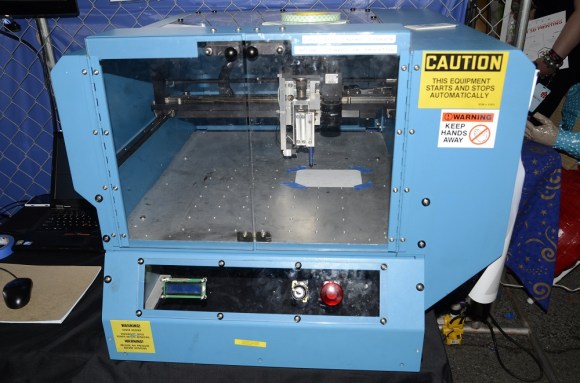
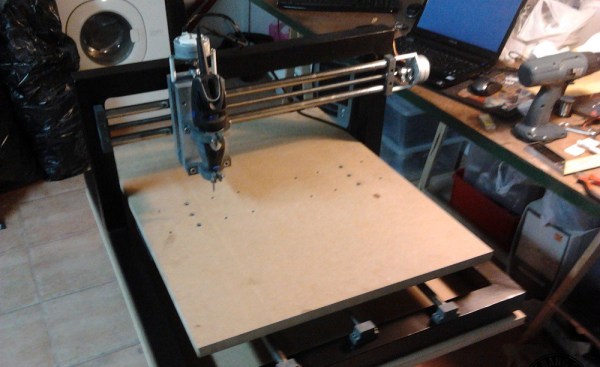
What do you get when you put together a husband/wife team of a machinist and mechanical engineer? If you’re [Matt and Michelle Hertel], you get a 5 axis CNC, which we think was one of the hidden gems at Maker Faire NY.

Hobby CNC machines have grown by leaps and bounds over the last few years. Nearly all these machines have been 3 axis (X,Y,Z). 5 (and more) axis machines have been around for years in the industrial world. These higher level machines never have made the jump to the hobby/home shop world.

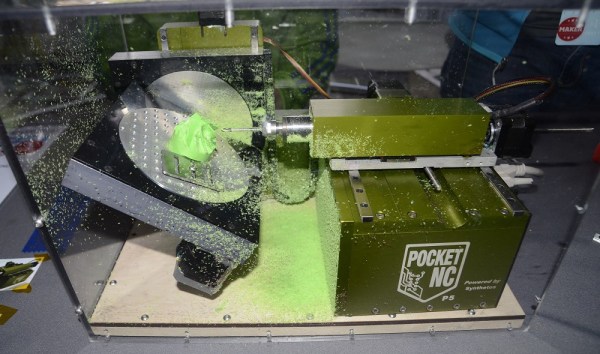
The P5’s two extra axis allow for extremely complex parts to be created in one setup. A good example of this would be a turbine wheel. Compound curves on (and behind) each blade would make this an impossible job for a 3 axis CNC. The P5 was machining these parts all weekend at Maker Faire NY. Even more impressive is the fact that it was cutting Delrin, not wax.

Continue reading “PocketNC P5 Takes Desktop CNC To The 5th Dimension”

Learn Machining From An Old School Metal Master

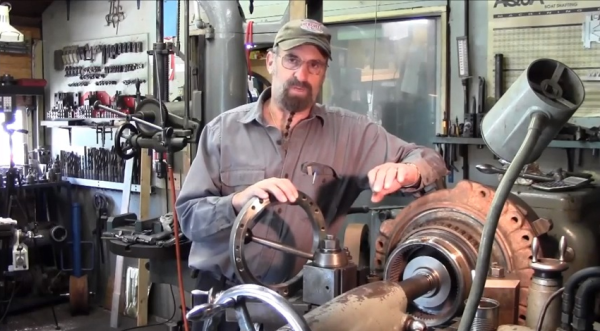
In the depths of YouTube there are still some jewels to be found. [Keith Fenner] is one of them. [Keith] owns Turn Wright Machine Works in Cape Cod, MA. From his small shop, He works on everything from sailboats to heavy equipment.

[Keith] describes himself as “An artist, and a jobber, 36 years in the trade”. We think he could add teacher to that list, as we’ve learned quite a bit about machining from his Youtube channel.

One of the interesting things about [Keith] is his delivery on camera. He makes the viewer feel like an apprentice machinist working alongside him. Rather than carefully setup shots with graphics, [Keith] narrates as he works paying jobs. He also has no problem showing us his mistakes – and recovery from them, as well as his victories.

The main tools at Turn Wright are the lathe and mill, but [Keith] isn’t old fashioned by any means. He has a complete PlasmaCAM setup and isn’t afraid to do a little computer work.

Most of [Keith’s] projects are broken up into several videos. One of our favorites is “So you broke it off in your hole”. In this series [Keith] shows what it takes to get a broken screw extractor (or EZ Out) out of a large diesel turbo. Get a feeling for what [Keith] has to offer with his “Day in the LIfe” video after the break.

Continue reading “Learn Machining From An Old School Metal Master”

BeagleBone Black Does CNC With RAMPS

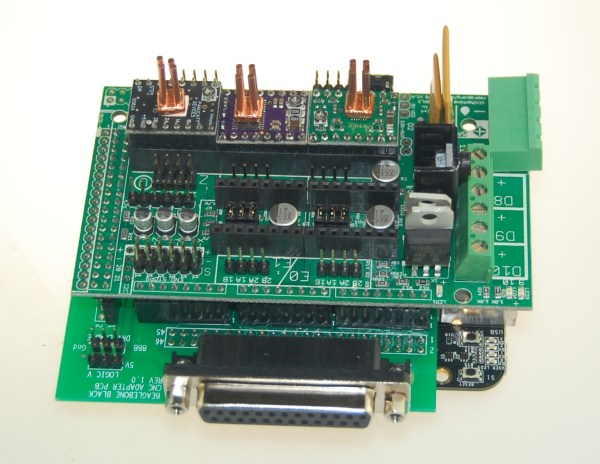
[Bart] Wanted to try controlling a CNC with his BeagleBone black, but didn’t want to invest in a CNC Cape. No problem – he created his own translator board for RAMPSLinuxCNC for the BeagleBone Black has been available for a few months now, and [Bart] wanted to give it a try. He started experimenting with a single stepper motor and driver.  By the time he hooked up step, direction, and motor phases, [Bart] knew he needed a better solution.

Several CNC capes are available for the BeagleBone boards, but [Bart] had a RAMPS board just sitting around, waiting for a new project.  Most RepRap fans have heard of the RAMPS – or Reprap Arduino Mega Pololu Shield.  In fact, we covered them here just a few days ago as part of our 3D Printering series.   RAMPS handle all the I/O needed for 3D printing, which carries over quite nicely to other CNC applications as well.   The downside is that they’re specifically designed for the Arduino Mega series. Continue reading “BeagleBone Black Does CNC With RAMPS”

Stewart Platform Reinvents The Wheel So You Don’t Have To

StewartPlatform

[Dan Royer] has noticed that most university projects involving a Stewart platform spend more time building a platform than on the project itself. He hopes to build a standard platform universities can use as the basis for other projects.

Stewart platforms are six degree of freedom platforms often seen hefting flight simulators or telescopes. The layout of the actuators allows movements in X,Y,and Z as well as pitch, roll and yaw. While large platforms often use hydraulic systems to accelerate heavy loads quickly. [Dan] is looking at a smaller scale system. His platform is built of laser cut wood and uses six steppers to control motion.

One of the harder parts in designing a platform such as this is creating a mechanical system that is strong, precise, and smooth. With so many linkages, it’s easy to see how binding joints could bring the entire thing to a grinding halt. [Dan] is currently using RC helicopter ball joints, but he’s on the lookout for something even smoother.

Continue reading “Stewart Platform Reinvents The Wheel So You Don’t Have To”

Revenge Of The Glueless Stool And A New Folding Chair

glueless stool

[Vincent] is at it again, with the final iteration of his glueless stool and a new project.

As many of you commented on the original post, three legs might not be enough. He might have taken note, as the final design contains not 3, not 4, but five legs. After the break we have a clip of it being used, and it looks quite sturdy!

But is that it? Is [Vincent] done with innovative wood furniture? Nope. Not since his wife came up with a challenge to create a practical, foldable, and especially, not ugly — chair. He began by researching the dry subject of chairs and determined the approximate popliteal height that his chair should provide. Keeping with the theme, he wanted this chair to be cut from a single piece of wood, just like the stool. A few sketches later and he had a basic design ready, still glueless, but unfortunately this time requiring hinges. After a few hiccups in his CNC program, he had a working foldable chair, but our guess is it’s not quite the final design.

Just like last time, all the files are freely available from his Github, so if you happen to have a CNC router, or maybe a laser cutter, you can make your own!

Continue reading “Revenge Of The Glueless Stool And A New Folding Chair”

Fail Of The Week: Laser Cutter That Makes Jagged Edges

This Fail of the Week is really only a failure because of the standards to which [eLabz] holds himself. The rig pictured above is a laser cutter built out of DVD drive parts. It goes above and beyond most of the optical drive CNC projects we see around here — it actually makes cuts! But [eLabz] looks on it as a failure because the steps of the driver motors are visible as jagged edges in those cuts. We see this more as a pausing point in the development process before the next refinement is made.

Continue reading “Fail Of The Week: Laser Cutter That Makes Jagged Edges”

Extruded Rail And 3D Printed Connectors Form A Proper Laser Engraver

3d-printed-laser-engraver

Fast and accurate is a good description of this laser engraver built by [Ragnar] and [Gunnar]. The’re planning to show it off at the Trondheim Maker Faire after the new year but they took it out in the wild for the PSTEREO Mini Maker Faire (also in Trondheim) this past August. The video below gives an overview of the build process and the engraver at work. But we also enjoyed reading the post about a few missteps in the early prototyping process. We call this one a proper laser engraver because it was purpose built from the ground-up. We still like seeing the engravers hacked from optical drives, but this really is a horse of a different color in comparison.

From the start they’re using familiar parts when it comes to CNC builds. The outer frame is made of extruded aluminum rail, with precision rod for the gantry to slide upon. Movement is facilitated with stepper motors and toothed belts, with all of the connecting and mounting parts fabricated on a 3D printer. The mistake made with an early (and unfortunately mostly assembled) prototype was that the Y axis was only driven on one side when it really needed to be driven on both. But filament is relatively cheap so a few tweaks to the design were able to fix this and get the production back on track.

Continue reading “Extruded Rail And 3D Printed Connectors Form A Proper Laser Engraver”