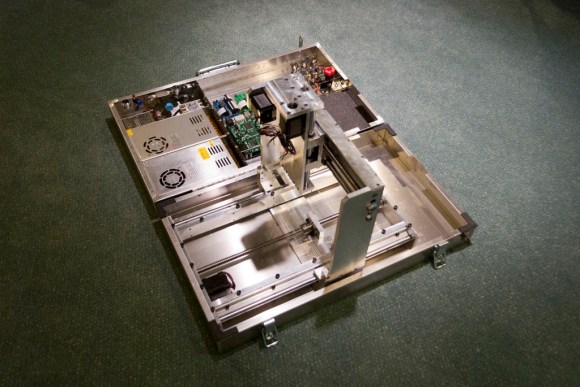
Magnetic CNC Marble Maze

magnetic-cnc-marble-maze

[Martin Raynsford] figured out a way to sneak some learning into a fun package. He did such a good job the test subjects didn’t even know they were teaching themselves just a tiny bit of CNC programming.

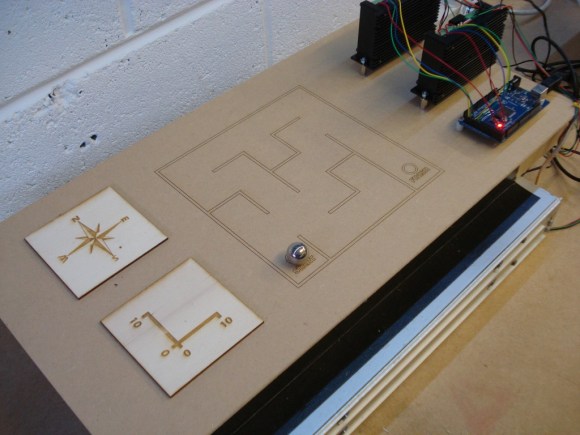
The apparatus above is a marble maze, but instead of building walls [Martin] simply etched a pattern on the playing field. The marble is a ball bearing which moves through the maze using a magnetic CNC gantry hidden underneath. Where does one get ball bearings of this size? If you’re [Martin] you scavenge them from your laser-cut Donkey Kong game.

He showed off the rig at the Maker Faire.  It takes simple commands as cardinal directions and units of movement. The ‘player’ (remember, they’re secretly learning something, not just playing a game) inputs a series of movements such as “N10,E10” which are then pushed through a serial connection to the Arduino. It follows these commands, moving the hidden magnet which drags the ball bearing along with it. It’s simple, but watch the clip after the break and we think you’ll agree the sound of the stepper motors and the movement of the ball will be like crack for young minds.

Continue reading “Magnetic CNC Marble Maze”

Altering Automotive Window Motors For Use In Your Projects

automotive-window-motor-for-your-projects

We agree with [Mário Saleiro] that the motors from a car’s power windows make for a fantastic high-torque solution to your next project. If you have a you-pick junkyard in your town they’ll be dirt cheap after you put in a bit of time to find and removing the parts from the yard. But you’ll probably want to add a few extra steps to get them ready, and he’s done a great job of documenting how he augmented them with wheels and rotary encoders.

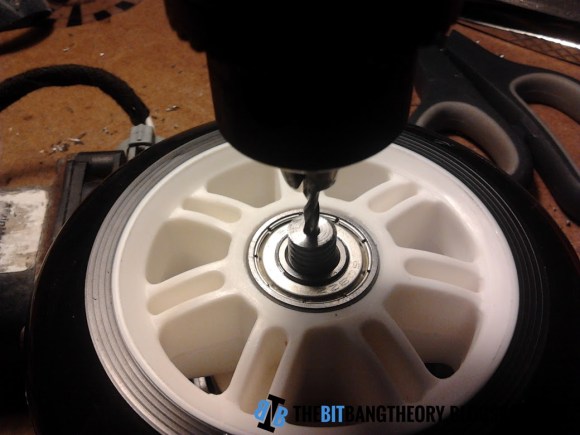
One aspect of the project which really struck home with us was his machine-shop-101 style tricks to mate the axle of the motor with the wheel. He has a process which ensures you will find the exact center of a cylinder as you work. This starts by lining up a bench vice on his drill press. He then inserts a drill bit upside down in the drill chuck, lowers it and clamps the vice on the bit. After loosening the chuck he ends up with the bit pointing up at the exact center of the chuck. Next he chucks up a piece of threaded rod, drilling a perfectly centered hole by lowering it into the drill bit while the drill press is rotating. The image above shows him using this machined part as a guide to continue the hole into the motor’s axle. Click through the link above to learn the rest of the tricks he uses.

Update: Lost PLA Metal Casting — The Movie

lost-pla-metal-casting-movie

Turning 3D printed plastic parts into metal objects is not a new concept. But we don’t see a lot of it and enjoyed watching the documentary version of [3DTOPO’s] lost PLA metal casting process so much we figured you’d want to see it too.

The thirty-five minute video walks through every part of the process which we originally learned about in September of last year. The process was developed as a way to fabricate parts that will be used in high-stress applications. For instance, the part seen above is a mounting bracket for the ball screws that moves the Z axis on a huge CNC build he’s been working on. A plastic part will break under the strain so he needed to make it out of aluminum alloy.

To start, the piece is modeled and printed in plastic to check the fit. Once it’s just right he scales it to 103% and prints it again to account for the shrinking of the metal as it cools. The next step is pictured above, adding paths using rigid foam insulation that allow for the metal pour and for air to escape. This is packed into a plaster and sand mold which dries before being cooked in a furnace to vaporize the foam and PLA. This leaves a perfect mold for the metal pour.

After the break you can see a 5-minute overview version of the project.

Continue reading “Update: Lost PLA Metal Casting — The Movie”

Voice Controlled Chess Robot

voice-controlled-chess-robot

[Ben Yeh] wrote in to tell us about this voice-controlled chess robot he built along with three others as a final project for their Georgia Tech ECE 4180 Embedded Systems Design class.

To handle the speech recognition they grabbed an EasyVR board. This is a fine solution because it prevents the need for a computer to process voice commands (remember, it’s an embedded systems class). This concept breaks down when you find out that the desktop computer next to the robot is where the chess game is running. Perhaps that can be moved to a microcontroller by the next set of 4180 students.

The robot arm portion of the project is shown off well in the clip after the break. Normally we’d expect to see stepper motors driving the axes of a CNC machine but in this case they’re using servo motors with built-in encoders. The encoders are i2c devices which feed info back to the main controller. There was a parts ordering snafu and the z axis motor doesn’t have an encoder. No problem, they just added a distance sensor and a reflector to measure the up and down movement of the claw.

Continue reading “Voice Controlled Chess Robot”

Semi-automatic Pick And Place Machine

semi-automatic-pick-and-place

This is a fascinating take on building your own pick and place machine. It does an amazing job of automating the hardest parts of hand assembly, while relying on human dexterity to achieve the hardest parts of automation. It’s a semiautomatic pick and place machine driven by an Arduino and controlled by an Android tablet.

The machine is built in two parts. The portion in the upper left feeds components from reels and is fully automated. The portion on the lower right consists of a padded arm-rest which slides smoothly along two axes. A mechanical arm with multiple articulations is attached to the end, culminating in a tip connector for some vacuum tweezers. Right handers are the only ones who will find this convenient, but oh well. The clip after the break shows it in action. The assembly technician first selects the component from an icon on the Android tablet. The reel machine then dispenses that part, which is picked up by the vacuum tweezers using the left hand to switch the vacuum on and off again. If the part orientation needs to be rotated it can done using the jog wheel on the Android app. It smooth, quick, and best of all, clever!

Continue reading “Semi-automatic Pick And Place Machine”

CNC Tic Tac Toe

cnc-tic-tac-toe

This computer controlled physical Tic Tac Toe game is built from parts scavenged from common consumer goods. Specifically, the sled is made up of a combination of printer and DVD drive parts.

The build is delightful, and you can’t move on to the next feature until you watch it play a game in the clip after the break. The game board can move along two axes. It’s obvious from the image above that the printer ink cartridge sled has been reused to let the board move left and right. But the DVD lens sled hidden under the board lets it move forward and back. The piece of protoboard seen on the left is an IR reflectance scanner. The board moves systematically under this sensor. Whenever a black square (placed by the human player) is in play it prevents the IR beam from reflecting back. What you can’t see in this image is the yellow disc dispenser which is just out of the frame. It uses the DVD disc tray motor to place the computer’s pieces. We think this build is just begging to be turned into a Turing Machine demonstration.

If you liked this one we’re sure you’ll also appreciate CNC chess.

Continue reading “CNC Tic Tac Toe”

Wooden Teeth For Your USB Keyboard

wooden-keyboard

We just got an ergonomic keyboard for the first time and absolutely love it. But the look of this keyboard hack has us second guessing ourselves. [Will Pretend] pulled off an absolutely stunning wooden retrofit for his USB keyboard. Be warned, his project log includes 175 photos, and most of them have captions.

He started off by taking apart the original USB keyboard to see what he was working with. Before digging in to the valuable wood stock he cut test pieces using some thin MDF. But once he had a clear plan to get to the end of the project it was full stem ahead.

The keys are not simple Chicklet style overlays, they have depth like you would expect to find on low-grade plastic peripherals. This was accomplished by milling each key, then sending them through the laser cutter to each the letter on top.

Take some time to make your way through the entire project (here’s a thumbnail layout if you get frustrated). Unfortunately [Will] says he doesn’t actually use the keyboard because of grains catching and the keys move around a bit too much. But it does work.